Joseph Banks florilegium
pp. 46-47 · Read in the full issue
Coming up, the great Joseph Banks florilegium
The Australian Broadcasting Corporation recently screened a TV program, “The Flowering of the Pacific”, which fore shadowed a literary venture of great significance to Pacific Is lands history and the study of the botany of the Pacific.
When Joseph Banks re turned to England following his voyage in Cook’s Endeavour, he was able to place his speci mens in the great botanical museums, including Kew some even eventually returned to the Royal Botanic Gardens in Sydney.
There were also 738 botani cal paintings which had been made on the voyage, and Banks decided that a florile gium, or anthology, of engrav ings of the paintings should be made. He employed 18 en gravers over a period of 13 years on the project, which cost him £7OOO, an enormous sum for that time a farm worker
of the day earned £5 a year.
However, for reasons which remain unclear, Banks did not complete the task by having the engravings published.
Now, as revealed in “The Flowering of the Pacific,” the printing house Alecto Historical
Editions, in conjunction with the British Museum’s Natural History Museum, is preparing the engravings for publication.
It is obvious that only the most eccentrically rich individual, or the wealthiest of institutions, will be able to possess the
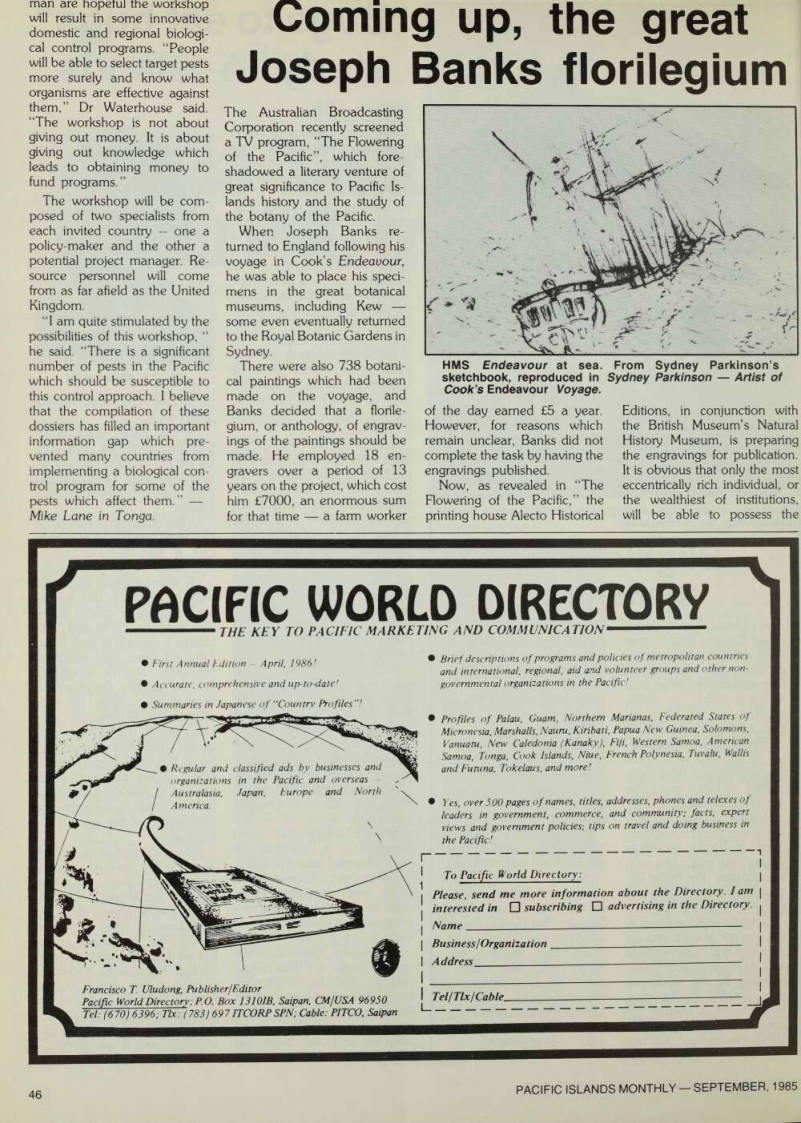
HMS Endeavour at sea. From Sydney Parkinson’s sketchbook, reproduced in Sydney Parkinson Artist of Cook’s Endeavour Voyage.
collection. One hundred and ten copies are to be made of the 738 plates, and it will take 10 years to complete the project.
The British Museum holds Syd ney Parkinson’s drawings as well as the copper plates pre pared for Banks.
Alecto approached the museum in 1963 with a view to publishing the engravings, but were shown the door. In 1978 a curator drew the publisher’s attention to the copper plates, which were still wrapped in their original 18th-century paper.
In the present project, there is constant and exceedingly care ful checking of the details of drawings against specimens to ensure absolute correctness.
Restoration of the plates to allow the finest reproduction is meticulous. For the craftsmen to produce eight to 10 plates a day is regarded as a high level of production.
When each set of engravings is completed the collection will occupy 34 large boxes not an item which would fit easily into the average Pacific Islands bibliophile’s library.
The final product will be unique in that only a few black and white engravings were ever made from Parkinson’s draw ings. The new florilegium will be the first published in color. It will probably be the largest direct printing project ever com pleted in the fine arts. The plates and original drawings will remain with the British Museum, which has guaranteed that no further reproduction will be done for a minimum of 50 years. However, as the pub lisher said: “In this laborious project automation does not apply . . . Nothing else like it will ever be done again certainly not in our age of
photography. ”
It is to be hoped that in the not too distant future there will be a public display of the combined talents of Joseph Banks, Daniel Solander, Syd ney Parkinson, the forgotten engravers, the contemporary craftsmen, and Alecto Historical Editions. Then we shall all be able to see how the 18th century travellers recorded the plant life of the Pacific in the 89 plates from Tahiti, 183 from New Zealand, and more than 300 from the east coast of Australia. Bill Coppell.