“Bugs to eat bugs”
pp. 45-46 · Read in the full issue
study in islands
Retirement certainly doesn’t mean sitting in a rocking chair for Dr Douglas Waterhouse, a plant protection consultant with the Australian Centre for In ternational Agricultural Re search (ACIAR). The distin guished entomologist is one of the driving forces behind a major workshop on the role of biological control of pests in the South West Pacific. He served 21 years as chief of the Austra lian Commonwealth Scientific and Industrial Research Or ganisation’s Division of En tomology in Canberra. Since retiring three years ago he’s been an active consultant work ing on projects in China and South-east Asia.
For the last two years he has been compiling information on the most serious pests of coun tries in the South-west Pacific for a 16-nation workshop which will be held in Nuku’alofa, Tonga, from October 16 to 25 this year.
The conference is a joint venture of ACIAR and GTZ, the German Overseas Assistance Agency. Dr Dirk Stechman, head of the Tongan/German Plant Protection Project is the host of the workshop.
Atolls in particular, but all islands in general, have very fragile eco-systems. Over-use of pesticides can have disastrous effects on the environment, thus the importance of biologi cal control as a pollution-free alternative to chemical control.
Biological control is simply an effort by man to restore the balance of nature to an en vironment which has been damaged by a pest that has been imported into a country.
These insects or diseases usual ly do great damage because none of their natural enemies are present in the new environ ment to check their spread.
Interviewed during a recent visit to Tonga, Dr Waterhouse said he had no doubt that Pacific Island countries would benefit greatly from the use of biological control. However, he said, the unknown factor was what priority each of the par-
ticipating countries would assign to it.
He said Pacific Island coun tries were good bets for biologi cal control because their animal kingdoms were usually simpler than those on continental land masses.
Unlike spraying of chemicals, biological control did not eradi cate a pest, but reduced its population in the target area.
He acknowledges that there were some spectacular succes ses in biological control in the islands in the 1920 s and ’3os.
Hawaii’s pineapple and sugar cane industries were saved by biological control programs.
But the last few decades have been more notable for their failures. Dr Waterhouse attri butes this to the lack of infor maion available to entomolog ists in the small island nations.
Many control programs failed because of a lack of numbers of natural enemies, or even the introduction of the wrong natu ral enemy.
Biological control is not al ways the best method, he con cedes. Some pests are better handled by chemical control.
For example, guava might be considered a weed by some people, but to villagers in the islands it was an important food source. Introducing a natural enemy of the guava, like an insect, would not work because the insects would not be selec tive. Thus, in such an instance, chemical control was better.
Both Waterhouse and Stech
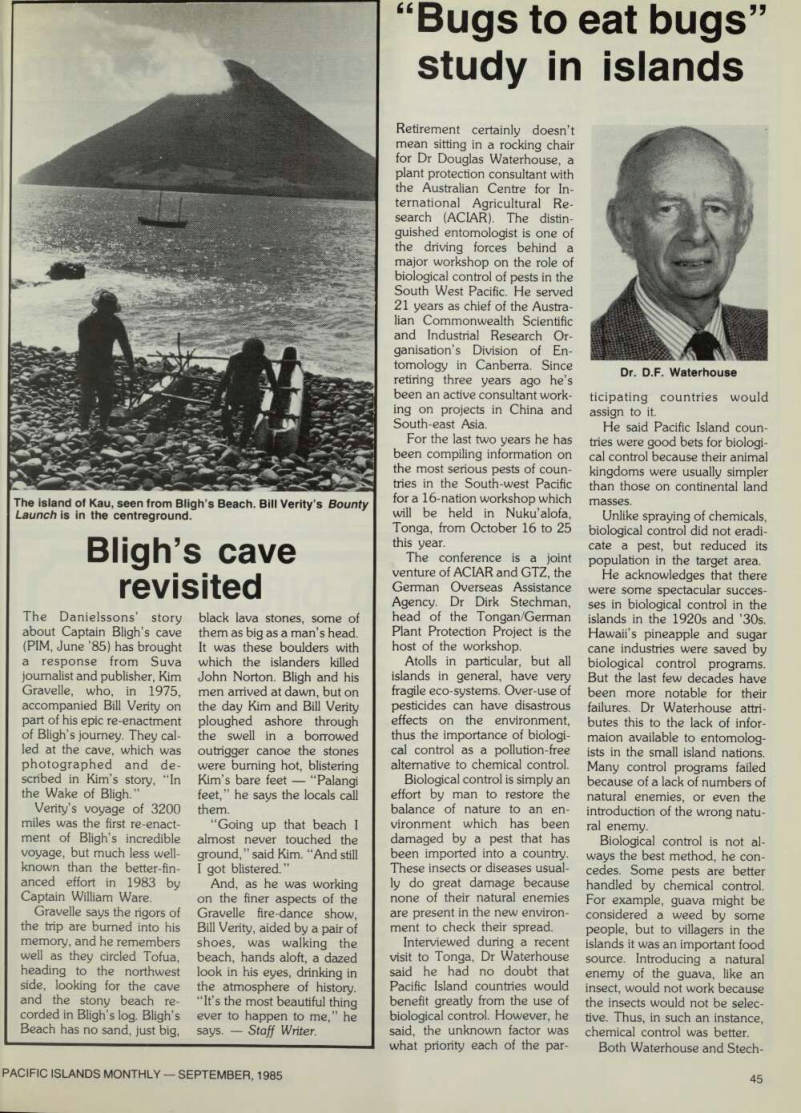
Dr. D.F. Waterhouse
man are nopetul the workshop will result in some innovative domestic and regional biologi cal control programs. “People will be able to select target pests more surely and know what organisms are effective against them,” Dr Waterhouse said.
“The workshop is not about giving out money. It is about giving out knowledge which leads to obtaining money to fund programs.”
The workshop will be com posed of two specialists from each invited country one a policy-maker and the other a potential project manager. Re source personnel will come from as far afield as the United Kingdom.
“I am quite stimulated by the possibilities of this workshop, “ he said. “There is a significant number of pests in the Pacific which should be susceptible to this control approach. I believe that the compilation of these dossiers has filled an important information gap which pre vented many countries from implementing a biological con trol program for some of the pests which affect them.”
Mike Lane in Tonga.