Flosse's French Festival
pp. 22-56 · Read in the full issue
The character of the Fourth Festival of Paci fic Arts held in Tahiti in the first two weeks of July was determined back in February. For that was when a majority of Pacific governments accepted an offer by French Polynesia’s . Premier Gaston Flosse to take over the festival after the French Government at the last minute had taken it away from the original organ isers, the New Caledonian Cultural Office, headed by in dependence leader Jean-Marie Tjibaou.
From the beginning, Flosse made no bones about what he had in mind it was to polish up France’s image in a region where, in his opinion, too many government heads and political leaders had a regrettable tendency to side with the FLNKS “terrorists” (as he con sistently labelled Tjibaou and company) instead of supporting the law-and-order government of the White settlers. In other
words, by staging the festival in Tahiti, Flosse was sure he would be able to show the world what a happy and prosperous place a French col ony is in “normal” circum stances.
This manoeuvre succeeded surprisingly well mainly due to the generosity of the French Government in picking up the tab for the air fares of all foreign delegations who balked at the cost of getting their troupes to far-off Tahiti.
Only five Pacific countries Vanuatu, Kiribati, Palau, Mar shall Islands and Niue re fused to participate out of solidarity with the FLNKS. Not even the fact that Tjibaou’s bitter opponent, Dick Ukeiwe, was invited to send an anti independence delegation from New Caledonia to Tahiti, pro duced a murmur of protest.
In fact the only serious opposition Flosse encountered came from other political and civic leaders in Tahiti. What
they contested most hotly was Flosse’s plan to combine the festival with the annual Tahitian July 14, or Tiurai, celebrations.
Not only was the time too short for the complex preparations, they argued, but in such circumstances the Festival of Pacific Arts would lose its speci fic and independent character.
Flosse’s reason for proceeding in this hasty manner was even less acceptable, for it was his firm intention to open the festi val on June 29, a date of special significance to him and his Tahoeraa party.
The foreign governments who accepted this date when it was put to them in February were told that it is our glorious local “Cession Day”.
The simple truth is that it was only through deceit and trickery that on that date in 1880 Tahiti and Moorea became a French colony. Once celebrated as a great historic anniversary, June 29 fell into complete oblivion in the 19505, with the emergence
Postmark Papeete
of Polynesian leaders and par ties strongly in favor of inde pendence. If June 29 was re membered at all, it was as a day of shame. Nobody cared, for instance, to celebrate the centenary of the French take over when it fell in 1980 (PIM
Continued on page 25
Marie-Therese and Bengt Danielsson
Aug. ’BO pi 08). Last year, when Flosse tried to revive it with a parade to the greater glory of the French Gaullist party and himself, not only the Opposition parties but also the two major churches refused to take part (PIM Sep. ’B4 p 27).
Flosse’s stubborn insistence on June 29 as opening day so infuriated Papeete’s pro-inde pendence Mayor Jean Juventin that he declared all parks and public buildings in the capital off-limits to the organisers for the duration of the festival. This was a serious blow to Flosse who now had to stage the festival in the adjacent, smaller town of Pirae, where he is mayor.
His biggest problem was that Pirae lacked a theatre of the international dimensions re quired for the occasion. Flosse’s solution was to build a whole new theatre, or rather conven tion hall, for 2000 spectators.
With three huge teams working round the clock, the contractors completed it in two months
at the staggering cost of CFP4OO million (about $A3.5 million), or three times as much as it would have cost in normal circumstances.
Oscar Temaru, the even more strongly pro-independ ence mayor of Tahiti’s second biggest town of Faaa, found an even more pointed way of expressing his disagreement with Flosse.
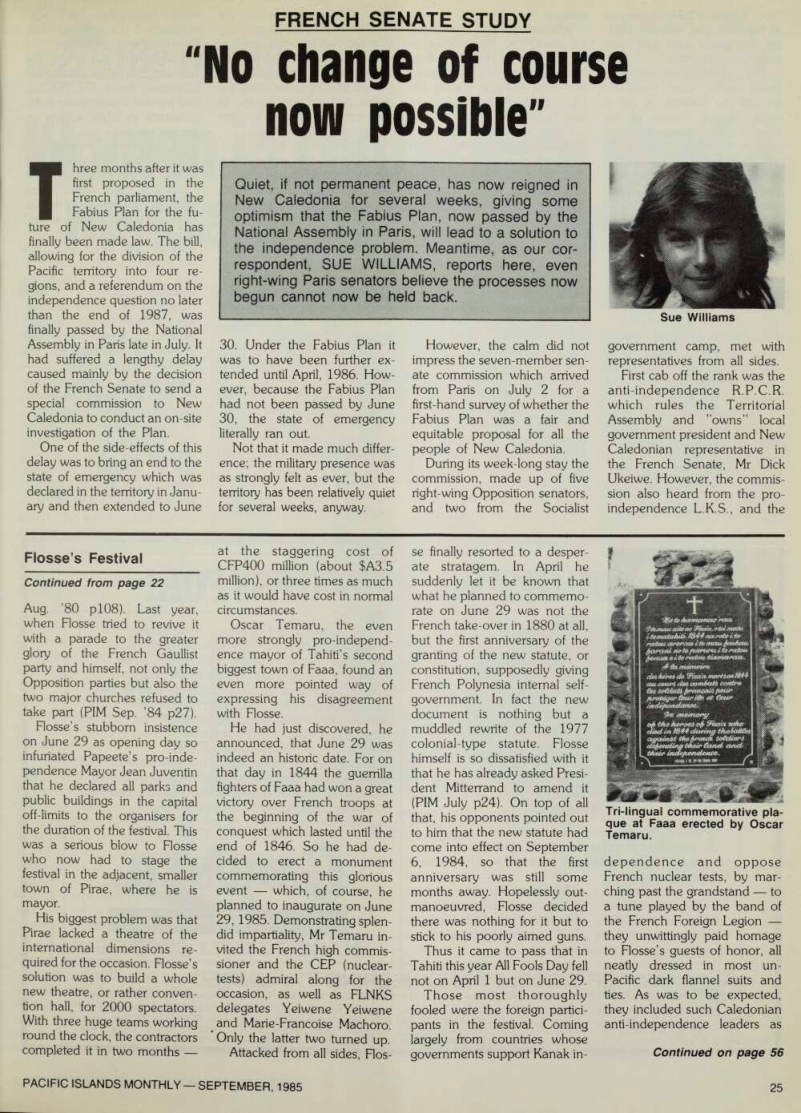
He had just discovered, he announced, that June 29 was indeed an historic date. For on that day in 1844 the guerrilla fighters of Faaa had won a great victory over French troops at the beginning of the war of conquest which lasted until the end of 1846. So he had de cided to erect a monument commemorating this glorious event which, of course, he planned to inaugurate on June 29, 1985. Demonstrating splen did impartiality, Mr Temaru in vited the French high commis sioner and the CEP (nuclear tests) admiral along for the occasion, as well as FLNKS delegates Yeiwene Yeiwene and Marie-Francoise Machoro.
Only the latter two turned up.
Attacked from all sides, Flos
se finally resorted to a desper ate stratagem. In April he suddenly let it be known that what he planned to commemo rate on June 29 was not the French take-over in 1880 at all, but the first anniversary of the granting of the new statute, or constitution, supposedly giving French Polynesia internal self government. In fact the new document is nothing but a muddled rewrite of the 1977 colonial-type statute. Flosse himself is so dissatisfied with it that he has already asked Presi dent Mitterrand to amend it (PIM July p 24). On top of all that, his opponents pointed out to him that the new statute had come into effect on September 6, 1984, so that the first anniversary was still some months away. Hopelessly out manoeuvred, Flosse decided there was nothing for it but to stick to his poorly aimed guns.
Thus it came to pass that in Tahiti this year All Fools Day fell not on April 1 but on June 29.
Those most thoroughly fooled were the foreign partici pants in the festival. Coming largely from countries whose governments support Kanak in-
dependence and oppose French nuclear tests, by mar ching past the grandstand to a tune played by the band of the French Foreign Legion they unwittingly paid homage to Flosse’s guests of honor, all neatly dressed in most un- Pacific dark flannel suits and ties. As was to be expected, they included such Caledonian anti-independence leaders as
Continued on page 56
Tri-lingual commemorative pla que at Faaa erected by Oscar Temaru.
Jacques Lafleur and Dick Ukeiwe. More surprising was the unannounced presence of former French prime minister Pierre Messmer, who as de Gaulle’s minister for defence back in the 1960 s supervised the installation of the nuclear test base at Moruroa, and is therefore often referred as the “father” of the French atomic bomb.
The opening ceremony glar ingly demonstrated the spiritual gulf separating Flosse and his aides all of whom wore European attire and the barefoot, lavalava-clad island ers from all over the Pacific.
After some dancing by local schoolchildren, proceedings were dominated by two long winded speeches in French which the organisers did not deem it necessary to translate into English for the sake of visitors. But, considering the paralysing dullness of what was said, perhaps that was the most charitable course to adopt.
This gulf persisted through out the two weeks of the festival. The basic trouble was that visitors to festival events mostly French settlers, officials and military personnel loved the foreign islanders for the wrong reasons, i.e., their exotic appearance and entertainment skills. Consequently nobody cared much about what hap pened to them in between the shows, and there were no spe cial gatherings for them except a few dinners for selected VIPs at the high com missioner’s residence.
Lodged in widely separated schools, the delegations were entirely dependent on transport supplied by the organisers.
True enough, buses punctually took them to the show venues and back. But none were avail able for visits to other delega tions, or to locals, in their spare time.
More egalitarian was the poli cy on food all delegations were fed European dishes. But this only led to a chorus of voices clamoring for taro, yams, bananas and fish. What the majority of the “little guys” resented most, however, was that they had to pay the regula tion, steep admission prices of
$lO to $l5 if, in their leisure time, they wanted to see a show put on by other islanders. Only after the Samoan, Papua New Guinean and Solomon Islands delegations threatened to take over ticket-selling to their own shows and keep the money for themselves did the organisers graciously consent to distribute a number of free tickets to each show.
Last but not least, the local mass media deserve strong criticism for their abject failure to provide the local population with the necessary background information on the various visit ing groups. The reason for this is easy to find: the reporters covering the festival for the two local daily newspapers and the government-owned radio and TV are all expatriate French men, who do not possess even the most elementary know ledge of the Pacific peoples and cultures. One TV commentator repeatedly referred to “plaited tapas”, and took the solemn kaua ceremony enacted by a group of Samoan chiefs in fono, for a friendly neighbor hood gathering at which a few mates gulp down cups of home brew. It was also obvious that he had never heard of Margaret Mead for, like all his colleagues, he kept referring throughout the festival to the famous taupou village maid as a “fian cee”, or a “princess”.
To mask their ignorance, the
journalists resorted to a slightly different trick; they filled the columns of their papers with pseudo-literary, pseudo-phi losophical balderdash about the “spirit” of the festival and the “soul” of this or that “tribe”.
The worst offender was the new editor of Les Nouuelles, who day after day proudly printed his totally unintelligible “meditations”.
On radio and TV, the favored method was to quote snippets from the Pacific Islands Year book about the countries of origin of the performers which was all very well but had nothing whatsoever to do with what was happening on stage.
The shining exception was a Tahitian, hired only after the festival began, probably on the assumption that a native must possess a better knowledge of island customs than an expat.
This assumption is, of course, totally wrong, as present-day Tahitians are highly accultu rated, and have never been taught anything at school or anywhere else about Pacific, or even Tahitian, customs and traditions. To our great relief this fellow, acting with more intelligence and dignity than his French colleagues, simply announced the program and then shut up, leaving the im ages to speak for themselves.
It still remains a mystery to us why the organising committee,
with about CFP3OO million ($A2.6 million) in the kitty, didn’t see fit to hire an anthropologist with a special ised knowledge of Pacific cul tures to explain and comment on the various shows and demonstrations, both in the theatres and on radio and TV.
In the end as many critics had foreseen the festival simply petered out, engulfed by the boisterous Tiurai celebra tions, which began several days before Bastille Day and lasted throughout July. Among the events drowned by the aval anche of dance and song con tests for local teams, canoe races, military parades, exhibi tions, and so on, was the festival’s closing ceremony.
This took place after many delegations, including the French and New Caledonian guests of honor, had left for home. It was held in a half empty stadium although by now admission was free for all.
By that time, the mass media, echoing the opinions of high ranking officials, had neatly summed up the political signif icance of Flosse’s French Festi val. This was that, by attending in such great numbers, the Pacific nations had clearly de monstrated that they no longer have any serious objections to French rule, or to French nuc lear tests. Marie-Therese and Bengt Danielsson.
The 2000-seat festival hall at Pirae, built for Arts Festival in less than two months.