watchdogs to keep
p. 19 · Read in the full issue
eyes on France
France will find itself on the back foot during the next 12 months, trying to define the status of its South Pacific territories, and justify its policies in relation to them.
The Sixteenth South Pacific Forum at Rarotonga charges its executive with the task of obtaining precise definitions of the legal status of New Caledo nia and French Polynesia.
At one time New Caledonia was inscribed on the list of the United Nations’ Decolonisation Committee of 24 but, years ago, France declared New Caledonia a department of metropolitan France and suc ceeded in having the listing removed.
A very few countries have since made rumblings about having New Caledonia re-in scribed; Vanuatu attempted to win support for such a move at the 1984 Forum meeting at Funafuti, Tuvalu, but could not raise the numbers. Instead, in a public statement rather sharply critical of his Forum colleagues.
After some tough debating among Forum delegates it was decided again not to try to get New Caledonia re-inscribed. In stead, the U.N. will be asked to give a legal international defini tion of the territory’s status so that Forum countries may be guided on whether they are dealing with a piece of France, or a most suspect chunk of the South Pacific.
The Forum had a “sleeper” from the United Nations at its last conference who kept out of the public eye, but who was on hand to take notes and offer advice on tactics.
He was Mr Renagi Lohia, Papua New Guinea’s perma nent representative to the U.N., who is also chairman of the U.N. committee which handles decolonisation matters as they are handed up to them from the Committee of 24.
Commenting on this Forum attitude, official conference spokesman, and New Zealand prime minister, David Lange, said he did not think countries like Russia, which are members of that U.N., committee, could tell the world very much about personal liberty and independ ence.
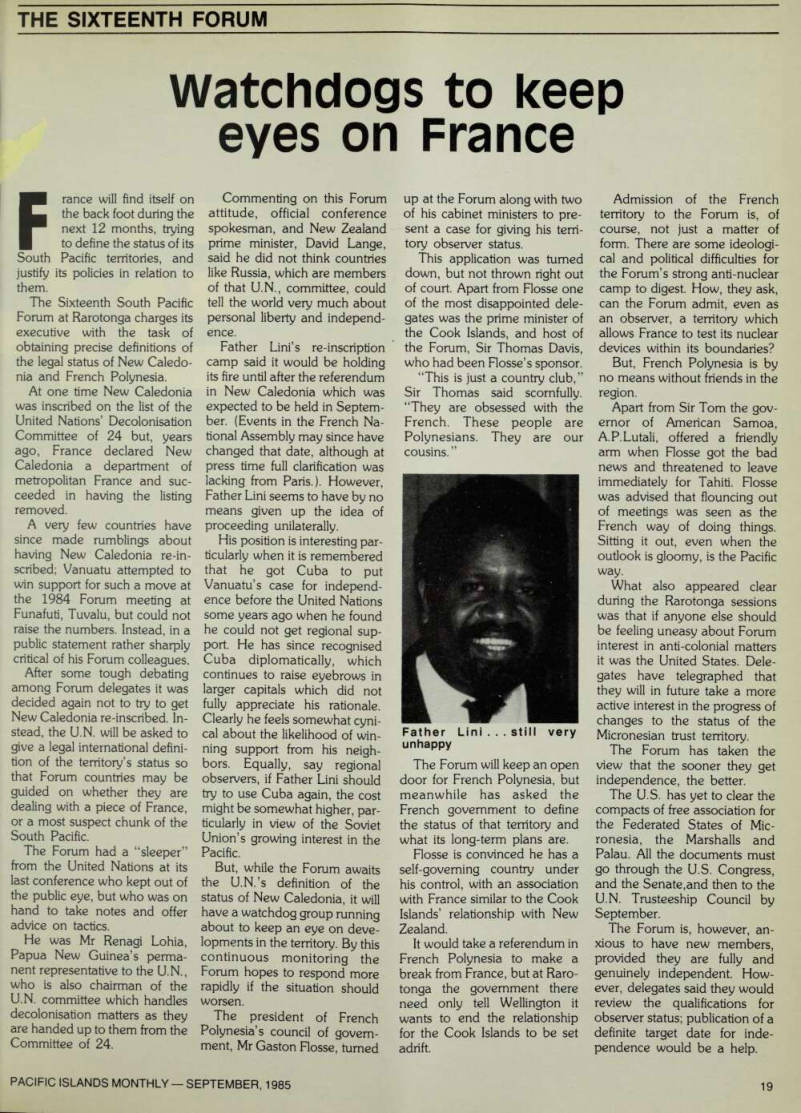
Father Lini’s re-inscription camp said it would be holding its fire until after the referendum in New Caledonia which was expected to be held in Septem ber. (Events in the French Na tional Assembly may since have changed that date, although at press time full clarification was lacking from Paris.). However, Father Lini seems to have by no means given up the idea of
proceeding unilaterally.
His position is interesting par ticularly when it is remembered that he got Cuba to put Vanuatu’s case for independ ence before the United Nations some years ago when he found he could not get regional sup port. He has since recognised Cuba diplomatically, which continues to raise eyebrows in larger capitals which did not fully appreciate his rationale.
Clearly he feels somewhat cyni cal about the likelihood of win ning support from his neigh bors. Equally, say regional observers, if Father Lini should try to use Cuba again, the cost might be somewhat higher, par ticularly in view of the Soviet Union’s growing interest in the Pacific.
But, while the Forum awaits the U.N.’s definition of the status of New Caledonia, it will have a watchdog group running about to keep an eye on deve lopments in the territory. By this continuous monitoring the Forum hopes to respond more rapidly if the situation should worsen.
The president of French Polynesia’s council of govern ment, Mr Gaston Flosse, turned
up at the Forum along with two of his cabinet ministers to pre sent a case for giving his terri tory observer status.
This application was turned down, but not thrown right out of court. Apart from Flosse one of the most disappointed dele gates was the prime minister of the Cook Islands, and host of the Forum, Sir Thomas Davis, who had been Flosse’s sponsor.
“This is just a country club,”
Sir Thomas said scornfully.
“They are obsessed with the French. These people are Polynesians. They are our cousins. ”
The Forum will keep an open door for French Polynesia, but meanwhile has asked the French government to define the status of that territory and what its long-term plans are.
Flosse is convinced he has a self-governing country under his control, with an association with France similar to the Cook Islands’ relationship with New Zealand.
It would take a referendum in French Polynesia to make a break from France, but at Raro tonga the government there need only tell Wellington it wants to end the relationship for the Cook Islands to be set adrift.
Admission of the French territory to the Forum is, of course, not just a matter of form. There are some ideologi cal and political difficulties for the Forum’s strong anti-nuclear camp to digest. How, they ask, can the Forum admit, even as an observer, a territory which allows France to test its nuclear devices within its boundaries?
But, French Polynesia is by no means without friends in the region.
Apart from Sir Tom the gov ernor of American Samoa, A.P.Lutali, offered a friendly arm when Flosse got the bad news and threatened to leave immediately for Tahiti. Flosse was advised that flouncing out of meetings was seen as the French way of doing things.
Sitting it out, even when the outlook is gloomy, is the Pacific way.
What also appeared clear during the Rarotonga sessions was that if anyone else should be feeling uneasy about Forum interest in anti-colonial matters it was the United States. Dele gates have telegraphed that they will in future take a more active interest in the progress of changes to the status of the Micronesian trust territory.
The Forum has taken the view that the sooner they get independence, the better.
The U.S. has yet to clear the compacts of free association for the Federated States of Mic ronesia, the Marshalls and Palau. All the documents must go through the U.S. Congress, and the Senate,and then to the U.N. Trusteeship Council by September.
The Forum is, however, an xious to have new members, provided they are fully and genuinely independent. How ever, delegates said they would review the qualifications for observer status; publication of a definite target date for inde pendence would be a help.
Father Lini . . . still very unhappy