Brave bid on regional
pp. 10-13 · Read in the full issue

The Sixteenth Forum
Brave bid on regional nuclear bans
In 16 years the South Pacific Forum has undergone considerable change, reflecting the new times, and tougher conditions sweeping into an area once known mostly, if somewhat erroneously, for its grass-skirted giris, its beaches, palms and utterly relaxed ways. Today major issues must be discussed - the nuclear threat prime among them, for after the Japanese, few people have had closer experience of the effects of nuclear explosions than the islanders of the Pacific. There are many who mourn the changes, and who look askance at the proliferation of documents, security men, protocol and prolixity now to be seen in the Forum meetings. But, as our correspondent, ROY VAUGHAN, reports in the following pages, much important, and constructive work was done this year at Rarotonga.
No one in this part of the world had heard much of the Treaty of Tlatelolco until talk be gan circulating about creating a nuclear-free zone in the South Pacific. Many would argue that the Latin American treaty with the almost unpronounceable name is pretty useless. It cre ated the first major nuclear-free zone in the world, but it has been accused of being a paper tiger, of achieving little of practi cal value in holding back the holocaust.
The decision which attracted most international attention at the Sixteenth South Pacific Forum was the ratification of a similar, though somewhat stronger, treaty, proposed some years ago, but more recently, and successfully, espoused by the Australian prime minister, Bob Hawke.
The Tlatelolco treaty allows many things, including nuclear testing for peaceful means, which have been condemned in the South Pacific treaty, and at this distance there is an impression that the average South American, let alone any one else, knows little about it.
Whether or not the newly launched South Pacific nuclear free zone treaty suffers the same fate remains to be seen.
When eight South Pacific Forum nations signed the treaty in Rarotonga on August 6, the 40th anniversary of the nuclear destruction of Hiroshima, they were charged with an optimism
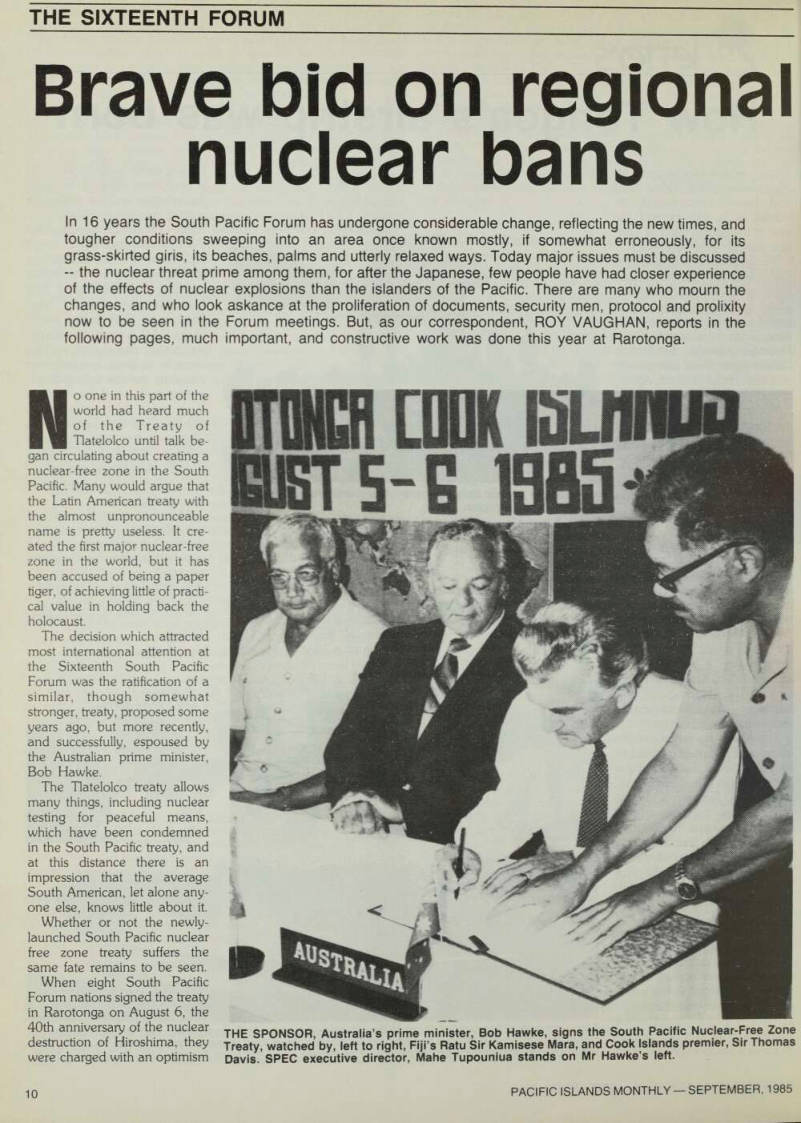
THE SPONSOR, Australia’s prime minister, Bob Hawke, signs the South Pacific Nuclear-Free Zone Treaty, watched by, left to right, Fiji’s Ratu Sir Kamisese Mara, and Cook Islands premier, Sir Thomas Davis. SPEC executive director, Mahe Tupouniua stands on Mr Hawke’s left.
that this was going to be a major breakthrough in the in ternational arms race.
It would freeze the spread of nuclear weapons in the South Pacific, proclaimed the prime minister of New Zealand, Mr David Lange.
Certainly, the treaty prohibits the manufacture, testing, stor age, dumping and use of nuc lear weapons and materials in the region.
Apart from the French, no one has been egaged in these activities in the South Pacific and, as far as is known, no-one has any immediate plans to get involved in the business, apart from Japan which has talked of nuclear waste dumping, but which has seemed lately to have decided to go very carefully on that subject.
What the South Pacific treaty effectively does, however,is proclaim a sort of wild life reserve where none of this nasty business may be con ducted.
Like all nature reserves and sanctuaries, it will require con stant surveillance to ensure that no-one violates it, but there is always the danger that, like a park, it can be suddenly re zoned if the ratepayers decide they can no longer afford the luxury of a park ... or if some developer comes along with a tempting offer.
The nuclear-free zone as de fined by the Treaty of Raroton ga is not a total sanctuary, however. It allows what it hopes will be controlled public useage in that member countries of the Forum are permitted to make their own defence arrange ments and host visiting nuclear warships.
Australia will continue to ex port uranium for peaceful pur poses, much to the annoyance of the prime minister of Vanuatu, Father Walter Lini, who believes some of it may end up being used by the French for their nuclear testing program at Moruroa.
Being a truly international park the South Pacific zone requires not just the signatures of all Forum members, but also the full support of the world’s
nuclear powers and the three metropolitan states, Britain, France and the U.S. which have colonies in the area.
The ultimate test will be whether the Forum gets that support, and it is already more than clear that France plans to continue its testing program at Muroroa.
The major nuclear powers were quite happy not to spread the nuclear arms race to Latin America, so, on the face of it, they should be supportive of the South Pacific zone. But there are also certain essential, and very potent differences be tween the area covered by the Treaty of Tlatelolco and that within the view of the Treaty of Rarotonga. The different post ure of the Soviet Union, and the current attitude of the U.S. are but two.
There is a a feeling, though, that the U.S. and the Soviet Union are keeping watch, hawk-like, on the full implica tions of the treaty, and the political niceties it will from now on produce.
What is abundantly clear is that the world is quite capable
of waging a nuclear war with or without a nuclear-free zone in the South Pacific and the con sequences of that war could be just as disastrous for the South Pacific, whether or not missiles or bombs were launched from, or fell into, the region.
The treaty was drawn up in the space of two years as a result of an Australian initiative launched by prime minister Bob Hawke at the Fourteenth Forum in Canberra.
A Forum working party put together the draft agreement which proved attractive enough to almost all the Forum nations at first official sighting for them to endorse it.
Vanuatu was the notable, but perhaps not unexpected, ex ception.
Father Walter Lini, some thing of a fiery idealist, clearly wanted it all to go much further, and pushed hard for a clause to be included banning nuclear testing and visits by warships.
Australia, the Cook Islands, Fiji, Kiribati, Niue, New Zea land, Tuvalu and Western Samoa all signed on the spot.
Others, including Papua New
Guinea, said they would need to consult with their national parliaments before committing themselves to an international treaty, but none, even including Vanuatu, indicated outright opposition.
The document was im mediately, and naturally, dub bed the Treaty of Rarotonga by Forum spokesman, David Lange, but a Fiji journalist said he thought it should be called the Treaty of Suva, since it is at that capital, next year, at the Seventeenth Forum, that the final signatures will be appended.
For a document potentially so important, the lack of cere monial at the signing was re markable.
A quick shuffle around at the end of the Forum meeting to get a few tables together in the White Sands restaurant of the Rarotonga Hotel; a call through the door to the press; a throng of about 90 journalists through which the signatories and their minders had to push, almost apologetically, to get to the papers they had to sign; no speeches; a bit of half-hearted clapping, and it was all over. ”1 am happy about it, but God knows what will happen if we have a war,” said the prime minister of Fiji, Ratu Sir Kamisese Mara.
Before, and during, the con ference the prime minister of the Cook Islands, Sir Thomas Davis, voiced concern about the ANZUS defence agreement and New Zealand’s ban on nuclear warships visiting its ports.
New Zealand prime minister, David Lange, who has borne the brunt of the international storm over his actions, and who has seen a rime of frost develop over his country’s previously close friendship with the U.S. as a result, told reporters that no Pacific leader mentioned the matter inside the Forum during working sessions. But, Sir Thomas was more than happy to talk many times about his worries when questioned out side the Forum’s inner sanctum from which the press and others are barred.
Australia and New Zealand had effectively cut the ground
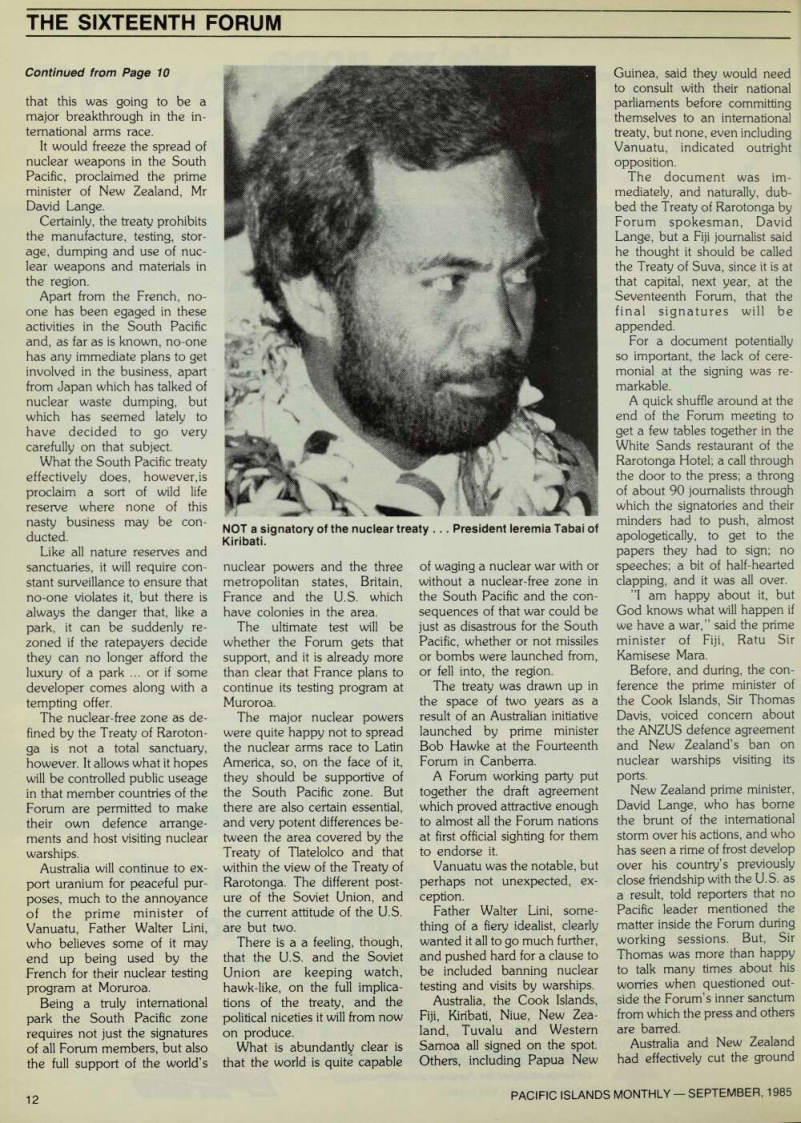
NOT a signatory of the nuclear treaty ... President leremia Tabai of Kiribati.
... Treaty signed
from under the feet of island countries, said Sir Thomas.
ANZUS no longer existed, no matter what anyone said.
It appears to have been this attitude, clearly stated before the Forum convened, which prompted New Zealand to whip up a new proposal for the Forum - a regional defence cooperative.
Mr Lange and his officials seem to have anticipated a bit of a blast from their Forum cousins. This did not materialise, it not being the Pacific way to lambast a friend, at least in public, but the New Zealanders trotted out their proposal nonetheless, and at the end of the conference had not made precisely clear what they proposed. Nor had they discovered what their regional
colleagues might desire.
Mr Lange spoke of regional cooperation in conventional military affairs, or training and support, and of ’’putting our money where our mouth used to be” but, in the end, it left most people wondering exactly what, if anything, he meant and whether, after all, he had im proved anything.
Mr Lange said, apparently by way of clarification (but succeeding largely only in deepening the mystery), that New Zealand did not plan to create a massive military machine, but simply sought to help train islanders to defend themselves against fairly minor acts of aggression, like in ternational terrorism or internal despotism.
Mr Lange did say, however, that he sought to improve in telligence gathering and sug
gested the establishment of a fisheries monitoring station to keep check of foreign fishing boats in the region. Since it is mostly the Americans who have been causing problems over fish, this isn’t likely to improve ANZUS relations,either.
And, finally, he said, the New Zealand proposal was in no way a suggestion to replace ANZUS. (Mr Lange’s view has always been that New Zealand remains a firm member of ANZUS, provided it is not cal led upon the handle nuclear weapons or ships; in other words, if N.Z. is no longer a member of ANZUS it is not because N.Z. walked away from it, but rather, that ANZUS was moved).
Regional security problems have been kicked around at previous Forums, ever since Vanuatu’s problems with Mr
Jimmy Stevens and his Phoenix Foundation-backed secessionist movement.
Sir Julius Chan, of PNG, actually suggested the raising of a multi-national, regional peace-keeping force, but it was knocked back for a variety of reasons, and no-one has since bothered to reintroduce it.
As long as the South Pacific remains relatively peaceful, and it must be doubted if even one leader sincerely sees a serious threat to that condition, so far as the islands themselves are concerned, any proposal to spend money on regional security will probably receive no more than lip-service.
That in itself probably made it easier for the Forum countries to endorse the Treaty of Raro tonga (or Suva), and all its fine, brave provisions. From Roy Vaughan in Rarotonga.