letters
How Tongoa’s airstrip was born
I much enjoyed the story of Air Melanesiae (PIM, May ’85) and, having been heavily in volved in it, can expand the epic of the construction of Ton goa airfield — it deserves it.
Tongoa airfield was built by a Condominium public works team and the people of the island on the initiative of the Island Council, led by its presi dent, Tom Tipoloamata, New Hebrides Airways, the French District Agent, Fred Lamodiere, and the British District Agent, myself.
When Fred and I first approached the Condominium (in the persons of two Resident Commissioners), for assistance in the construction of the strip, we received no noticeable en couragement, so we set about finding a different route to our goal.
We obtained approval for a Condominium PWD bulldozer, on its way back to Vila from the north, to be offloaded on Ton goa to work for a short period on upgrading the island’s roads. (We didn’t mention the fact that the only motor transport on Tongoa was a war-time jeep without lights, brakes or petrol tank). The landing of the bulldozer was a considerable feat in itself.
There was no wharf on the island and the machine had to be swung over the side of the Tutuba on to a makeshift pon toon. But the ship’s boom snapped as the ’dozer was being lowered and the machine went straight to the bottom to lie in 20 feet or so of water.
Entirely unperturbed, Captain Roy Gubbay sent a cable ashore, passed it around a stout tree, took the cable back out and made it fast to the sunken bulldozer. Then he steamed the Tutuba slowly out to sea — and so the bulldozer arrived on the shore, still upright. A few buck ets of free water and the newly christened Le Sousmarin roared into life and charged off to carve a much improved road
up to the plateau where the villages lay.
My colleague and I then pointed out to our masters that there would be a considerable delay before the bulldozer could be picked up after finishing the road, and would it not be a highly worthwhile and
cost-effective use of the machine for it to assist the islanders construct their airfield?
Out-manoeuvred, the Con dominium could only agree.
Time was still short, and the airfield as first “completed” re quired all the skill of Paul Burton to put the de Havilland
Drover down there was only a very short distance between the wingtips and the sides of a cutting through a hillock.
So, rather unwillingly, the Condominium sent more equipment and the airfield was at last readied for its official opening. Came the great day; Fred Lamodiere and I were flown in by Paul Burton ahead of the V.I.P. party to be with the welcoming crowd and, as Paul came in to land, low over the coconuts (for the strip was not overly long, and he needed every yard), there was an awful bump as we knocked down a large wooden triumphal arch carrying the banner ’’WEL COME” which enthusiasts had put up at the very beginning of the landing strip.
After that even the sight of two Resident Commissioners (from the next flight) with two pairs of scissors, making two simultaneous cuts through the ribbon to open the airfield, came as a slight anti-climax.
R.E.N.Smith
Whangarei New Zealand
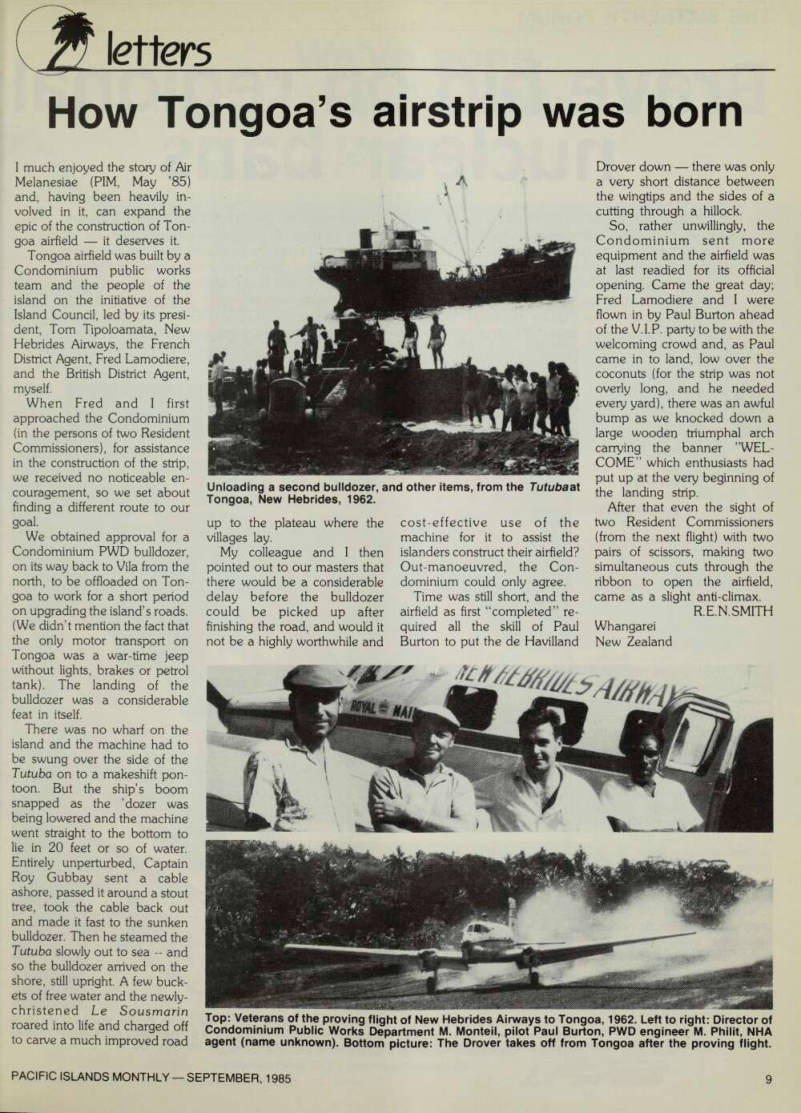
Top: Veterans of the proving flight of New Hebrides Airways to Tongoa, 1962. Left to right: Director of Condominium Public Works Department M. Monteil, pilot Paul Burton, PWD engineer M. Philit, NHA agent (name unknown). Bottom picture: The Drover takes off from Tongoa after the proving flight.
Unloading a second bulldozer, and other items, from the Tutuba at Tongoa, New Hebrides, 1962.