on today, yesterday
p. 41 · Read in the full issue
Solomons writers on today, yesterday
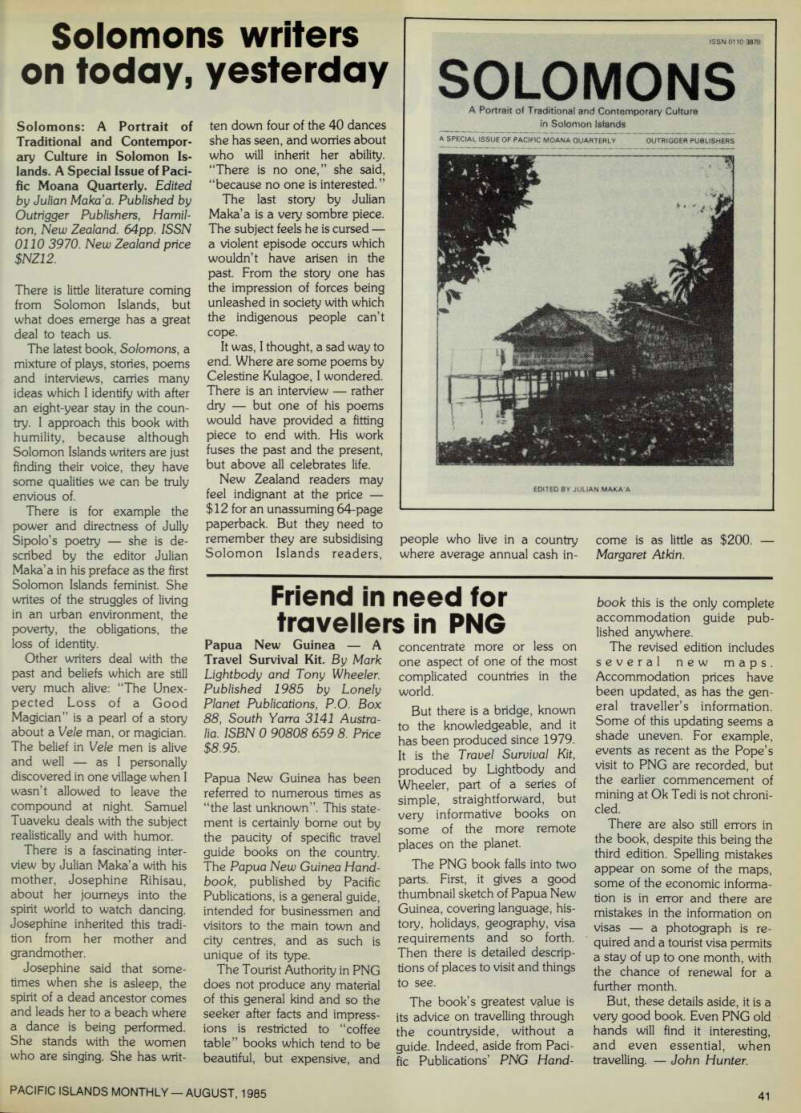
Solomons: A Portrait of Traditional and Contempor ary Culture in Solomon Is lands. A Special Issue of Paci fic Moana Quarterly. Edited by Julian Maka’a. Published by Outrigger Publishers, Hamil ton, New Zealand. 64pp. ISSN 0110 3970. New Zealand price
Snzi2.
There is little literature coming from Solomon Islands, but what does emerge has a great deal to teach us.
The latest book, Solomons, a mixture of plays, stories, poems and interviews, carries many ideas which I identify with after an eight-year stay in the coun try. I approach this book with humility, because although Solomon Islands writers are just finding their voice, they have some qualities we can be truly envious of.
There is for example the power and directness of Jully Sipolo’s poetry she is de scribed by the editor Julian Maka’a in his preface as the first Solomon Islands feminist. She writes of the struggles of living in an urban environment, the poverty, the obligations, the loss of identity.
Other writers deal with the past and beliefs which are still very much alive: “The Unex pected Loss of a Good Magician” is a pearl of a story about a Vele man, or magician.
The belief in Vele men is alive and well as I personally discovered in one village when I wasn’t allowed to leave the compound at night. Samuel Tuaveku deals with the subject realistically and with humor.
There is a fascinating inter view by Julian Maka’a with his mother, Josephine Rihisau, about her journeys into the spirit world to watch dancing.
Josephine inherited this tradi tion from her mother and grandmother.
Josephine said that some times when she is asleep, the spirit of a dead ancestor comes and leads her to a beach where a dance is being performed.
She stands with the women who are singing. She has writ
ten down four of the 40 dances she has seen, and worries about who will inherit her ability.
“There is no one,” she said, “because no one is interested.”
The last story by Julian Maka’a is a very sombre piece.
The subject feels he is cursed a violent episode occurs which wouldn’t have arisen in the past. From the story one has the impression of forces being unleashed in society with which the indigenous people can’t cope.
It was, I thought, a sad way to end. Where are some poems by Celestine Kulagoe, I wondered.
There is an interview rather dry but one of his poems would have provided a fitting piece to end with. His work fuses the past and the present, but above all celebrates life.
New Zealand readers may feel indignant at the price $l2 for an unassuming 64-page paperback. But they need to remember they are subsidising Solomon Islands readers,
people who live in a country where average annual cash in
come is as little as $2OO.
Margaret Atkin.