Pruning would improve
pp. 39-40 · Read in the full issue
books
Pruning would improve Hawaii guide
The Maverick Guide to Hawaii, 1985 Edition. By Robert IV. Bone. Published by Pelican Publishing Company, Gretna, Louisiana, 1985. 444 pp. ISBN 0 38289 469 2. Price $U510.95 paperback.
A good guide book should meet three general criteria. It should be written by someone who knows the region well; it should be up-to-date; and it should be concise. Robert Bo ne’s Maverick Guide to Hawaii, 9th edition, admirably fulfils the first two criteria, but not the last one.
The Guide has four introduc tory chapters followed by six others, each covering one of the six largest Hawaiian islands.
Chapter 1, as well as sections in the four introduction chapters on the factors behind changes in air fares to Hawaii (pp 10-18), and what to wear (pp 21-23), and in the last six chapters describing airports, could be profitably left out. The Guide devotes over 80 of its pages to discussing tourist sights of the islands, over 70 pages to describing hotels, and nearly 60 to restaurants. These are the three areas where Bone’s thor ough acquaintance with the state, and with its tourist facili ties, shines. His information is detailed and interesting and up-to-date (as of time of this writing). Bone’s desire to be comprehensive makes him violate the claim laid down by himself and his wife in the very first sentence in the Guide's preface: “Everything in this book represents our own ex periences and opnions.” Neith er of them has visited and investigated each and every one of the hotels and re staurants mentioned, which leads them to rely on the
testimony of others even if those others are probably just as impartial in their assessments as the Bones themselves would have been.
For the hotels, Waikiki is, of course, where most of them are. Rates there run between under $3O a night in the dozen or so budget hotels to over $lOOO for the Kahala Hilton, which is not right in Waikiki but which is, in their opinion, the best hotel on Oahu. On the island of Hawaii, or the “Big Island”, the Kona Hotel charges only $lO a night, which is surely the cheapest in the state. The hotel with the best room acces sories seems to be the Waiohai on Kauai; each room has a pre-stocked refrigerator, a hid den television and a small wet bar. The most lavish hotel is the Hyatt Regency Maui, built at a
cost of $BO million and charging up to $l4OO a night.
Descriptions of hotels are among the best passages in the Guide. Here is how Mauna Kea Beach Hotel looks (pp 392-93): the hotel has “long, low, ter raced facades not obtrusive de spite size; everything nestled into the side of a hill; trees, plants, waterfalls, and rock walls extending from outdoors to inside the hotel edifice; two large gardens, one north and one south; spacious lobby over looking a flower-filled interior court ... A museumful of Oriental art (more than 1000 objets) scattered throughout the building’s walkways; several excellent Hawaii artists also re presented; mirror-bright, brass walled elevators with parquet floors to lift you to your room level; elegant bedchambers,
some with separate entrance foyers and dressing rooms; plain, white walls; floral artwork; framed sea shell col lections; bright, solid colors; thick throw rugs on smooth hex-tiled floors; wicker and cane furnishings; brass lamps; no TVs in the rooms (by de sign); sliding louvred doors to the large lanais; bathrooms with mirrored wall; Italian marble basins; hidden teak-doored re frigerators in all units.”
When it comes to re staurants, the Bones admit that the personnel of the various better ones keeps changing, so that their judgments on re staurants tend to be much more tentative than their judgments of hotels. When it comes to food, the passion fruit chiffon pie on Kauai sounds especially delectable to try in Hanapepe
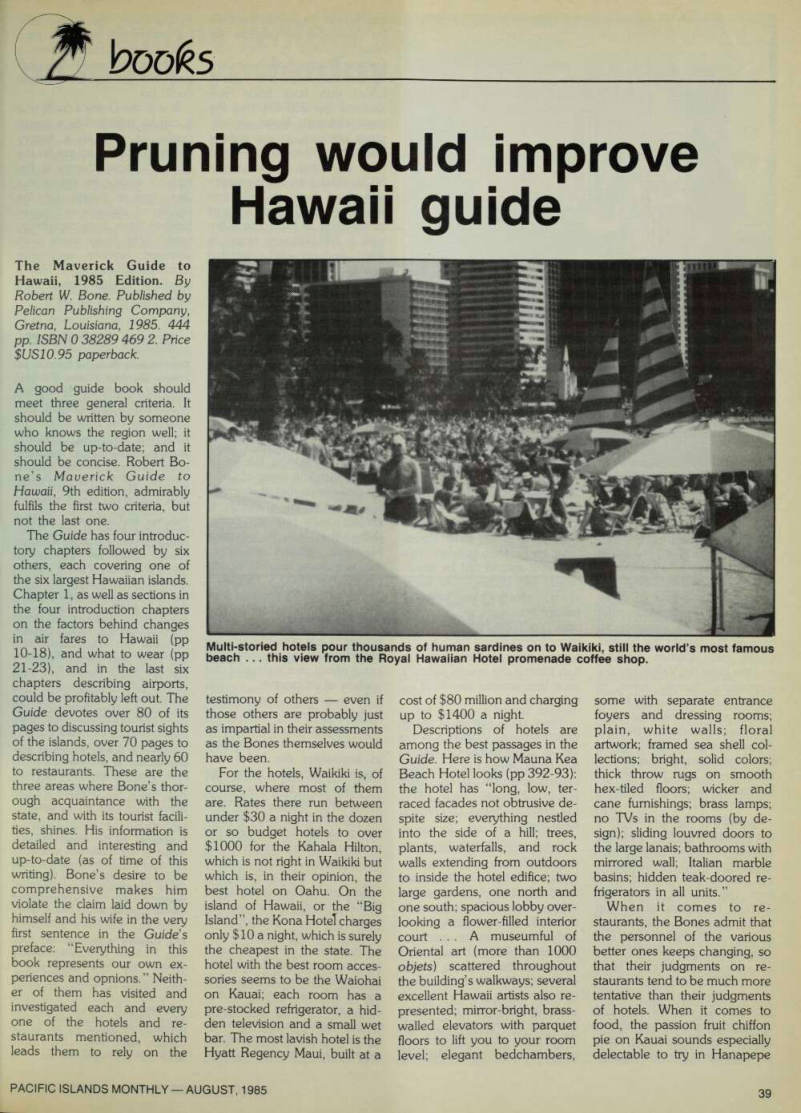
Multi-storied hotels pour thousands of human sardines on to Waikiki, still the world’s most famous beach ... this view from the Royal Hawaiian Hotel promenade coffee shop.
(p 260); for drinks, there is the Tedeschi winery on Maui which now uses Camelian grapes not just the pineapples it started with (p 321).
Along with descriptions of hotels, the sections on sights are among the best parts of the book. On Oahu, there are the Pali Lookout and the Arizona Memorial, the most-visited tourist attraction in the state.
Lanai offers a 16,000-acre pineapple plantation, the largest in the world (p 359).
Both Kauai and Maui offer splendid natural features to gaze at, the former the Na Pali Coast and Waimea Canyon and the latter lao Valley and the somnolent, bucolic town of Hana. Of course, the Big Island has its several volcanoes and black sand beaches formed by the sea’s erosion of lava shards; Pele, the Hawaiian goddess of fire, is now said to reside in Halemaumau crater in Kilauea volcano (p 415).
In addition to the deletion of the passages mentioned earlier, several other changes could be made to tidy up the Guide. All the various lists included of flora (pp 41-44), fauna (pp 45-50), Hawaiian words (pp 64-66), the annual calendar of events (pp 85-89), the tour bus companies (pp 195-98), the entertainers working Waikiki (pp 232-36) and the various island addresses (pp 239-40, 282, 341-42, 428-29) could be helpfully placed together at the end of the book; in addi tion, the list of Hawaiian words
could be expanded to include all Hawaiian words used in the Guide. (When Hawaiian nouns that are not yet common in English usage are to be used in the plural form, the Bones should not add a final “-s”; after all, Hawaiian speakers do not form plurals that way.) To pay the Bones back in their own coin, there is too much “pun ishment” throughout the Guide; it should not be eradi cated, just pruned. On occa sion, they use jarring metaphors, such as “rainbow mills” (p 37) what could be more incongruous than to im agine a heavy industrial opera tion turning out one of nature’s most insubstantial beauties? that needs to go.
There are a couple of minor anachronisms. Wahiawa is no longer “the battered old planta tion town” they say it is (p 188).
Gilbert Islanders (p 85) have been “I-Kiribati” since 1979; the New Hebrides (p 393) is now Vanuatu.
Other appealing features of the Guide are all those his torical and factual tidbits scat tered through almost every chapter. In the chapter on Oahu, for example, you are not only told about ancient Hawaiian gliding (now a lost art), and the Nuuana battles waged by Kamehameha I, but you also learn what a hamzah is, as well as a great deal about fine arts in the state (pp 63, 77-85). In other chapters, we learn that the oldest Western
structure in the islands was built by Australian ex-convicts on Maui in 1801 (p 314); that George Munro, from New Zea land, virtually replanted parts of Lanai with flora from New Zealand (pp 368-69); that the most elaborate heiau, or reli gious platform, in the state is more than 80 metres long and is to be found on Molokai (p 353), which also has the state’s only sand dunes (p 352); that the “Big Island” holds acres of petroglyphs at Puaho (p 409), and a 300,000-acre ranch (p 406), and, to end a list that could go on for some time, there are the “barking” sands and the beefalo of Kauai (pp 267, 272).
The Guide also has its se rious side. One section of an introductory chapter is titled “Problems in paradise,” and there are scattered references to crime and racial tensions, both past and present, in several of the chapters on the individual islands. Bone attributes prob lems in the Makaha, Waimana lo and Nanikuli areas of Oahu to economics; but they might also stem from a desire to protect one’s territory, some thing that private, largely Hawaiian, citizens are doing that is in some ways compara ble to what the U.S. military is doing with large tracts of land throughout the state. In any case, just what the roots of the problems are should merit the consideration of anyone who cares about the state and the welfare of its people.
The word “paradise” perhaps deserves just as much of a hearing as these problems.
A main feature of the Guide is to encourage the belief that Hawaiian society is there with its Aloha spirit, which is discus sed briefly along predictable lines (pp 89-91), and its remote resorts somehow remaining the same over the decades if not the centuries, as in the case of the Aloha spirit. Given the violent and rapacious legacy of Kamehameha I, the sandal wood mania of the early 19th century, the depopulation and the decades of immigration and intense tourism, all of which are mentioned in the Guide itself, it seems to me that both the Aloha spirit and the remoteness of the islands cannot possibly have remained nor can they be expected to remain as they were.
In that case, the Aloha spirit may no longer be an accurate description of what is; instead, it will become a regret for what has been, or an ideal of what could be.
It is to the Guide’s credit that it can be regarded as a tourist guide, as well as a history primer of sorts, a source for the study of social change in the state, a source for urban stu dies, and a source for the history of tourism and tourist facilities there. Such complexity could only have come with constant revision and with much initial hard work. May it continue to be revised and
improved.
M. L. Berg.
Books Received
The Hawaiian Poetry of Religion and Politics. By John Chariot. Published 1985 by University of Hawaii Press, 2840 Kolowalu Street, Honolulu, Hawaii 96822. ISBN 0 939154 38 2. Price $US12.00.
Mead’s Other Manus: Phenomenology of the Encounter. By Lola Romanucci- Ross. Published 1985 by Bergin & Garvey Publishers, Inc., 670 Amherst Rd., South Hadley, Mass. 01075, USA.
ISBN 0 89789 064 7. Price $US24.95.
Sun, Sea, Surf and Sand — the Myth of the Beach. By Geoffrey Dutton.
Published 1985 by Oxford University Press, 7 Bowen Crescent, Melbourne, Vic. 3000. ISBN 0 19 554411 0. Price $40.00.
The Art of Captain Cook’s Voyages.
Volumes 1 & 2. By Rudiger Joppien and Bernard Smith. Published 1985 by Ox ford University Press, 7 Bowen Crescent, Melbourne, Vic. 3000, Australia. ISBN Volume 1 0 19 5544552. ISBN Volume 2 0 19 554456 0. Two volume set $150.00.
Japan Handbook. By J. D. Bisignani.
Published by Moon Publications, PO Box 1696, Chico, CA 95927, USA.
ISBN 0 9603322 2 7. Price $12.95.
Adventurous Spirits: Australian mig rant society in pre-cession Fiji. By John Young. Published 1984 by Univer sity of Queensland Press, Box 42, St.
Lucia, Queensland 4067, Australia.
ISBN 0 7022 1704 2. Price $40.00.
The Effects of Development on Traditional Pacific Island Cultures.
Report of the conference held jointly with the Pacific Islands Society on April 27-29, 1984. Published by the Public Affairs Department, Royal Common wealth Society, 18 Northumberland Avenue, London WC2N 5BJ, England.
ISBN 0 907640 30 3. No price provided.
The Rigger’s Apprentice. By Brion Toss. Published 1984 by International Marine Publishing Company, 21 Elm Street, Camden, Maine 04843, USA.
ISBN 0 87742 165 X. Price $US27.50.
Bareboating. By Brian M. Fagan. Pub lished 1985 by International Marine Publishing Company, 21 Elm Street, Camden, Maine 04843, USA. ISBN 0 87742 173 0. Price $US34.95.
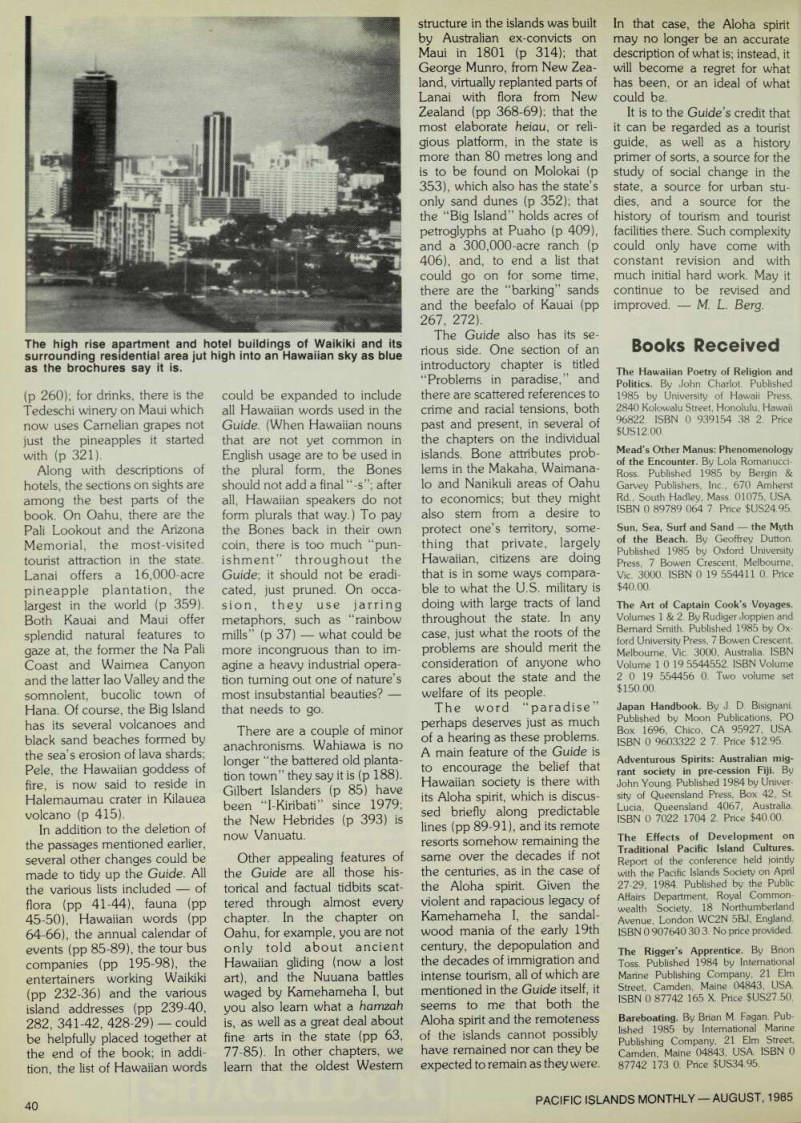
The high rise apartment and hotel buildings of Waikiki and its surrounding residential area jut high into an Hawaiian sky as blue as the brochures say it is.