Devotion to quality
pp. 31-33 · Read in the full issue
trade winds
Trading With Japan
Devotion to quality is total
As one of the great manufacturing and trading nations of the world, Japan has eco nomic links with almost every country on the globe. Over the last decade or so, however, the attention of her long-range planners has turned more and more towards the Pacific. On the face of it, this should be good for the island countries, and in some respects it is. But the problem for the island na tions is that, for the most part, and inevitably, the Pacific means in Japanese business minds, the rim of the Pacific Basin, not the bits in the mid dle.
The majority of Japanese are quite keenly aware of what they call ’’the southern islands,” not as prospective trading partners, but as idyllic retreats to be dreamed of from amidst the press and stress of modem, urban Japan, and hopefully visited whenever opportunity might allow. There is, in fact, an unspoken, undefined, but nonetheless perceptible, com mon view among leading Japanese that the Pacific Is lands should be preserved as they are, as havens of beauty and tranquillity in a world grown so busy and so deman ding.
Such are nice ideas, but they don’t do much for island traders seeking a niche in the huge, and very demanding, Japanese market.
A day spent at the enormous, grey concrete, Tokyo headquarters of what even Japanese businessmen wryly call, with a twinkle in the eye, the ’’notorious MITI,” the Ministry of International Trade and Industry, explains why some of the problems arise, but
also shows that more is being done about it than many people understand.
Yet, as a percentage of Japanese trade, the islands, with the exception of a vast mineral storehouse like Papua New Guinea, will always be extremely small and, in a coun try like Japan, that presents peculiar problems of its own.
Even Fiji, with an industrial infrastructure quite large by is land standards, can be stretch ed to fill orders from Australian department store chains, and, by comparison with the great Japanese chains, like Tokyu, the Australians are really quite small. For Japan is a country of
120 million highly-organised, disciplined, group-minded people, who are prosperous enough to demand, and get, the best there is.
The classic story told by Tokyo-based foreign trade promoters alleges that the Brit ish shippers of Johnnie Walker, the famous Scotch whisky, sought to improve Japanese sales of their standard red label blend, and, applying standard European logic, dropped their price. Sales dropped like rocks for Scotch sells in Japan not on its price, but on its snob-value, and who would offer his hon ored guests a publicly dis counted brand?
Probably more than any other country in the free world Japan orchestrates her trade.
MITI is all-powerful, not, it seems, because it is dictatorial, but because what it decides is a distillation of all the interests involved. Thus do the many parts of the entire, huge enter prise, Japan, Inc., seem to move more or less in the same direction and at the same time for mutual benefit.
Smaller nations cannot match Japanese sales and pro duction horsepower, but they can hope to emulate their effi ciency and, much more impor tantly, learn to adapt them selves and their products to the
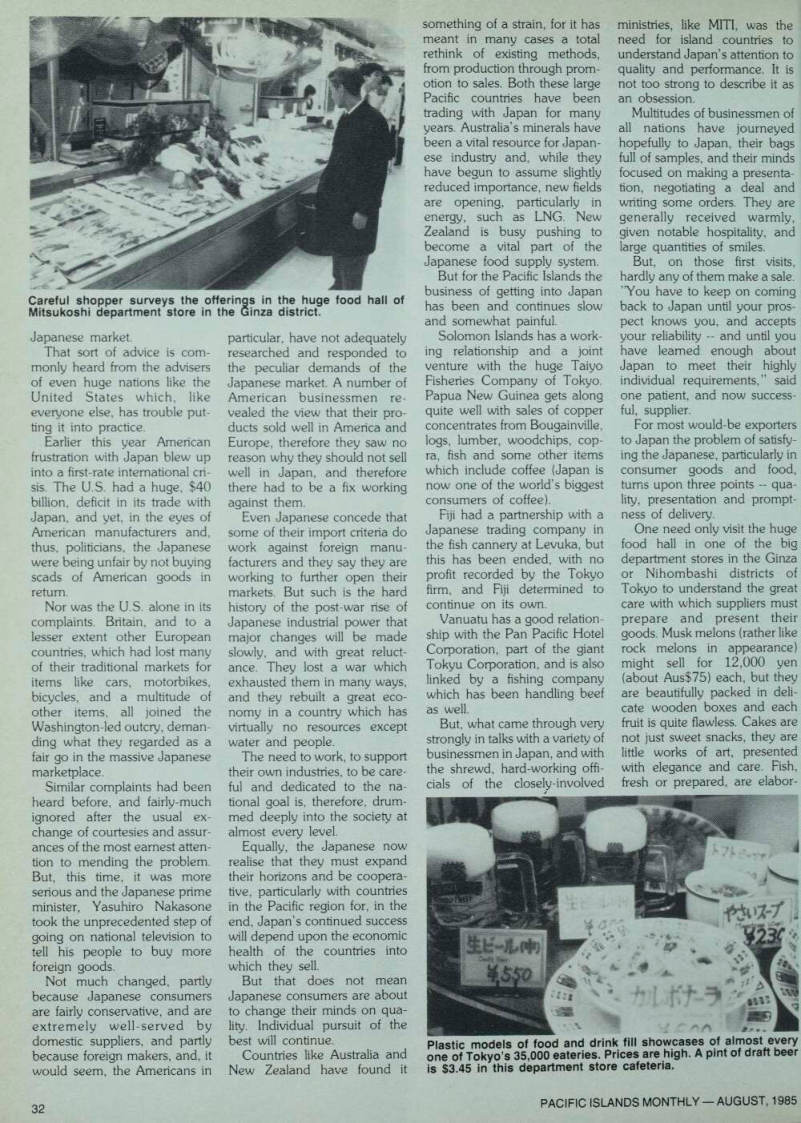
The glittering, glamorous Ginza district of Tokyo: a seven-days-a-week shoppers’ paradise, but a tough nut for foreigners to crack.
Japanese market.
That sort of advice is com monly heard from the advisers of even huge nations like the United States which, like everyone else, has trouble put ting it into practice.
Earlier this year American frustration with Japan blew up into a first-rate international cri sis. The U.S. had a huge, $4O billion, deficit in its trade with Japan, and yet, in the eyes of American manufacturers and. thus, politicians, the Japanese were being unfair by not buying scads of American goods in return.
Nor was the U.S. alone in its complaints. Britain, and to a lesser extent other European countries, which had lost many of their traditional markets for items like cars, motorbikes, bicycles, and a multitude of other items, all joined the Washington-led outcry, deman ding what they regarded as a fair go in the massive Japanese marketplace.
Similar complaints had been heard before, and fairly-much ignored after the usual ex change of courtesies and assur ances of the most earnest atten tion to mending the problem.
But. this time, it was more serious and the Japanese prime minister, Yasuhiro Nakasone took the unprecedented step of going on national television to tell his people to buy more foreign goods.
Not much changed, partly because Japanese consumers are fairly conservative, and are extremely well-served by domestic suppliers, and partly because foreign makers, and, it would seem, the Americans in
particular, have not adequately researched and responded to the peculiar demands of the Japanese market. A number of American businessmen re vealed the view that their pro ducts sold well in America and Europe, therefore they saw no reason why they should not sell well in Japan, and therefore there had to be a fix working against them.
Even Japanese concede that some of their import criteria do work against foreign manu facturers and they say they are working to further open their markets. But such is the hard history of the post-war rise of Japanese industrial power that major changes will be made slowly, and with great reluct ance. They lost a war which exhausted them in many ways, and they rebuilt a great eco nomy in a country which has virtually no resources except water and people.
The need to work, to support their own industries, to be care ful and dedicated to the na tional goal is, therefore, drum med deeply into the society at almost every level.
Equally, the Japanese now realise that they must expand their horizons and be coopera tive, particularly with countries in the Pacific region for, in the end, Japan’s continued success will depend upon the economic health of the countries into which they sell.
But that does not mean Japanese consumers are about to change their minds on qua lity. Individual pursuit of the best will continue.
Countries like Australia and New Zealand have found it
something of a strain, for it has meant in many cases a total rethink of existing methods, from production through prom otion to sales. Both these large Pacific countries have been trading with Japan for many years. Australia’s minerals have been a vital resource for Japan ese industry and, while they have begun to assume slightly reduced importance, new fields are opening, particularly in energy, such as LNG. New Zealand is busy pushing to become a vital part of the Japanese food supply system.
But for the Pacific Islands the business of getting into Japan has been and continues slow and somewhat painful.
Solomon Islands has a work ing relationship and a joint venture with the huge Taiyo Fisheries Company of Tokyo.
Papua New Guinea gets along quite well with sales of copper concentrates from Bougainville, logs, lumber, woodchips, cop ra, fish and some other items which include coffee (Japan is now one of the world’s biggest consumers of coffee).
Fiji had a partnership with a Japanese trading company in the fish cannery at Levuka, but this has been ended, with no profit recorded by the Tokyo firm, and Fiji determined to continue on its own.
Vanuatu has a good relation ship with the Pan Pacific Hotel Corporation, part of the giant Tokyu Corporation, and is also linked by a fishing company which has been handling beef as well.
But, what came through very strongly in talks with a variety of businessmen in Japan, and with the shrewd, hard-working offi cials of the closely-involved
ministries, like MITI. was the need for island countries to understand Japan’s attention to quality and performance. It is not too strong to describe it as an obsession.
Multitudes of businessmen of all nations have journeyed hopefully to Japan, their bags full of samples, and their minds focused on making a presenta tion, negotiating a deal and writing some orders. They are generally received warmly, given notable hospitality, and large quantities of smiles.
But, on those first visits, hardly any of them make a sale. ”You have to keep on coming back to Japan until your pros pect knows you, and accepts your reliability - and until you have learned enough about Japan to meet their highly individual requirements,” said one patient, and now success ful, supplier.
For most would-be exporters to Japan the problem of satisfy ing the Japanese, particularly in consumer goods and food, turns upon three points qua lity, presentation and prompt ness of delivery.
One need only visit the huge food hall in one of the big department stores in the Ginza or Nihombashi districts of Tokyo to understand the great care with which suppliers must prepare and present their goods. Musk melons (rather like rock melons in appearance) might sell for 12,000 yen (about Auss7s) each, but they are beautifully packed in deli cate wooden boxes and each fruit is quite flawless. Cakes are not just sweet snacks, they are little works of art, presented with elegance and care. Fish, fresh or prepared, are elabor-
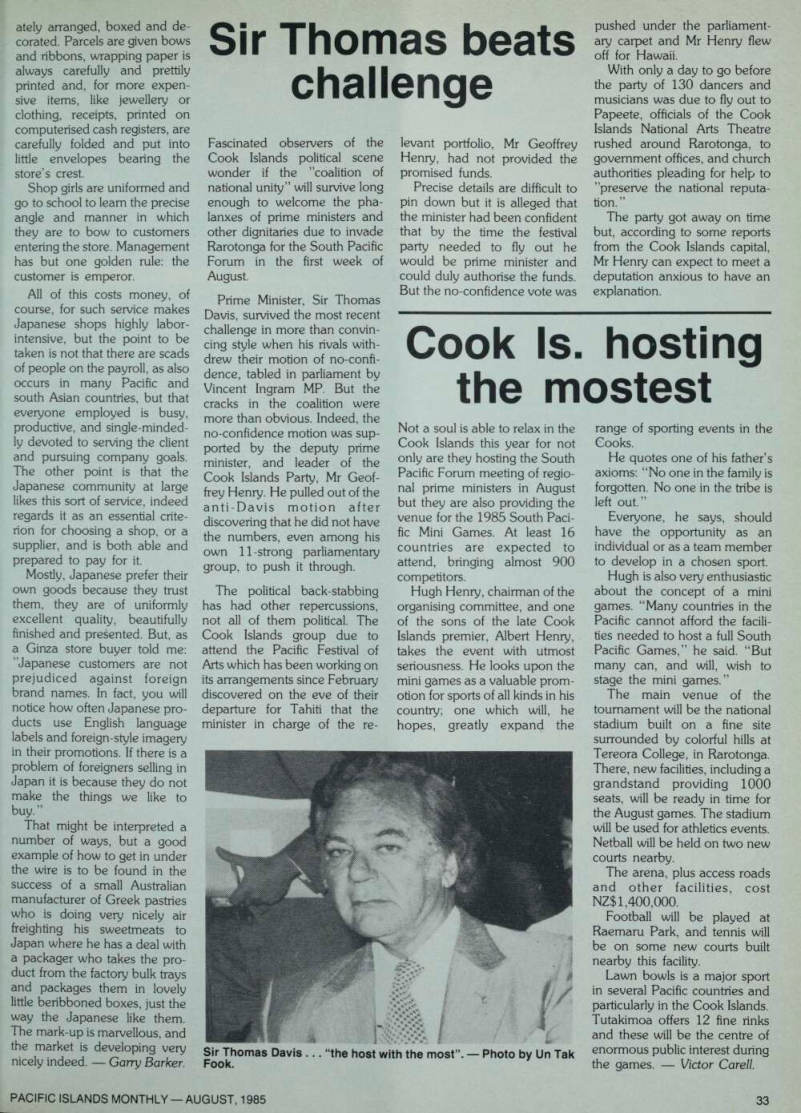
Careful shopper surveys the offerings in the huge food hall of Mitsukoshi department store in the Ginza district.
Plastic models of food and drink fill showcases of almost every one of Tokyo’s 35,000 eateries. Prices are high. A pint of draft beer is $3.45 in this department store cafeteria.
ately arranged, boxed and de corated. Parcels are given bows and ribbons, wrapping paper is always carefully and prettily printed and, for more expen sive items, like jewellery or clothing, receipts, printed on computerised cash registers, are carefully folded and put into little envelopes bearing the store’s crest.
Shop girls are uniformed and go to school to leam the precise angle and manner in which they are to bow to customers entering the store. Management has but one golden rule: the customer is emperor.
All of this costs money, of course, for such service makes Japanese shops highly labor intensive, but the point to be taken is not that there are scads of people on the payroll, as also occurs in many Pacific and south Asian countries, but that everyone employed is busy, productive, and single-minded ly devoted to serving the client and pursuing company goals.
The other point is that the Japanese community at large likes this sort of service, indeed regards it as an essential crite rion for choosing a shop, or a supplier, and is both able and prepared to pay for it.
Mostly, Japanese prefer their own goods because they trust them, they are of uniformly excellent quality, beautifully finished and presented. But, as a Ginza store buyer told me; ’’Japanese customers are not prejudiced against foreign brand names. In fact, you will notice how often Japanese pro ducts use English language labels and foreign-style imagery in their promotions. If there is a problem of foreigners selling in Japan it is because they do not make the things we like to buy.”
That might be interpreted a number of ways, but a good example of how to get in under the wire is to be found in the success of a small Australian manufacturer of Greek pastries who is doing very nicely air freighting his sweetmeats to Japan where he has a deal with a packager who takes the pro duct from the factory bulk trays and packages them in lovely little beribboned boxes, just the way the Japanese like them.
The mark-up is marvellous, and the market is developing very
nicely indeed.
Garry Barker.