Time warp for Tahiti visitor
pp. 29-30 · Read in the full issue
Tahiti visitor
For the thousands of foreign visitors who flocked to Tahiti in July to enjoy the orgy of native singing, dancing and prancing known as the Pacific Arts Festi val, first contact with local na tive customs was as a rule rather disconcerting. For today in Tahiti the roads are teeming with 50,000 motor vehicles whose drivers are engaged in a wild race which often ends in hospital or in the cemetery. The native huts are all made of imported Oregon pine, corru gated iron and concrete, and the only genuine jungle is to be found in Papeete, where imita tors of Mad Max prowl around at night and pounce on starry eyed visitors in search of the sexy hula girls and noble sav ages who have given Tahiti its worldwide reputation as an earthly paradise. Asked to give a welcoming speech to a group of festival visitors, we addressed them thus: We shall give you what you have come for. Just close your eyes and follow us back to Tahiti at the time of Captain Cook. No, don’t start looking for a hotel, because there aren’t any. Your problem is actually that too many hospitable Tahi tians, both male and female, have taken hold of you and are trying to drag you off in diffe rent directions. For this reason you are still standing bewil dered on the beach when a tall
man of commanding counte nance and majestic bearing ar rives. Everybody, including your friendly captors, steps back and uncovers the upper parts of their bodies, as a sign of respect. This makes you realise suddenly that some of the long haired Tahitians whom you have taken to be women are actually men.
In order to save you from making another mistake, we should also tell you that the stately individual who has been shown so much deference is not the King of Tahiti, for there is no such person. The island is divided, by boundaries radiat ing from a central point, into 18 different “kingdoms,” each with its own, independent ruler.
Poino, the one facing you, is simply the chief of Haapape, where historic Matavai Bay and Point Venus are situated.
Poino rubs his nose against yours, takes your hand and leads you to a large oval hut which resembles a Greek tem ple with its high roof resting on rows of round pillars. The only furniture consists of a small stool for the chief and a wooden chest containing valu able feather cloaks and shell jewellery. Poino, his four wives, 20 relatives and six servants all sleep on the floor which is covered with a thick, soft layer of grass. Genuine Tahitian huts have no walls and are therefore
Postmark Papeete
air-conditioned by the trade winds.
All the neighbors, who have by now gathered round the hut, watch you closely and make loud remarks which produce peals of laughter. Keep smiling and stoically accept once and for all this all-pervading lack of privacy. The golden rule in Tahiti is not to try to hide anything, least of all yourself. If you do, it means that you are guilty of some dishonorable act.
Your behavior must be as open as the house you live in.
Also keep smiling when you discover that your luggage has disappeared. As your Tahitian hosts have already demons trated, they are overwhelmingly generous and cheerfully give away all their worldly posses sions. So, naturally, they expect you to be equally prodigal and to take for granted that you will
Marie-Thérèse and Bengt Danielsson
have no objections if they anti cipate a little by taking your belongings before you yourself have had time to distribute them. Only stupid foreigners call this theft.
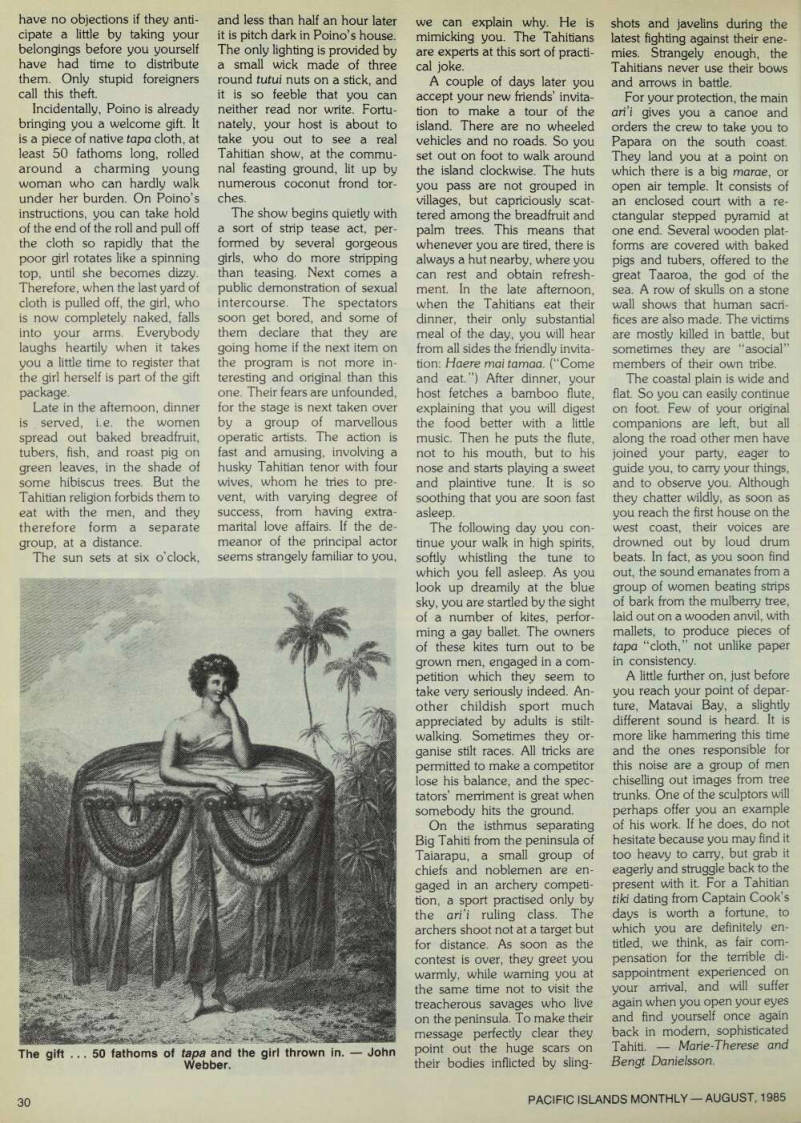
Incidentally, Poino is already bringing you a welcome gift. It is a piece of native tapa cloth, at least 50 fathoms long, rolled around a charming young woman who can hardly walk under her burden. On Poino’s instructions, you can take hold of the end of the roll and pull off the cloth so rapidly that the poor girl rotates like a spinning top, until she becomes dizzy.
Therefore, when the last yard of cloth is pulled off, the girl, who is now completely naked, falls into your arms. Everybody laughs heartily when it takes you a little time to register that the girl herself is part of the gift package.
Late in the afternoon, dinner is served, i.e. the women spread out baked breadfruit, tubers, fish, and roast pig on green leaves, in the shade of some hibiscus trees. But the Tahitian religion forbids them to eat with the men, and they therefore form a separate group, at a distance.
The sun sets at six o’clock,
and less than half an hour later it is pitch dark in Poino’s house.
The only lighting is provided by a small wick made of three round tutui nuts on a stick, and it is so feeble that you can neither read nor write. Fortu nately, your host is about to take you out to see a real Tahitian show, at the commu nal feasting ground, lit up by numerous coconut frond tor ches.
The show begins quietly with a sort of strip tease act, per formed by several gorgeous girls, who do more stripping than teasing. Next comes a public demonstration of sexual intercourse. The spectators soon get bored, and some of them declare that they are going home if the next item on the program is not more in teresting and original than this one. Their fears are unfounded, for the stage is next taken over by a group of marvellous operatic artists. The action is fast and amusing, involving a husky Tahitian tenor with four wives, whom he tries to pre vent, with varying degree of success, from having extra marital love affairs. If the de meanor of the principal actor seems strangely familiar to you,
we can explain why. He is mimicking you. The Tahitians are experts at this sort of practi cal joke.
A couple of days later you accept your new friends’ invita tion to make a tour of the island. There are no wheeled vehicles and no roads. So you set out on foot to walk around the island clockwise. The huts you pass are not grouped in villages, but capriciously scat tered among the breadfruit and palm trees. This means that whenever you are tired, there is always a hut nearby, where you can rest and obtain refresh ment. In the late afternoon, when the Tahitians eat their dinner, their only substantial meal of the day, you will hear from all sides the friendly invita tion: Haere mai tamaa. (“Come and eat”) After dinner, your host fetches a bamboo flute, explaining that you will digest the food better with a little music. Then he puts the flute, not to his mouth, but to his nose and starts playing a sweet and plaintive tune. It is so soothing that you are soon fast asleep.
The following day you con tinue your walk in high spirits, softly whistling the tune to which you fell asleep. As you look up dreamily at the blue sky, you are startled by the sight of a number of kites, perfor ming a gay ballet. The owners of these kites turn out to be grown men, engaged in a com petition which they seem to take very seriously indeed. An other childish sport much appreciated by adults is stilt walking. Sometimes they or ganise stilt races. All tricks are permitted to make a competitor lose his balance, and the spec tators’ merriment is great when somebody hits the ground.
On the isthmus separating Big Tahiti from the peninsula of Taiarapu, a small group of chiefs and noblemen are en gaged in an archery competi tion, a sport practised only by the ari’i ruling class. The archers shoot not at a target but for distance. As soon as the contest is over, they greet you warmly, while warning you at the same time not to visit the treacherous savages who live on the peninsula. To make their message perfectly clear they point out the huge scars on their bodies inflicted by sling
shots and javelins during the latest fighting against their ene mies. Strangely enough, the Tahitians never use their bows and arrows in battle.
For your protection, the main ari’i gives you a canoe and orders the crew to take you to Papara on the south coast.
They land you at a point on which there is a big marae, or open air temple. It consists of an enclosed court with a re ctangular stepped pyramid at one end. Several wooden plat forms are covered with baked pigs and tubers, offered to the great Taaroa, the god of the sea. A row of skulls on a stone wall shows that human sacri fices are also made. The victims are mostly killed in battle, but sometimes they are “asocial” members of their own tribe.
The coastal plain is wide and flat. So you can easily continue on foot. Few of your original companions are left, but all along the road other men have joined your party, eager to guide you, to carry your things, and to observe you. Although they chatter wildly, as soon as you reach the first house on the west coast, their voices are drowned out by loud drum beats. In fact, as you soon find out, the sound emanates from a group of women beating strips of bark from the mulberry tree, laid out on a wooden anvil, with mallets, to produce pieces of tapa “cloth,” not unlike paper in consistency.
A little further on, just before you reach your point of depar ture, Matavai Bay, a slightly different sound is heard. It is more like hammering this time and the ones responsible for this noise are a group of men chiselling out images from tree trunks. One of the sculptors will perhaps offer you an example of his work. If he does, do not hesitate because you may find it too heavy to carry, but grab it eagerly and struggle back to the present with it. For a Tahitian tiki dating from Captain Cook’s days is worth a fortune, to which you are definitely en titled, we think, as fair com pensation for the terrible di sappointment experienced on your arrival, and will suffer again when you open your eyes and find yourself once again back in modern, sophisticated Tahiti. Marie-Therese and Bengt Danielsson.
The gift ... 50 fathoms of tapa and the girl thrown in. - John Webber.