contemporary Samoa
pp. 57-58 · Read in the full issue
The women prevail in novel of contemporary Samoa
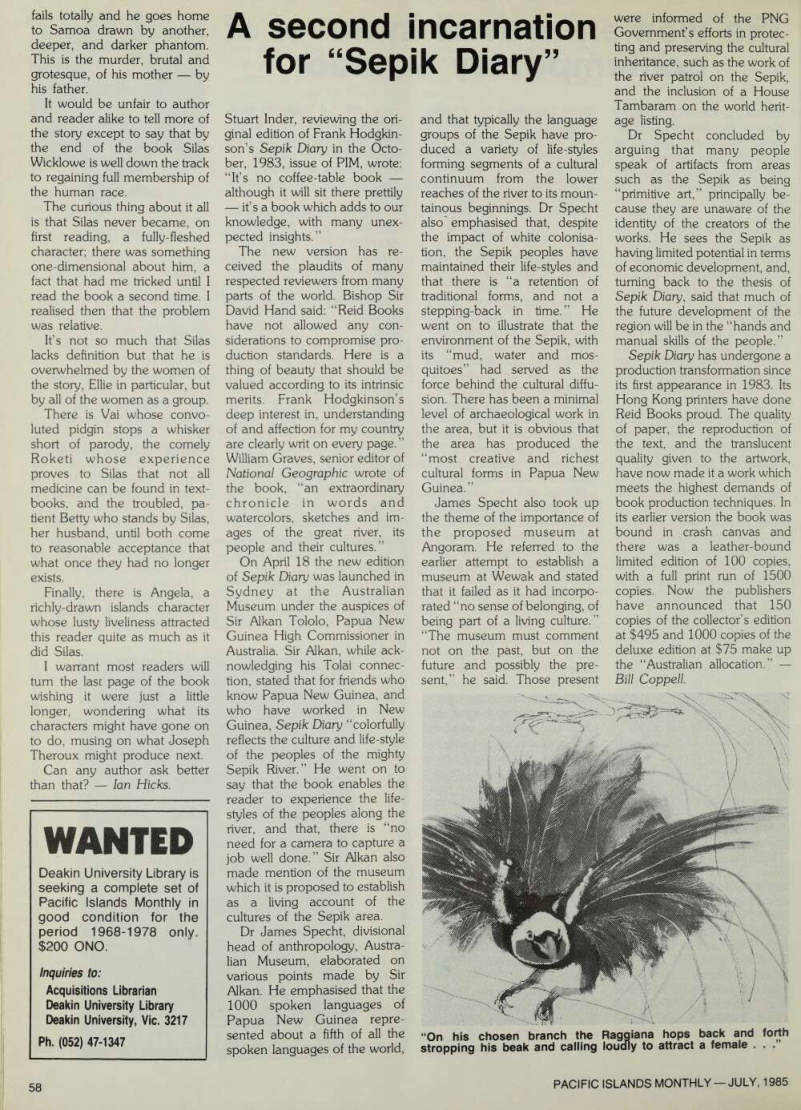
Black Coconuts, Brown Magic. By Joseph Theroux.
Published by the Dial Press, Doubleday & Company, Inc., Garden City, New York, 1983.
ISBN 0 385 27947 7. Price $U513.95.
It’s impossible to pick up this book without feeling a mixture of interest, envy and sympathy, all three emotions flowing from the one factor the author’s name.
One feels immediate interest in a book by someone called Theroux because Paul Theroux is such an accomplished, no, brilliant, author, and one won ders how another writer in his family will fare.
One feels envy, no doubt quite unfairly, because one wonders whether the fact that the author’s name is Theroux had anything to do with his having found a publisher at all.
And one feels sympathy be cause, given the author’s name, this slim, first novel will be judged not as it should be i.e., on its own merits but, human nature being what it is, on how it stacks up against Paul Theroux’s works.
Mind you, Joseph Theroux has his publisher to blame at least in part for the drawing of such unfair comparisons. One hardly judges a book merely on its dust-jacket blurb, but it is that blurb which takes the bit between its teeth this way: “In this dark exotic comedy by Joseph Theroux the newest voice in the famous writing clan a lush island in Samoa becomes a refuge for a young, battle-weary American doctor who is returning to the tropics of his childhood.”
In one sense it’s a fair point to make, given that many book lovers would probably be una ware that there is a Theroux clan of writers. But there most certainly is. Albert-Eugene and Anne Theroux, the one French- Canadian and the other of Italian extraction, have seven children, two of them daughters who, according to World Au thors, 1970-75, lack artistic ambitions.
But Eugene Jnr. paints and
draws caricatures as a hobby, Alexander is a novelist, and Paul we all know about. Then comes Joseph, and finally there is Peter, with five novels writ ten, though none published, before he started college.
What, then, of Joseph’s book? The first point to be made about it is that it has a lovely sense of place, no minor matter when dealing with a novel set in the Pacific.
I’ve never been to Samoa, but from what I have seen of the Pacific at large the tone of the novel, its ability to draw the reader into a credible back ground, are impressive. Two examples will suffice.
The first passage introduces the reader to one of the book’s key characters, Ellie. Every Pacific community has its Ellie, the large, rumbustious lady who is a critical bridge between traditions and the modem so ciety which coexists uneasily with those traditions. The read er meets Ellie on an aircraft preparing to take off from Hawaii to fly home to Samoa “There was a commotion farther up the aisle. A half dozen people were standing, opening overhead compart ments to store briefcases and sweaters. Rocking her way through was an enormous brown woman. She held a bulging shopping bag in one hand and a tricycle overhead and laughed uproariously all the while. She seemed not to hear the mutterings of protest from the people she was shov ing aside, or the stewardess who vainly reached for her tricycle.
“Around her neck were maile vines and necklaces of hard candy, their cellophane wrap pings knotted together.
Attached to her loudly flowered muumuu were buttons painted with slogans, gold angels with ruby eyes, plastic flowers and ribbons. She looked . . . like a Christmas tree.”
In two paragraphs, Theroux has Ellie firmly set in the read er’s mind. It doesn’t matter if he hasn’t seen Samoa. It requires only the most fleeting aquaint
ance with the Pacific to know that he has the character just right. And he has a similar knack with the physical en vironment as is shown in his description of a tropical down pour: “The rain tractored down the mountains and the breezes spun into a wind. The foliage of bushes, banana trees, and breadfruit trees on a nearby hill caught the rays of sunlight and swayed like a sing-along crowd clapping and rocking out of sync.
“And then the rain was upon them. Great gray sheets tore across the yard, whipping up sand and splashing it upon the boles of trees, only to be scoured off by another sheet.
On the concrete pathway, the rain jangled down like bunches of silver keys. Then the yard was hidden. The gutterless roof of the house dropped a shining curtain of water around them.
At the curtain’s base, a trough was created in the sand. A gust of wind drove a spray of water into the room.”
As to the story itself, it is one which is becoming increasingly familiar as the veterans of In dochina seek to exorcise their
demons by telling their tales to a public at last prepared to listen.
Silas Wicklowe is a Vietnam veteran who carries with him a double load of horror. He has, of course, the average Gl’s neurosis spawned by an awful war. But Silas was a medic in ’nam and he is racked also by the knowledge of the many wounded men he could not save, of the men he patched together knowing full well that once back in the line they were odds-on to return to him, wounded if they were lucky but more likely in a plastic body bag. Neurosis and guilt are a cancer to his self-confidence; they gnaw away at what had been a happy marriage.
He tries to expiate his guilt by training as a doctor in Califor nia, then heads to Hawaii with his wife. There the marriage
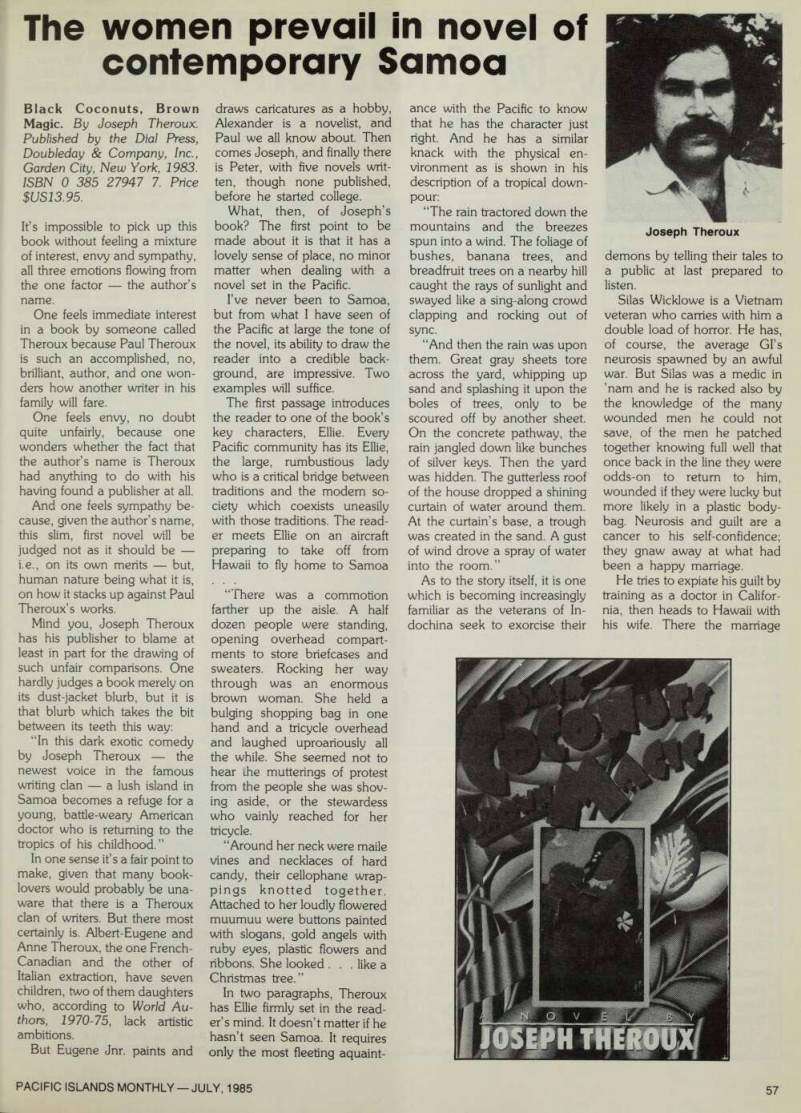
Joseph Theroux
fails totally and he goes home to Samoa drawn by another, deeper, and darker phantom.
This is the murder, brutal and grotesque, of his mother by his father.
It would be unfair to author and reader alike to tell more of the story except to say that by the end of the book Silas Wicklowe is well down the track to regaining full membership of the human race.
The curious thing about it all is that Silas never became, on first reading, a fully-fleshed character; there was something one-dimensional about him, a fact that had me tricked until I read the book a second time. I realised then that the problem was relative.
It’s not so much that Silas lacks definition but that he is overwhelmed by the women of the story, Ellie in particular, but by all of the women as a group.
There is Vai whose convo luted pidgin stops a whisker short of parody, the comely Roketi whose experience proves to Silas that not all medicine can be found in text books, and the troubled, pa tient Betty who stands by Silas, her husband, until both come to reasonable acceptance that what once they had no longer exists.
Finally, there is Angela, a richly-drawn islands character whose lusty liveliness attracted this reader quite as much as it did Silas.
I warrant most readers will turn the last page of the book wishing it were just a little longer, wondering what its characters might have gone on to do, musing on what Joseph Theroux might produce next.
Can any author ask better than that? lan Hicks.