overview of Fiji’s history
pp. 55-56 · Read in the full issue

books
Varied studies add up to fine overview of Fiji’s history
The Fijian People. Before and After Independence, 1959- 1977. By Isireli Lasaqa. Pub lished 1984 by Australian Na tional University Press. Pp. xvi, 231,158 N 0 7081 0416 9. $A12.95.
The Political Economy of Fiji.
By Jay Narayan. Published 1984 by South Pacific Review Press, PO Box 2359, Govern ment Buildings, Suva, Fiji, Pp. xxi, 144, no ISBN indicated.
Available through Pacific Publications in Australia.
Fiji. A Short History- By De ryck Scan. Published 1984 by George Allen & Unwin, Austra lia, Pp. xvi, 202, ISBN 0 86861 (cloth), ISBN 0 86861 319 3 (pbk.). $A 22.95 (cloth), $9.95 (paper bound).
Three volumes on the history of Fiji published at about the same time, but very different in their emphasis and content. The three volumes, moreover, are from representatives of the three principal groups that have shaped the island country’s past and who dominate its present the Fijians, the Indians, and the Europeans.
Lasaqa, whose ancestors ar rived thousands of years ago, presents us with a book which the outsider may find hard to follow, for it is written for those who know Fiji well or who hope to do so by actually living there.
The author, a geographer by training (at the Australian Na tional University), has been a government official for many years. The style is that of an experienced bureaucrat giving advice to his juniors. The book is directed, in the main, to his fellow Fijians, cajoling them to work harder, or scolding them for their lack of entrepreneurial skill. He admonishes youth for not listening to their parents,
but, a page later, decries in attentive parents who do not raise their offspring properly.
The book describes his com patriots and their way of life, but it also prescribes what the author believes are necessary changes for his people to prog ress. Land tenure (and deve lopment), education, politics, the economy in general, all come up in the course of his survey.
And he has his own ideas on
all of these topics, from the units of government that he thinks are most appropriate to details of their administration.
The title of the book echoes the 1959 (and very influential) report by Australian National University geographer and senior Pacific historian Oskar Spate. Both books share the characteristic of being long on opinion but, it seems to me, rather short on data to support some of those opinions.
As the foreword to the book is written by the Fiji Prime Minister, Ratu Sir Kamisese Mara, one must assume that if Lasaqa’s book is not a manifes to for the ruling Alliance Party, at least it is not antagonistic to that organisation’s political and philosophical aims.
The only unanswered ques tion about the book that I would have is why it ends its story in 1977, and took another seven years to reach publication.
Lasaqa’s audience for The Fijian People will be , of course, his own people who will be interested in knowing what a senior member of their govern ment thinks. In that sense, it is a very personal volume. It is quite clear, at those places where he mentions them at all, that the messages for other inhabitants of Fiji (he calls them “other races”) are mainly warnings that his own people must be allowed to develop.
Non-Fiji citizens who either come to work or to do business in Fiji will find Lasaqa’s views of interest for the same reason.
The pacing of the paragraphs, the tone of authority, make the book read as though the author was giving a leisurely seminar; a catalogue of his personal views on contemporary Fiji.
The final group that will be interested in the book are yet to be bom, for it is to history that such a work must be destined.
Outsiders, as well those living in the Fiji of the future, will find Lasaqa’s comments a rare in sight into how those currently in charge wanted their country to go- By contrast, Deryck Scarr’s Fiji is intended for those in terested in Fiji today and the history that produced it. The modest title belies the consider able erudition sandwiched in between its colorful covers.
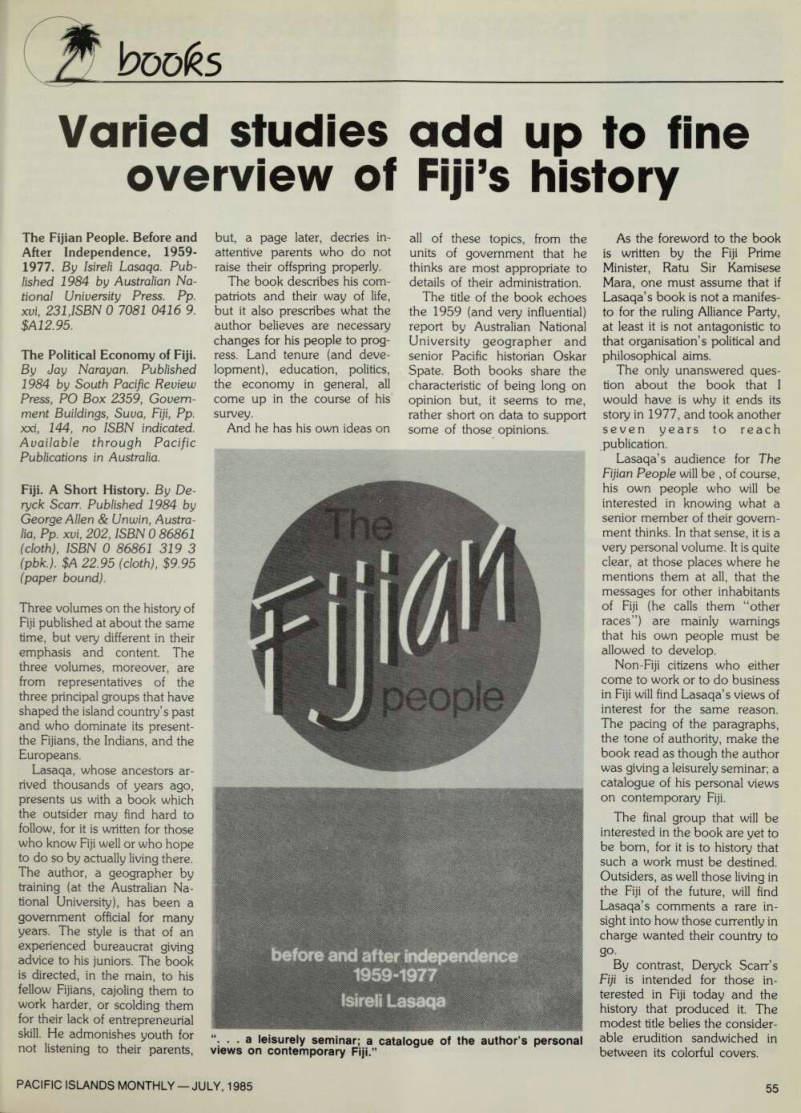
“... a leisurely seminar; a catalogue of the author’s personal views on contemporary Fiji.”
With a kind of literary zoom lens, Scarr moves easily from colonial macro, to close up personal diaries.
People in Fiji, of whatever background, will be looking up their ancestors’ names in the index, discovering the scandals of the past, as well as the frank observations that the people of those days made of one an other.
Four mega-chapters, each with several subdivisions, are easily laid out; the style is a delight to read, in marked con trast to some of Scarr’s past volumes.
The book is produced for a popular market, but that does not mean that it is shallow.
References, for those in terested, are discreetly at the
rear of the work; there is a helpful glossary and pronuncia tion guide, and a short bib liography. The work, though, is written largely from primary sources, making this more than a summary.
It is, in fact, a substantial contribution to the history of Fiji itself, as well as being a first rate introduction for people with a general interest in the topic.
As Lasaqa had a Prime Minister do his forword, Scarr has Minister for Education and Youth, Dr. Ahmed Ali, write his.
It is rare that one comes across a book on the Pacific that is both scholarly and well written; even more rarely are such works both substantial contributions to the literature, as well as being accessible to the lay reader.
The Scarr book is suitable not only for the Pacific scholar, but also the casual traveller.
The clarity of the expression suggests that it could be also a suitable upper secondary school text.
While Lasaqa’s text is a high ly personal statement, Scarr is almost excluded as a personal
ity in the text. It is evident, though, that he loves Fiji and revels in the details of that place’s history, to which he has made such a substantial con tribution.
There are no government officials associated with Jay Narayan’s The Political Eco nomy of Fiji and one would be surprised had there been. If sociology has been long in coming to academia in general, it has been even more distant in the Pacific.
Sociologists don’t mind studying the poor; it is their bread and butter, along with various classes of deviants.
But, sociologists have been very reluctant to leave their cities and civilised comforts. It has been to the anthropologist that studies in the Third World have fallen.
Narayan is a sociologist, trained in Britain and Canada; he is also an Indo-Fijian, son of a migrant worker, brought to Fiji at an earlier time, when people’s work contracts, rather than their bodies, were bought and sold.
It probably had to be a Fiji Indian who would become the country’s first sociologist. Just as Fiji’s first anthropologist, the late Sydney University-trained R.R. Nayacakalou, had char acteristically written on leader ship, so Narayan turns his analytical attention to a political and economic history of his country.
For it is in the arena of politics and in the sphere of the eco nomy that most Indo-Fijians find themselves located, for bet ter or for worse.
The stereotypic Indian in Fiji is the duty-free shop owner; he is the one that the tourist sees and remembers. Visitors to Fiji rarely see the poor Indian cane farmer and his family; they do not know that emigration by Indians, to North America, and also Australia, is several times that of Fijians.
The Indian in Fiji is excluded from the national definition, as is clear in the Lasaqa and Scarr volumes. After over a century, the Indian in Fiji is seen as the guest, with the Fijians as the host.
It is no wonder, then, that the first proper sociological study of Fiji, looks at the economic and political history of the place,
trying to comprehend the why behind the taken for granted facade of calm life in Fiji.
The focus of the Narayan essay is on Fiji as a political and economic colony of larger forces. The author is avowedly Marxist in his orientation, which produces the occasional syntac tic difficulty for those not famil iar with the concepts, and rather technical terminology he chooses to employ. Political economy is not for the popular market, though the reader in terested in a very different view of history will be rewarded by having a view of Fiji that has not been given to us before. It is sensitive to social (Narayan should add also cultural) in equality; to uneven distribution of resources; to the logic of a system which pits both Fijian and Indian one against the other.
We are quite used to associating race, even ethnicity, with Fiji; with Narayan we now have the beginnings of an analysis of the class structure there.
The author is openly pes simistic and feels that his coun try will continue to be under the thumb of external interests; to operate with imported systems that constrain rather than help people to live productive lives.
If one were to contrive an association for these three books, Scarr’s is downtown Suva, a bustling exotic society, while Lasaqa’s is the quiet of the Fijian village, of muffled, respectful voices.
Narayan’s is the slums, which few outsiders see.
You can tell these books by their covers: Fiji sports a museum watercolour of traditional life, while Fijian People is a sober diagram of an orange sun in a blue sky, over a deep aqua sea.
Narayan’s is bright red, with a blue inset map of the Fiji islands, encircled in chains.
As a final note, it is perhaps worthwhile pointing out that given the usual price of books on the Pacific, these three are remarkably good value. As a trio (with Narayan making it a troika?) of tomes on a similar subject, they make a good set and provide the reader with a comprehensive view of those familiar islands. Grant McCall.