for “Sepik Diary”
p. 58 · Read in the full issue
A second incarnation for “Sepik Diary”
Stuart Inder, reviewing the ori ginal edition of Frank Hodgkin son’s Sepik Diary in the Octo ber, 1983, issue of PIM, wrote: “It’s no coffee-table book — although it will sit there prettily — it’s a book which adds to our knowledge, with many unex pected insights.”
The new version has re ceived the plaudits of many respected reviewers from many parts of the world. Bishop Sir David Hand said: “Reid Books have not allowed any con siderations to compromise pro duction standards. Here is a thing of beauty that should be valued according to its intrinsic merits. Frank Hodgkinson’s deep interest in, understanding of and affection for my country are clearly writ on every page. ”
William Graves, senior editor of National Geographic wrote of the book, “an extraordinary chronicle in words and watercolors, sketches and im ages of the great river, its people and their cultures.”
On April 18 the new edition of Sepik Diary was launched in Sydney at the Australian Museum under the auspices of Sir Alkan Tololo, Papua New Guinea High Commissioner in Australia. Sir Alkan, while ack nowledging his Tolai connec tion, stated that for friends who know Papua New Guinea, and who have worked in New Guinea, Sepik Diary “colorfully reflects the culture and life-style of the peoples of the mighty Sepik River.” He went on to say that the book enables the reader to experience the life styles of the peoples along the river, and that, there is “no need for a camera to capture a job well done.” Sir Alkan also made mention of the museum which it is proposed to establish as a living account of the cultures of the Sepik area.
Dr James Specht, divisional head of anthropology, Austra lian Museum, elaborated on various points made by Sir Alkan. He emphasised that the 1000 spoken languages of Papua New Guinea repre sented about a fifth of all the spoken languages of the world,
and that typically the language groups of the Sepik have pro duced a variety of life-styles forming segments of a cultural continuum from the lower reaches of the river to its moun tainous beginnings. Dr Specht also emphasised that, despite the impact of white colonisa tion, the Sepik peoples have maintained their life-styles and that there is “a retention of traditional forms, and not a stepping-back in time.” He went on to illustrate that the environment of the Sepik, with its “mud, water and mos quitoes” had served as the force behind the cultural diffu sion. There has been a minimal level of archaeological work in the area, but it is obvious that the area has produced the “most creative and richest cultural forms in Papua New Guinea.”
James Specht also took up the theme of the importance of the proposed museum at Angoram. He referred to the earlier attempt to establish a museum at Wewak and stated that it failed as it had incorpo rated “no sense of belonging, of being part of a living culture.”
“The museum must comment not on the past, but on the future and possibly the pre sent,” he said. Those present
were informed of the PNG Government’s efforts in protec ting and preserving the cultural inheritance, such as the work of the river patrol on the Sepik, and the inclusion of a House Tambaram on the world herit age listing.
Dr Specht concluded by arguing that many people speak of artifacts from areas such as the Sepik as being “primitive art,” principally be cause they are unaware of the identity of the creators of the works. He sees the Sepik as having limited potential in terms of economic development, and, turning back to the thesis of Sepik Diary, said that much of the future development of the region will be in the “hands and manual skills of the people.”
Sepik Diary has undergone a production transformation since its first appearance in 1983. Its Hong Kong printers have done Reid Books proud. The quality of paper, the reproduction of the text, and the translucent quality given to the artwork, have now made it a work which meets the highest demands of book production techniques. In its earlier version the book was bound in crash canvas and there was a leather-bound limited edition of 100 copies, with a full print run of 1500 copies. Now the publishers have announced that 150 copies of the collector’s edition at $495 and 1000 copies of the deluxe edition at $75 make up the “Australian allocation.”
Bill Coppell
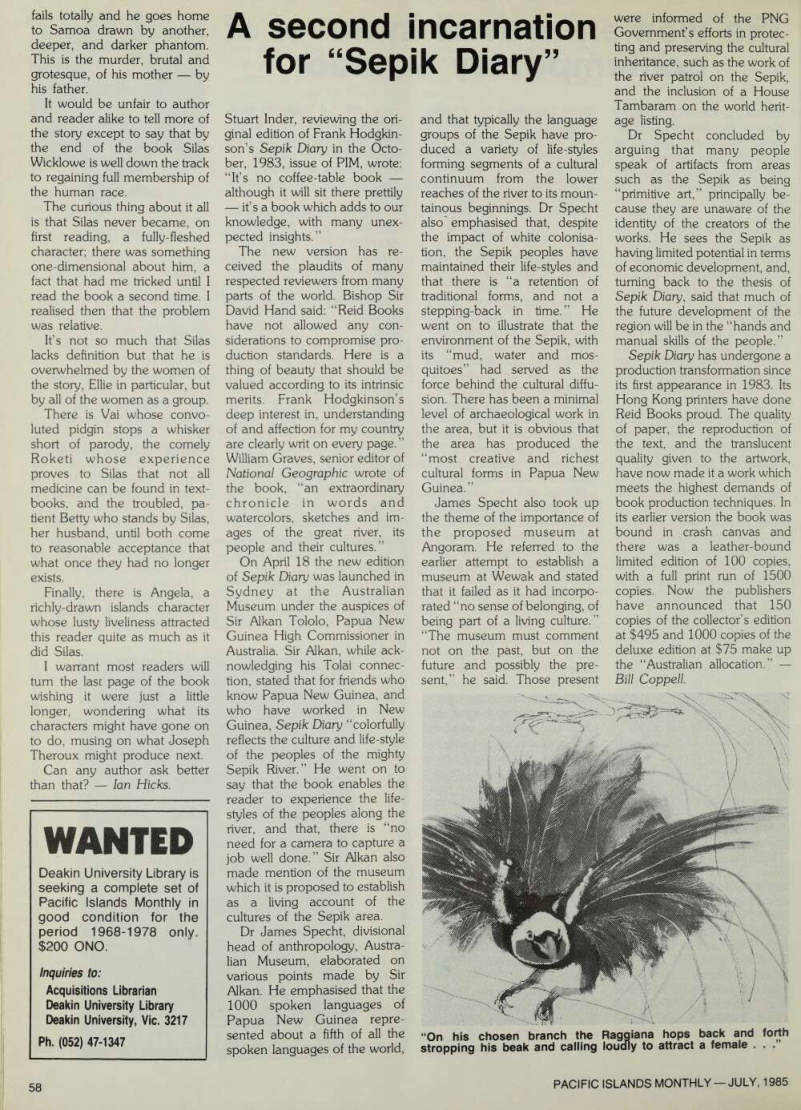
“On his chosen branch the Raggiana hops back and forth stropping his beak and calling loudly to attract a female . . ."