Coffee everywhere
p. 50 · Read in the full issue
at $3.50 a cup
By any standards Tokyo is a riveting city. Packed with more than 12 mil lion people, humming with life, full of color and bustle, it yet retains much of the classical serenity of Japanese culture. Amidst the rush and noise there is a multitude of corners where people may pause at a shrine, sit in a garden to study the flight of a dragonfly in the sun, or idly row a dinghy on a castle moat, and contem plate a life less pressured than that of a Tokyo ’’salaryman” committed for life to the service of a great corporation. Japan ese companies demand more of their people, benefit from a degree of commitment prob ably unparallelled by workers in any other country, but also offer more protection.
Take the train to Harajuku on a Sunday morning and walk down the narrow streets full of coffee shops and boutiques catering to the thousands of young men and women who live in the district and work in the towering offices which make up Tokyo’s central busi ness district. The area is very deeply influenced by the west, and yet, on the brink of the 21st Century, it is not so much western as universal, internatio nal, materialist, and the kind of thing people everywhere find exciting. Harajuku is full of tea houses, sushi bars, Chinese restaurants, coffee galleries, sandwich shops, noodle places, tempura and yakatori spots, and, of course, McDonald’s universal hamburgers. Only McDonald’s refuses to follow the otherwise universal habit of putting plastic replicas of the food sold into streetside show cases. Even in Tokyo everyone knows what a McDonald’s hamburger looks like.
Yet, only a few hundred yards from Harajuku is the Meiji shrine, not an ancient monu
ment, but of great significance in modem Japan because it was the Emperor Meiji (1868-1912) who launched his country to wards its present place as a great world industrial and tech nological power. It is fitting, therefore, that the shrine to him, and his Empress, is a place of broad peaceful acres, of quiet tree-lined pathways, lakes and, most luxurious of all in the heart of crowded Tokyo, space to run, or just to view.
Japan is a fascinating mixture of the old and the obsessively new; the two sides are integral to the modem Japanese way of life which is, now, not too subtly changing the people. Kanji characters are, of course, the main means of written com munication, but the language is now liberally sprinkled with English...and the hybrid thing called ’’Japlish.”
The enormously efficient Japanese media industry (Tokyo’s Dentsu, now wedded to a major American group, is the world’s biggest advertising agency, and the Yomiuri Shim bun the world’s biggest daily newspaper), uses English seemingly as often as Japanese, sometimes with startling results.
One of the more popular soft drinks in town rejoices in the name ’’Sweat. ” It doesn’t mean in Japanese what it means in English. And there are plenty of other examples of English words used for their shape, or their sound.
The department store is also a highly developed, and totally absorbing, Japanese phe nomenon. A tour through their food halls, any one of which would rival Harrods of London, is like a gourmet’s magic carpet flight around the world. In stores like Tokyu, and Takashi maya at Nihonbashi, or Matsu zakaya, Mitsukoshi, Hankyu and the others crowding the rich Ginza district, or in the
multitude of specialty shops, the range is amazing. But, take your cheque book.
For 4000 yen (about Auss2s), you may buy IOOg of the finest quality, richly marbled Kobe beef, which looks to be about 50 per cent fat. Tastes are changing and young people, conscious of their fi gures, their health and their wallets, are turning away from such traditional delicacies.
There is a trend towards health foods of the western style and a trend in Japan looks like an avalanche anywhere else.
The Ginza even boasts a chain of hot bread shops selling everything from hamburger rolls to pumpernickel rye.
Not every meat is as pricey as Kobe beef.. good quality chick en sells in these top-line shops for about Aus7s cents for IOOg, and minced beef for just under Aussl per IOOg. Grilling steak, may be had for Auss6.2s per 100 g.
Coffee shops are everywhere some of them not much bigger than a large telephone booth selling excellent filter coffee at 400 to 600 yen (Auss2.so to $3.75 a smallish cup) and all manner of ex quisitely decorated and cut
sweet French-style cakes.
Croissants are very much in, just as they are in Sydney, London, and the better parts of New York.
During our visit to Tokyo the great trade crisis developed be tween Japan and the United States which is, currently, in deficit to Japan to the tune of about $4O billion. Japanese prime minister, Yasuhiro Naka sone, went on television to ask his people to ’’Buy More Fore ign Goods” (it was a statement very much in capitals, such was the order of the upset). Naka sone himself journeys to Takashimaya to spend 80,000 yen on foreign goods. Unfortu nately they were all European, which gave spice to the quiet Japanese public retort that fore igners did not offer them much of interest. But, such is the strength of the Japanese or ganisation, that within a day of the Nakasone speech every subway carriage, and many bill boards, sported posters carrying his exhortation.
The Japanese do buy foreign goods; they buy according to price and taste, but many fore ign suppliers, and the Amer icans in particular, have not yet bothered to research the mar ket sufficiently. In many cases it is not price, but quality, or the lack of it, which turns a Japan ese consumer back to his own country’s goods. Thus the top line European designers jewellers, dressmakers, shoemakers and tailors seem to do well in their rich, elegant Ginza salons.
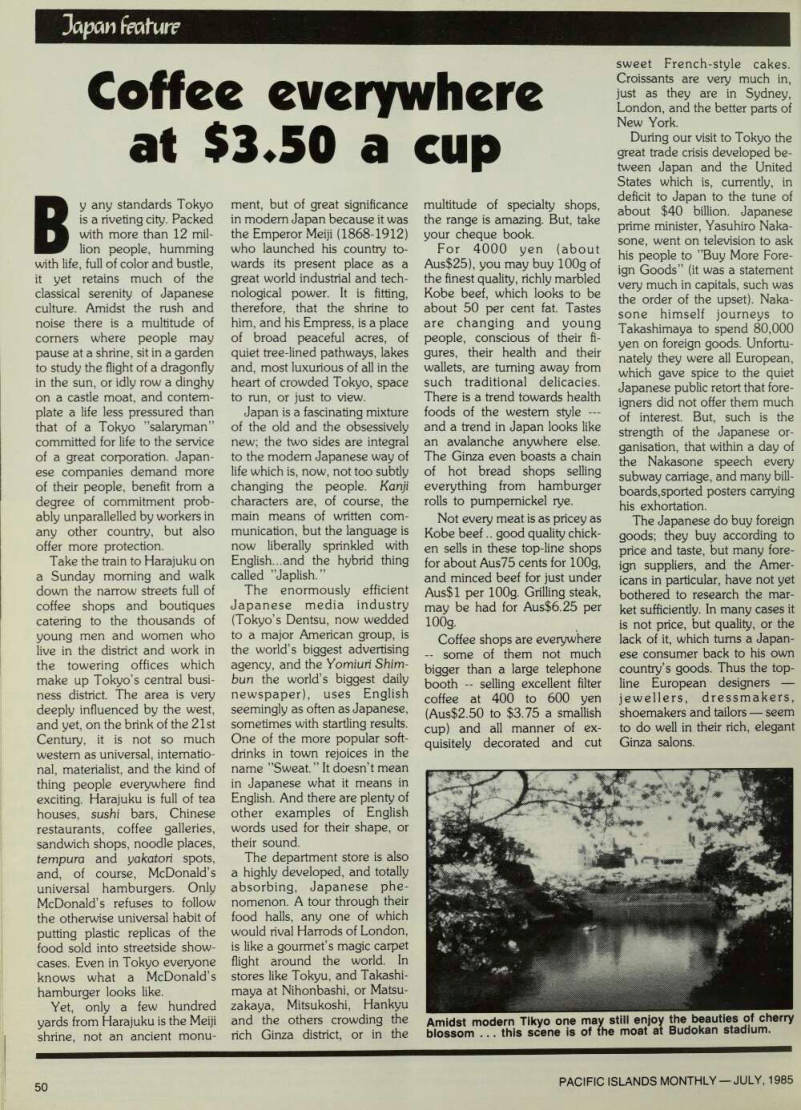
Amidst modern Tikyo one may still enjoy the beauties of cherry blossom ... this scene is of the moat at Budokan stadium.