wizard of Japan
p. 49 · Read in the full issue
Electronics: Giant wizard of Japan
A special affinity seems to exist between Japanese people and electronics.
They are masters of the miniature, wizards of a world of flashing lights, whirring robots, little clocks that speak the time, and computers controlling everything from the running of the railways to the time they cook a hamburger or a pot of rice.
The names in this industry are familiar in even the most remote comers of the world and in some places have be come generic terms for pro ducts in just the way the inven tions of Messrs Hoover, Biro and Macintosh were in an ear lier world just delicately poin ting a toe at the great tech nological ocean on which we now float.
The bigger names like Hitachi, Sony, Matsushita, (usually seen in the Pacific as National Panasonic and Tech nics), Sharp and Sanyo, have carried much of the Japanese popular technological miracle into ordinary households almost everywhere in the world.
Smaller firms,like Aiwa, Akai, Clarion, Kenwood, Nakamichi, Pioneer, and a host of others, have all carved out their niches in an industry where success seems to come from knowing more and more about less and less.
Matsushita is a giant in the hi-fi, radio, and consumer household goods areas. In the Pacific their products have taken the lion’s share of what were once almost exclusively the markets of European and American brands.
Hitachi is massive, a com pany involved in consumer goods and in the furthest reaches of some of the most esoteric engineering and elec tronic science known to man. It
is also a rather more conserva tive company than some of its competitors and has had enor mous success with a range of products which cover just about every conceivable way of using electrical and electronic know ledge. ”Our products may not look quite as pretty as those of some of our competitors,” said Ichiro Kawamoto, executive vice president of the Hitachi Sales Corporation, ’’but we make sure they always work very well. We think that is most important.” (There they were again, those two words the Japanese have made their own: quality and reliability).
Hitachi was very early into the Pacific market, establishing offices in Melbourne, and then spreading to all the other state capitals. They were slightly different in their method of opening up this new area in that rather than send a senior Japanese executive to head the venture, they hired an Austra lian, Ken Caldicott. Satoshi (Tommy) Matsuda, who was the senior Japanese in Mel bourne, remembers him warm ly, as a friend, a ’’rather rough diamond, I think, who called a spade a bloody shovel,” and an exceptional leader. ”It was a very good partner ship for us. He got the message across to the local people with whom we worked and to the distributors, and we went from strength to strength.”
Hitachi’s Australian venture,a major part of its growing Pacific involvement, took over from an earlier distributorship arrange ment with AWA. In 10 years it has increased its capital from Auss2oo,ooo to $1.5 million without a single extra dollar being put in from Tokyo.
They have operated in a very conservative way wherever they have gone, preferring to
make progress steadily, without price-cutting among their dealers, depending upon the quality of their product, and the excellence of their back-up services, which they handle themselves, to spread the word. ”We like to become a part of the local community wherever we go,” said Mr Kawamoto.
Marketing is, of course, only part of any company’s activity.
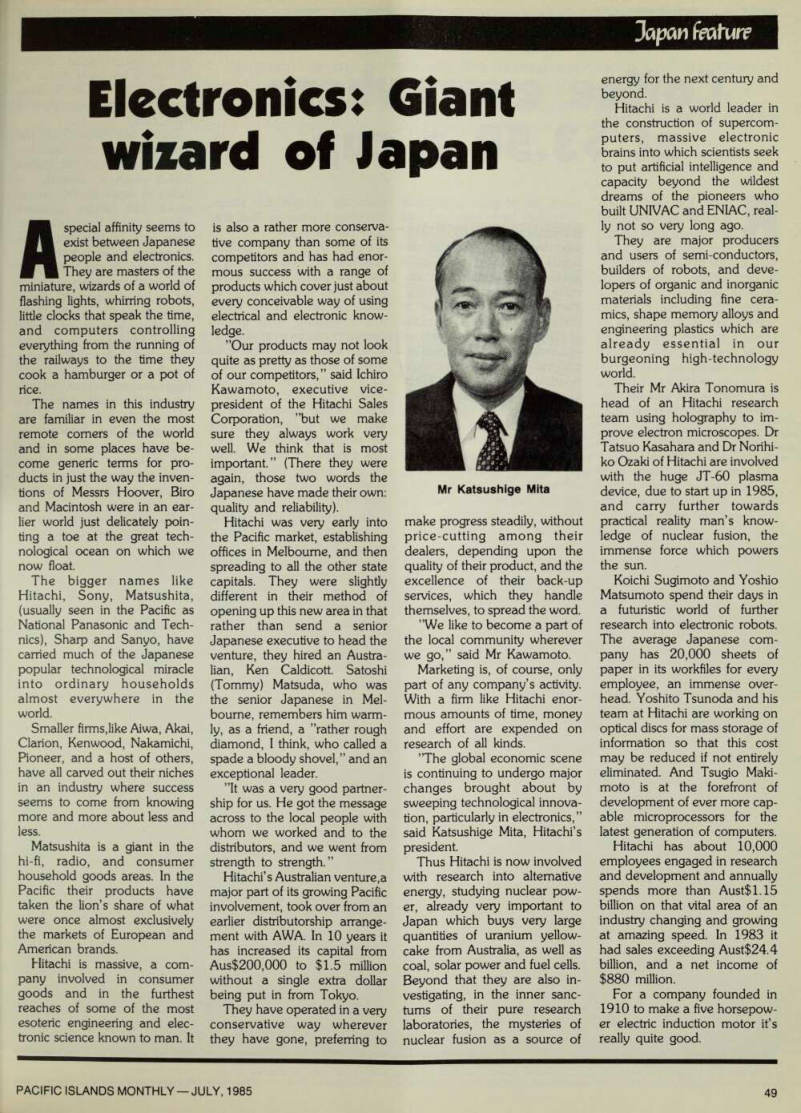
With a firm like Hitachi enor mous amounts of time, money and effort are expended on research of all kinds. ’The global economic scene is continuing to undergo major changes brought about by sweeping technological innova tion, particularly in electronics,” said Katsushige Mita, Hitachi’s president.
Thus Hitachi is now involved with research into alternative energy, studying nuclear pow er, already very important to Japan which buys very large quantities of uranium yellow cake from Australia, as well as coal, solar power and fuel cells.
Beyond that they are also in vestigating, in the inner sanc tums of their pure research laboratories, the mysteries of nuclear fusion as a source of
energy for the next century and beyond.
Hitachi is a world leader in the construction of supercom puters, massive electronic brains into which scientists seek to put artificial intelligence and capacity beyond the wildest dreams of the pioneers who built UNIVAC and ENIAC, real ly not so very long ago.
They are major producers and users of semi-conductors, builders of robots, and deve lopers of organic and inorganic materials including fine cera mics, shape memory alloys and engineering plastics which are already essential in our burgeoning high-technology world.
Their Mr Akira Tonomura is head of an Hitachi research team using holography to im prove electron microscopes. Dr Tatsuo Kasahara and Dr Norihi ko Ozaki of Hitachi are involved with the huge JT-60 plasma device, due to start up in 1985, and carry further towards practical reality man’s know ledge of nuclear fusion, the immense force which powers the sun.
Koichi Sugimoto and Yoshio Matsumoto spend their days in a futuristic world of further research into electronic robots.
The average Japanese com pany has 20,000 sheets of paper in its workfiles for every employee, an immense over head. Yoshito Tsunoda and his team at Hitachi are working on optical discs for mass storage of information so that this cost may be reduced if not entirely eliminated. And Tsugio Maki moto is at the forefront of development of ever more cap able microprocessors for the latest generation of computers.
Hitachi has about 10,000 employees engaged in research and development and annually spends more than Austsl.ls billion on that vital area of an industry changing and growing at amazing speed. In 1983 it had sales exceeding Austs24.4 billion, and a net income of $BBO million.
For a company founded in 1910 to make a five horsepow er electric induction motor it’s really quite good.
Mr Katsushige Mita