Tokyo market
p. 47 · Read in the full issue
Pacific fish bis at Tokyo market
At 4.30 a.m. even Tokyo, with its teeming 12 mil lion people, is relatively quiet, its streets dark and almost deserted - except under the sprawling, wood and metal awnings of the Tokyo Central Fish Market in the river side city district of Tsukiji.
There, as the freezer trucks come honking through the gloom, while headbanded por ters clatter about with their handcarts, trundling frozen tuna carcases, and the expert buyers lean over the fish digging at the meat with their tasting knives, all is feverish activity.
The serrried ranks of tuna lie on the shining wet cement like bombs waiting for World War II raiders. Vapor rises from them to form an eerie mist under the canopies, through which the figures of men move, ghostlike, tending their dead, but costly, charges.
All is relatively quiet as the buyers move around until, pre cisely at 5 a.m. (Japanese are more punctual, even, than the Dutch), the auctions start. Only experts can follow the lightning bids. A system of finger signals, indicating price is used together with a rapid-fire patois few but the market people understand.
The range of fish is incredi ble. There are huge black tuna from the cold southern oceans south of Australia, weighing 400 kg or more, worth Auss9 or $lO a kilo at wholesale, and much-favored by sushi eaters who like its marbling of fat.
There are strange,red bulge eyed fish taken from the deep trenches of the Pacific, silver sardines, speckled trout, mack erel, bream, snapper, lobsters, prawns, shrimp, tiny white fish which lie in buckets in their thousands and look for all the world like pale spaghetti. There
is smoked fish, raw fish, fried fish and dried fish, salt fish, fresh fish, live fish and dead fish, there is finned fish and shell fish and fish that doesn’t even look like fish. And it all goes into the giant process of feeding one of the largest and most crowded cities in the world.
Fish is a staple of Japanese diet. The three municipal fish markets in Tokyo, let alone the rest of Japan, handle more than 800.000 tonnes a year of fresh, frozen, ocean and river fish.
Tokyo’s Tsukiji is the monster of the trio, handling annually nearly 750,000 tonnes valued at Auss3.9 billion.
The market’s statistics are staggering. It covers an area of 225,215 sq metres and handles not only fish, but also meat, fruit and vegetables. Six days a week the produce comes pour ing through, attended by a daily tide of 70,000 people, of whom 17.000 are market workers and 53.000 are customers. A total
of 17,000 cars and trucks come in to park or unload.
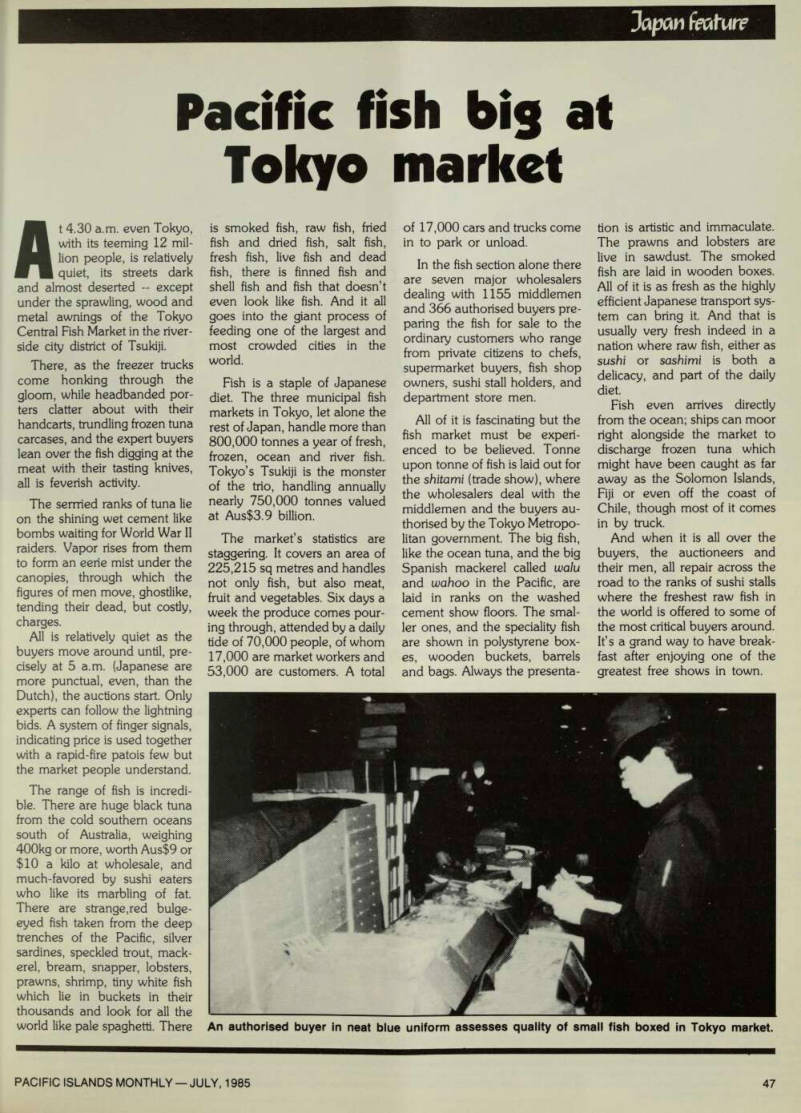
In the fish section alone there are seven major wholesalers dealing with 1155 middlemen and 366 authorised buyers pre paring the fish for sale to the ordinary customers who range from private citizens to chefs, supermarket buyers, fish shop owners, sushi stall holders, and department store men.
All of it is fascinating but the fish market must be experi enced to be believed. Tonne upon tonne of fish is laid out for the shitami (trade show), where the wholesalers deal with the middlemen and the buyers au thorised by the Tokyo Metropo litan government. The big fish, like the ocean tuna, and the big Spanish mackerel called walu and wahoo in the Pacific, are laid in ranks on the washed cement show floors. The smal ler ones, and the speciality fish are shown in polystyrene box es, wooden buckets, barrels and bags. Always the presenta
tion is artistic and immaculate.
The prawns and lobsters are live in sawdust. The smoked fish are laid in wooden boxes.
All of it is as fresh as the highly efficient Japanese transport sys tem can bring it. And that is usually very fresh indeed in a nation where raw fish, either as sushi or sashimi is both a delicacy, and part of the daily diet.
Fish even arrives directly from the ocean; ships can moor right alongside the market to discharge frozen tuna which might have been caught as far away as the Solomon Islands, Fiji or even off the coast of Chile, though most of it comes in by truck.
And when it is all over the buyers, the auctioneers and their men, all repair across the road to the ranks of sushi stalls where the freshest raw fish in the world is offered to some of the most critical buyers around.
It’s a grand way to have break fast after enjoying one of the greatest free shows in town.
An authorised buyer in neat blue uniform assesses quality of small fish boxed in Tokyo market.