go round
p. 53 · Read in the full issue
Trade makes the world go round
There are days, especial ly those spent among the vast international corporations based in Tokyo, when one sees the world as little bigger than an orange. Contact among businessmen and technicians is instant, immediate and compre hensive.
In the office automated machines hum away at the human bidding, churning out copies of complex documents or plans sent in across thousands of miles of cable in just a few seconds. Computers gossip away among them selves, heedless of time or distance - some of them could be on the moon, or in a spaceship circling Mars, for all the difference it might make in their manner of working. They whirr on, sorting, sifting, collat ing and ordering the informa tion which is now the warp and weft, the very sinews, of mod ern society.
Life seems now to be inex tricably enmeshed in a fascinat ing web of wires and silicon chips, of video display termi nals, multi-megabyte storage discs, the entire contents of the Encyclopaedia Britannica con tained in a chip the size of a grape, and technology so high the ordinary man cannot even see the soles of its feet.
And yet, in the midst of this, good old-fashioned trading still goes on, satisfying the basic need of the world to buy and sell.
These two aspects of life today come together in a huge, grey office building in Tokyo which is the headquarters of C.ltoh and Co, Ltd., one of the great sogo shosha, or trading houses, of Japan. The differ ence is that C.ltoh is now one of the greatest trading houses in the world.
It has a capital of US$lBO million. In 1984 its transactions
totalled U 5560,105 billion, for a gross trading profit of US$l.2 billion and a net income of US$2l million. It has 10,000 employees, 36 main offices or branches in Japan, and locally incorporated subsidiaries, bran ches or representative offices in 144 cities in 87 countries.
The corporation trades in virtually everything from nee dles to space stations - from water desalination plants in Libya, oil refineries in Malaysia, power generators in Queens land, and plastics plants in China to about 70 per cent of the entire Australian wool clip.
Its name is to be found on computer-aided design and manufacturing systems, on computer equipment like high speed printers, in chemicals, genetics, energy, sugar refining, farming, medicine, food proces sing, steel, textiles and, in fact, anything which can be bought, sold, swapped, bartered, or built.
And all of this began in 1858, in Tokyo, with a relatively mod est textile wholesaling company called Itoh Chu.
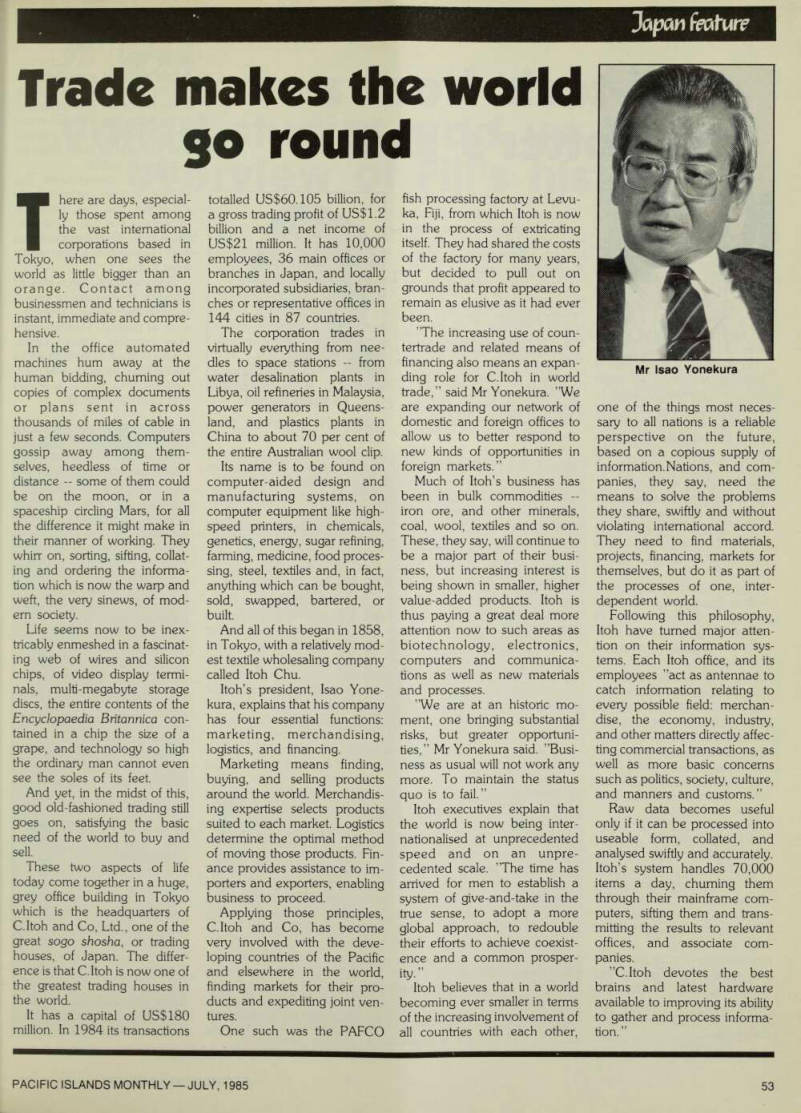
Itoh’s president, Isao Yone kura, explains that his company has four essential functions: marketing, merchandising, logistics, and financing.
Marketing means finding, buying, and selling products around the world. Merchandis ing expertise selects products suited to each market. Logistics determine the optimal method of moving those products. Fin ance provides assistance to im porters and exporters, enabling business to proceed.
Applying those principles, C.ltoh and Co, has become very involved with the deve loping countries of the Pacific and elsewhere in the world, finding markets for their pro ducts and expediting joint ven tures.
One such was the PAFCO
fish processing factory at Levu ka, Fiji, from which Itoh is now in the process of extricating itself. They had shared the costs of the factory for many years, but decided to pull out on grounds that profit appeared to remain as elusive as it had ever been. ’’The increasing use of coun tertrade and related means of financing also means an expan ding role for C.ltoh in world trade,” said Mr Yonekura. ”We are expanding our network of domestic and foreign offices to allow us to better respond to new kinds of opportunities in foreign markets.”
Much of Itoh’s business has been in bulk commodities iron ore, and other minerals, coal, wool, textiles and so on.
These, they say, will continue to be a major part of their busi ness, but increasing interest is being shown in smaller, higher value-added products. Itoh is thus paying a great deal more attention now to such areas as biotechnology, electronics, computers and communica tions as well as new materials and processes. ”We are at an historic mo ment, one bringing substantial risks, but greater opportuni ties,” Mr Yonekura said. ’’Busi ness as usual will not work any more. To maintain the status quo is to fail.”
Itoh executives explain that the world is now being inter nationalised at unprecedented speed and on an unpre cedented scale. ’’The time has arrived for men to establish a system of give-and-take in the true sense, to adopt a more global approach, to redouble their efforts to achieve coexist ence and a common prosper • i_ n ity.
Itoh believes that in a world becoming ever smaller in terms of the increasing involvement of all countries with each other,
one of the things most neces sary to all nations is a reliable perspective on the future, based on a copious supply of information. Nations, and com panies, they say, need the means to solve the problems they share, swiftly and without violating international accord.
They need to find materials, projects, financing, markets for themselves, but do it as part of the processes of one, inter dependent world.
Following this philosophy, Itoh have turned major atten tion on their information sys tems. Each Itoh office, and its employees ’’act as antennae to catch information relating to every possible field; merchan dise, the economy, industry, and other matters directly affec ting commercial transactions, as well as more basic concerns such as politics, society, culture, and manners and customs.”
Raw data becomes useful only if it can be processed into useable form, collated, and analysed swiftly and accurately.
Itoh’s system handles 70,000 items a day, churning them through their mainframe com puters, sifting them and trans mitting the results to relevant offices, and associate com panies. ’’C.ltoh devotes the best brains and latest hardware available to improving its ability to gather and process informa tion.”
Mr Isao Yonekura