Motor industry drives
pp. 39-41 · Read in the full issue
on into future
Many industries have contributed to the Japanese economic miracle but two in particular have made Japan’s reputation for devotion to all round excellence: the electronic and the automotive. In the Pacific it is the names on the cars, buses and trucks, motor cycles and outboard motors which are best-known; really household names now: Toyota, Nissan, Mazda, Honda, Suzuki, Yamaha, Kawasaki, Isuzu, Hino, Subaru, Daihatsu, and Mitsubishi. Turn a comer on even the most isolated island road, and you see at least one of them. Go to a seaside market and see the outboards power ing canoes full of fish and produce, enabling outer island people to join the cash eco nomy. They have wrought a revolution for they have in creased the mobility of ordinary people many times over.
Toyota on its own is now the third-largest motor manufactur er in the world, producing more than 3,250,000 vehicles a year, of the national total of more than 11,100,000. Japanese ve hicles in general have sup planted many erstwhile famous names to the point where, in some countries, including most of the Pacific, and Australia and New Zealand, they have ceased to sell at all.
Japanese engineers have also changed the kind of vehicle in use, for their advances have been astonishing in such vital areas as fuel efficiency (of utmost importance in small eco nomies which must struggle to find sufficient hard currency to buy petroleum). According to figures compiled by the Japan Automobile Manufacturers’
Association, fuel efficiency of Japanese cars has risen from an average of 9km per litre of fuel
in 1975 to better than 13km per litre today. At the same time cars have become more luxu rious, more reliable and better equipped. Air-conditioning is now commonplace and stan dard on many models. They have become safer, through the use of more efficient disc brakes as standard, better construction methods and the fitting of seat belts. At the same time engines are becoming cleaner - Japan’s emission control standards are the most stringent in the world In the last 30 years the progress made has been spectacular. And yet research continues, perhaps even accelerates, for in the brain storming departments of all the manufacturers, engineers and scientists are working for a world at last coming to terms with the fact that petroleum is
far too valuable simply to burn.
Yet internal combustion en gines, burning alternative fuels, look like being with us for many years yet.
At the great Japanese Expo ’B5 at Tsukuba, about an hour from Tokyo by fast train, Japanese companies have combined to display some of their theories about the future.
Hitachi, for example, be lieves that cars will be self guiding, following cables buried in expressways according to the dictate of computers into which the drivers (or will they by then be simply passengers?) have punched their destinations. Bet ter still, these automatic cars will avoid accidents, for they will refuse to break the law or travel dangerously. And even if some one decides they prefer to do the driving themselves, the computer car will offer advice
on the most convenient route.
By then, of course, cars will be built by computer-directed robots; in fact the latest Japan ese factories are already highly automated and the trend is growing very rapidly.
Indeed, cars are already largely designed by computers which take into account not only the artistic innovations of the designers, but also informa tion from other computers about wind resistance, road stability, braking limits and so forth.
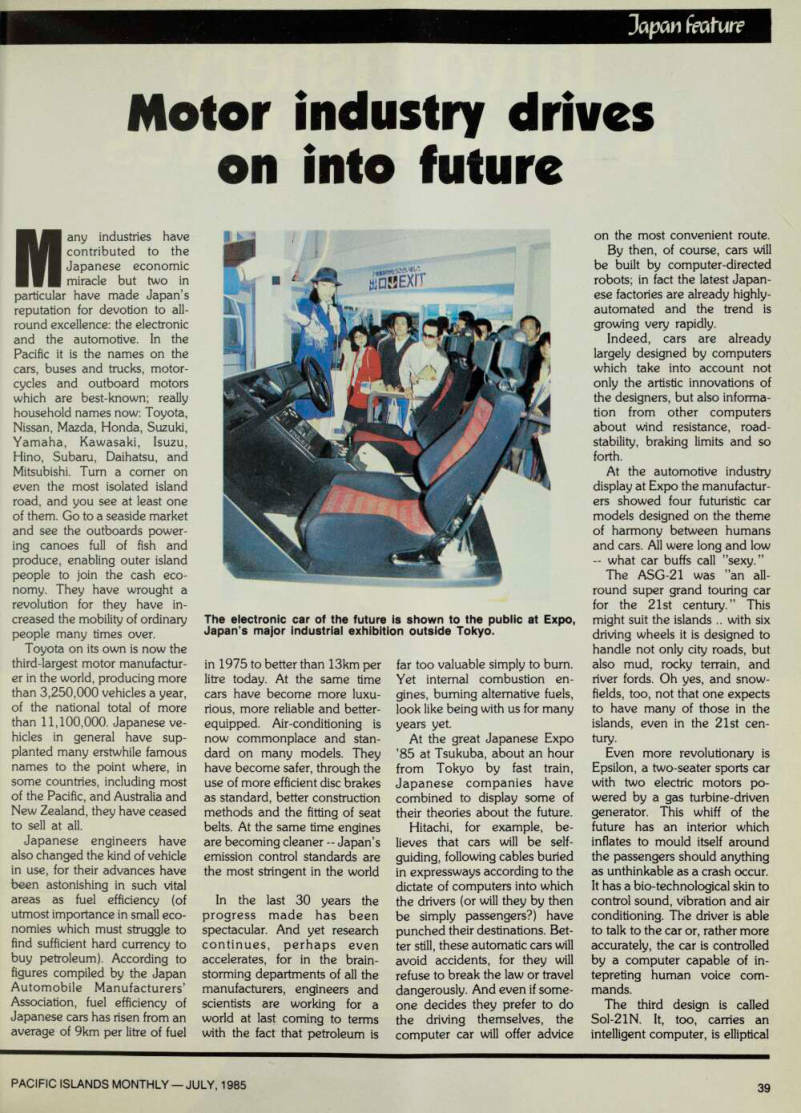
At the automotive industry display at Expo the manufactur ers showed four futuristic car models designed on the theme of harmony between humans and cars. All were long and low - what car buffs call ’’sexy.”
The ASG-21 was ”an all round super grand touring car for the 21st century.” This might suit the islands .. with six driving wheels it is designed to handle not only city roads, but also mud, rocky terrain, and river fords. Oh yes, and snow fields, too, not that one expects to have many of those in the islands, even in the 21st cen tury.
Even more revolutionary is Epsilon, a two-seater sports car with two electric motors po wered by a gas turbine-driven generator. This whiff of the future has an interior which inflates to mould itself around the passengers should anything as unthinkable as a crash occur.
It has a bio-technological skin to control sound, vibration and air conditioning. The driver is able to talk to the car or, rather more accurately, the car is controlled by a computer capable of in tepreting human voice com mands.
The third design is called Sol-2 IN. It, too, carries an intelligent computer, is elliptical
The electronic car of the future is shown to the public at Expo, Japan’s major industrial exhibition outside Tokyo.
in shape and has a replaceable cabin so that seating configura tion may be varied to suit a variety of tasks. Like Epsilon it has four-wheel drive and four wheel steering (which should at least make parking a breeze in the jam-packed cities of the future).
Finally there was Man-Bow, a sort of space-cycle for a single passenger, a design which, so the automotive futurists say ’’makes possible some intelli gent communication between driver and car like the re lationship between a rider and his horse. ” It is fish-shaped and has a solar-powered motor.
None of them will ever be built, of course. All are purely products of the fertile imagina tions of futurologist engineers and designers, and perhaps also a bit of the hyperbole of publicity men. Yet they show some of the directions in which the ever-innovative Japanese automotive industry is moving.
Meantime, as an industry, it rumbles powerfully ahead. The latest available figures say the automobile industry accounts for more than 10 per cent of the total production of all Japanese manufacturing, and is second only to the electrical industry (12 per cent of gross total) in importance. It employs, directly or indirectly, 5.5 million people, or more than 10 per cent of the entire Japanese work force and in fiscal 1983, the latest figures published by the industry, it made U 5532,213 billion dollars in export sales (21.9 per cent of total Japanese export revenue).
But if they exported a lot of vehicles, Japan also kept a lot.
Despite its small size it has 42 million motor vehicles on its roads, more than any other country except the U.S., and now has two cars for every three families.
Which perhaps explains a sort of economic conundrum: The revenue from all the ve hicles exported in 1983 amounted to 70 per cent of the value of Japan’s imports of crude oil in that year, which, in turn, was a whopping 40 per cent of all Japanese imports.
Just goes to show how impor tant the car has become.