"Mr Pacific" surveys his
pp. 35-38 · Read in the full issue


favorite ocean
Noboru Gotoh is one of the top ten major tycoons of Japanese trade and industry. At the age of 69 he still works 12 hours a day and heads the enormous Tokyu Corporation, a conglomerate of railways, supermarkets, depart ment stores, real estate com panies, engineering plants and hotels scattered across Japan, on the West Coast of the U.S.A. and around the Pacific.
He is also known as Japan’s “Mr Pacific,” for it was he who was the force behind creation of the Pacific Basin Economic Council and the Pacific Society of Japan.
P.B.E.C. is an information exchange among major businessmen all around the Pacific, but primarily America, Australia, New Zealand, and, of course, Japan. The Pacific So ciety is of more academic bent and provides a forum for study of all manner of Pacific in
terests, from education, history and culture, to the protection of the environment and the health of the people.
Mr Gotoh’s list of chairman ships and seats on boards of directors is considerable and ranges from the leadership of his own group of companies, through the presidency of what is, in effect, his corporation’s own university, to a seat as counsellor to the Bank of Japan, membership of the program consultation commit tee for the Japanese broadcas ting corporation, NHK, and presidency of both the Tokyo Chamber of Commerce and Industry and the national Japan Chamber of Commerce and Industry. He is a member of the Economic Council of Japan and chairman of the Postal Services Council.
He is also a confidant of the Japanese prime minister, Mr Yasuhiro Nakasone, who
attended the same school as Mr Gotoh, a matter of major note in Japanese society.
He is, in short, an immensely powerful figure in Japanese affairs, a multi-millionaire and a member of the inner councils of one of the major industrial nations on earth.
He is also very much in love with the Pacific. He, and his corporation, are deeply in volved with developments in the region, although his own view of the islands themselves tends to be perhaps a shade more rose-tinted and idealistic than some of the Pacific’s an xious seekers after progress would prefer. Yet he under stands very well their needs and aspirations and is to be counted one of the region’s best friends in high places.
I spoke with him, in Tokyo, at his large, but surprisingly sim ple, even spartan, presidential office at the Japan Chamber of
Commerce and Industry, through that organisation’s astonishingly fluent chief in terpreter.
“The vitality of the Pacific region is now attracting notice, but I am concerned that the trend at the moment is too much on industrialisation,” he said. “I worry that the beautiful natural environment of the Pacific will be damaged if this trend goes too far.”
Then what direction should the major Pacific nations, like Japan, take in helping the southern islands?
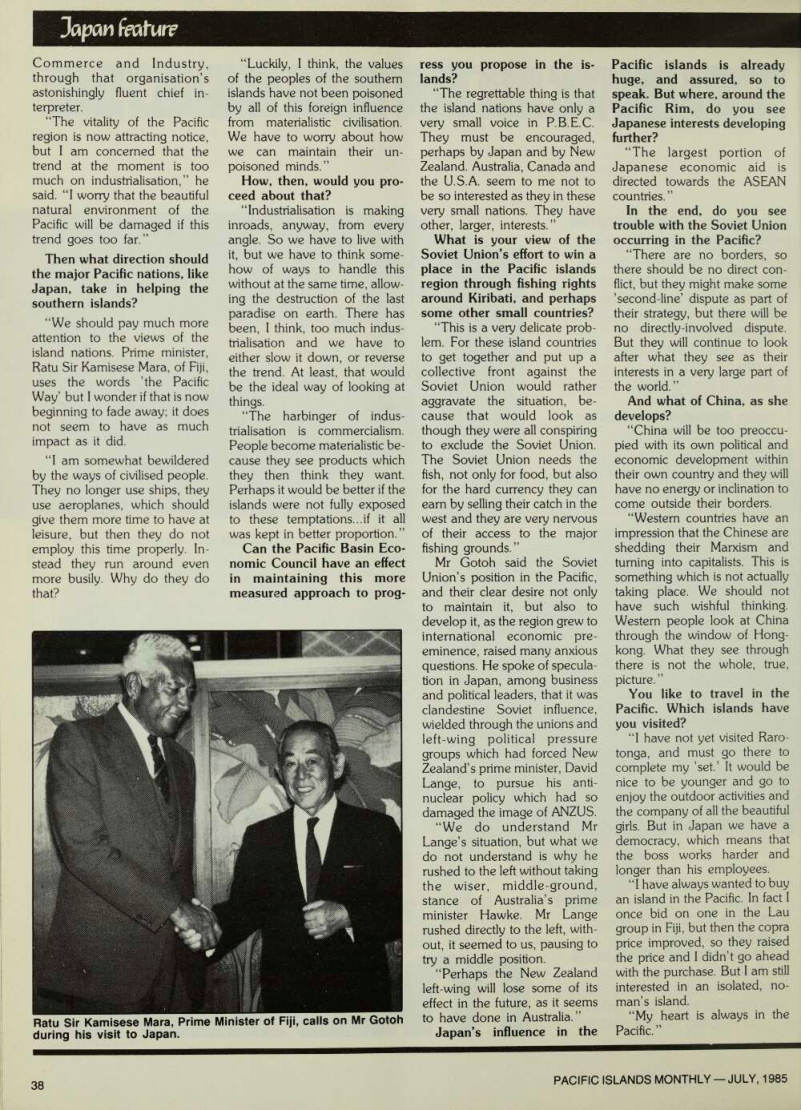
“We should pay much more attention to the views of the island nations. Prime minister, Ratu Sir Kamisese Mara, of Fiji, uses the words ’the Pacific Way’ but I wonder if that is now beginning to fade away; it does not seem to have as much impact as it did.
“I am somewhat bewildered by the ways of civilised people.
They no longer use ships, they use aeroplanes, which should give them more time to have at leisure, but then they do not employ this time properly. In stead they run around even more busily. Why do they do that?
“Luckily, I think, the values of the peoples of the southern islands have not been poisoned by all of this foreign influence from materialistic civilisation.
We have to worry about how we can maintain their un poisoned minds.”
How, then, would you pro ceed about that?
“Industrialisation is making inroads, anyway, from every angle. So we have to live with it, but we have to think some how of ways to handle this without at the same time, allow ing the destruction of the last paradise on earth. There has been, I think, too much indus trialisation and we have to either slow it down, or reverse the trend. At least, that would be the ideal way of looking at things.
“The harbinger of indus trialisation is commercialism.
People become materialistic be cause they see products which they then think they want.
Perhaps it would be better if the islands were not fully exposed to these temptations...if it all was kept in better proportion. ”
Can the Pacific Basin Eco nomic Council have an effect in maintaining this more measured approach to prog-
ress you propose in the is lands?
“The regrettable thing is that the island nations have only a very small voice in P.B.E.C.
They must be encouraged, perhaps by Japan and by New Zealand. Australia, Canada and the U.S.A. seem to me not to be so interested as they in these very small nations. They have other, larger, interests.”
What is your view of the Soviet Union’s effort to win a place in the Pacific islands region through fishing rights around Kiribati, and perhaps some other small countries?
“This is a very delicate prob lem. For these island countries to get together and put up a collective front against the Soviet Union would rather aggravate the situation, be cause that would look as though they were all conspiring to exclude the Soviet Union.
The Soviet Union needs the fish, not only for food, but also for the hard currency they can earn by selling their catch in the west and they are very nervous of their access to the major fishing grounds.”
Mr Gotoh said the Soviet Union’s position in the Pacific, and their clear desire not only to maintain it, but also to develop it, as the region grew to international economic pre eminence, raised many anxious questions. He spoke of specula tion in Japan, among business and political leaders, that it was clandestine Soviet influence, wielded through the unions and left-wing political pressure groups which had forced New Zealand’s prime minister, David Lange, to pursue his anti nuclear policy which had so damaged the image of ANZUS.
“We do understand Mr Lange’s situation, but what we do not understand is why he rushed to the left without taking the wiser, middle-ground, stance of Australia’s prime minister Hawke. Mr Lange rushed directly to the left, with out, it seemed to us, pausing to try a middle position.
“Perhaps the New Zealand left-wing will lose some of its effect in the future, as it seems to have done in Australia.”
Japan’s influence in the
Pacific islands is already huge, and assured, so to speak. But where, around the Pacific Rim, do you see Japanese interests developing further?
“The largest portion of Japanese economic aid is directed towards the ASEAN countries. ”
In the end, do you see trouble with the Soviet Union occurring in the Pacific?
“There are no borders, so there should be no direct con flict, but they might make some ’second-line’ dispute as part of their strategy, but there will be no directly-involved dispute.
But they will continue to look after what they see as their interests in a very large part of the world.”
And what of China, as she develops?
“China will be too preoccu pied with its own political and economic development within their own country and they will have no energy or inclination to come outside their borders.
“Western countries have an impression that the Chinese are shedding their Marxism and turning into capitalists. This is something which is not actually taking place. We should not have such wishful thinking.
Western people look at China through the window of Hong kong. What they see through there is not the whole, true, picture. ”
You like to travel in the Pacific. Which islands have you visited?
“I have not yet visited Raro tonga, and must go there to complete my ’set.’ It would be nice to be younger and go to enjoy the outdoor activities and the company of all the beautiful girls. But in Japan we have a democracy, which means that the boss works harder and longer than his employees.
“I have always wanted to buy an island in the Pacific. In fact I once bid on one in the Lau group in Fiji, but then the copra price improved, so they raised the price and I didn’t go ahead with the purchase. But I am still interested in an isolated, no man’s island.
“My heart is always in the Pacific. ”
Ratu Sir Kamisese Mara, Prime Minister of Fiji, calls on Mr Gotoh during his visit to Japan.