“last paradise"
pp. 33-35 · Read in the full issue
Japanese sigh for “last paradise"
Although foreigners of va rious kinds have intruded into the Pacific over many centuries, it was the iron-willed emissaries of Queen Victoria the missionar ies, the sailors and the mer chants who brought to the Islands the great processes of change still coursing through the region. They brought Christianity, parliamentary poli tics, communications, in ternational trade, and the be ginnings of consumerism, all of which altered, irrevocably, life in the remote and sunny is lands. They even changed the racial structure of some places.
The colonists have now all but gone and, apart from a few, the islands are now indepen dent. Yet outside influences continue to arrive, affecting all the island peoples to a greater or lesser extent. For it was change itself which was the major influence of the fore igners upon cultures which had been more or less static for centuries. And of all sources of such change, none is now more important than Japan.
The Japanese, however, have not come to the Pacific as colonists,and nor have they ar rived with buckets of brimstone and tales of fiery retribution for fleshly sins. Indeed, by com parison with the Europeans, and certainly with groups like Fiji’s Indians, New Caledonia’a French and Vietnamese, and, of course, the omnipresent small Chinese traders and shopkeepers, the Japanese are hardly in the islands at all.
But their influence is now to be found in every corner through their products, their trade, their ships and their aid and, of course, the fast-growing numbers of their tourists.
In the last 40 years the Japanese have wrought mira
cles of industrial productivity and technological efficiency in a land where the only true re source was, and remains, the people. Their hands and their brains, their energy, discipline, skill and dedication have made Japan a great modern power.
All over the world Japanese names have become household words and benchmarks of ex cellence. In the Pacific, which the Japanese have made their front yard, they have to a large degree swamped almost everyone else. The list of pro ducts they offer is seemingly endless - cars, refrigerators, motors, pumps, boats, ships, radios, televisions, recorders, computers, cameras, textiles, paper, printing, plastics, pens, sports goods, medical equip ment, tractors, food, calcula tors, watches, copiers, type
writers, telephones, earth satel lite stations, telescopes, toys...
But the foreigners, including the Japanese, have also brought their knowledge, and today a man whose father might have been a simple fisherman, and his great-grand father even a cannibal, may be found repairing a watch, servic ing a computer, or flying a jet aeroplane.
The Japanese very early on embraced the idea of the Pacific Basin and, through men like Noboru Gotoh, head of the vast Tokyu Corporation, with its rail ways, engineering plants, trad ing houses and tourist hotels, has set about building its strength and intra-regional cooperation.
But, most people in ad vanced countries, including most leaders of business and
opinion in Japan, see the Basin mostly as a rim. For them the Pacific is the West Coast of the U.S., China, the ASEAN coun tries, Australia, New Zealand and, still to be fully-embraced, Central and Latin America. The islands are there, but they are small and their resources are even smaller.
Almost every island nation has a large trade imbalance with Japan. Papua New Guinea, with its mineral wealth and huge timber resources, is better off than most. But even a bigger Pacific Island country like Fiji finds itself buying six or seven times more from Japan than anyone can find to sell back.
With some exceptions, one of the best among them being the Taiyo Corporation, Japan’s biggest fishing company, no-
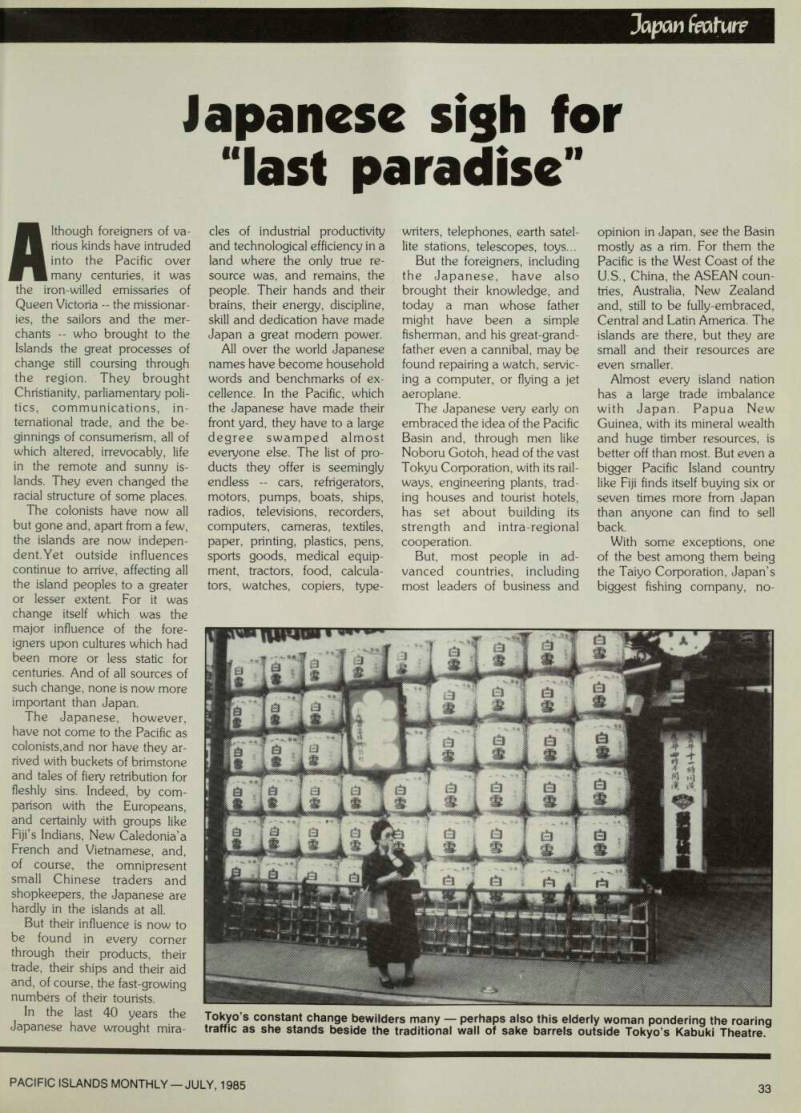
Tokyo’s constant change bewilders many - perhaps also this elderly woman pondering the roaring traffic as she stands beside the traditional wall of sake barrels outside Tokyo’s Kabuki Theatre.
body does very much about this imbalance, taking it to be among the facts of a tough life.
The islands rack their brains about trade, and push for in vestment, but success on any large scale continues to elude them.
Taiyo has a joint venture in fishing and fish processing with the Solomon Islands. Until re cently, when they withdrew for lack of profit, C.Itoh, the huge Tokyo-based international trad ing conglomerate, shared the fish cannery at Levuka in Fiji.
This was a brave and manful effort by Itoh which might have succeeded but for the high cost of operating in Ovalau.
Economic pundits see oppor tunities for agricultural and hor ticultural joint ventures, but enormous work will be needed to get them up and running.
Japan offers a huge, and rich, market for fruit, vegetables and fish. In Japanese supermarkets tropical fruits sell at prices an islander would think astronomi cal; 10 or 20 times higher than in Pacific places where they assist their growers by con veniently hurling themselves off the trees.
But, if the Japanese pay high prices for their produce, they also demand standards of qua lity which countries much more sophisticated and technically advanced than a Pacific island nation have trouble meeting.
Japan’s preoccupation with product quality , and with high performance in such matters as the meeting of delivery dates, is total and uncompromising.
Even the most optimistic of Pacific enthusiasts cannot but concede that, with some excep tions like wood chips and lum ber, it may be some time yet before large quantities of island products sell regularly in Japan.
Yet there are opportunities, albeit still fairly small, for joint ventures with Japanese com panies seeking to develop is land industries able to find markets perhaps not in Japan, but elsewhere around the Paci fic. This was the basis of Taiyo’s enterprise, which produced fish for sale in the United States.
Brightest hope of all, how ever, is tourism. Tokyu Corporation, through its sub
sidiary, Pan-Pacific Hotels, already has several resorts in the Pacific, including Le Lagon, one of the two first-class hotels in Port-Vila, and has quite elaborate plans for major ex pansion in a number of islands over the next 10 years or so.
Other Japanese investors are looking at hotel sites in Fiji, Micronesia and elsewhere.
Indeed, when all is done, it is tourism which continues to offer the best hope of attracting major Japanese investment in, and involvement with, the Paci fic islands.
A great many Japanese have a very romantic view of the Pacific islands. To some degree that is a disadvantage for the islands for it leads to the view among business leaders, bank ers and such, that the islands ought to be kept as the last earthly outpost of Paradise, un tarnished by crass commerce and industry.
Indeed, Tokyo is thick with
billboards, brochures, travel agencies and guidebooks telling the jam-packed, frantically competitive, hustled and bus tled Japanese that, ”Yes, Miss Yamomoto, there is peace and privacy on earth, and it comes wrapped in warm, crystal-clear water, with bouquets of gently waving coconut palms and be vies of simple, gentle, island folk, who may not bring your bus on time, but they will smile nicely about it...”
If the Pacific Islands, gener ally, have a task ahead of them it may be to persuade the Japanese that they seek more out of life than bit parts as brown angels in a Tokyo salary man’s vision of Holiday Heaven. Probably tourism will always be the mainstay of the island economies; leisure and the pursuit of it, particularly by the denizens of the high-tech world, being one of the new miracle industries. Nor should
they ignore it, for the rewards of top-line performance can be considerable, and much could flow from it in terms of subsidi ary supply and service enter prises once acceptable stan dards had been achieved.
Yet, in the eyes and minds of the islanders themselves, that is not enough. They, too, are involved in processes of change which, in their terms, are just as enormous as those working anywhere else. The islanders have to choose, so far as the pressure of events, and external forces, allow them a choice, between their traditional way, with all its many human and also perhaps even economic advantages, and the tech nological world.
Japan is already helping them make that choice while at the same time itself growing as a nation with legitimate interests not only around the Pacific, but right across it.