Coconuts and Cheysanthemums
pp. 31-32 · Read in the full issue
tez
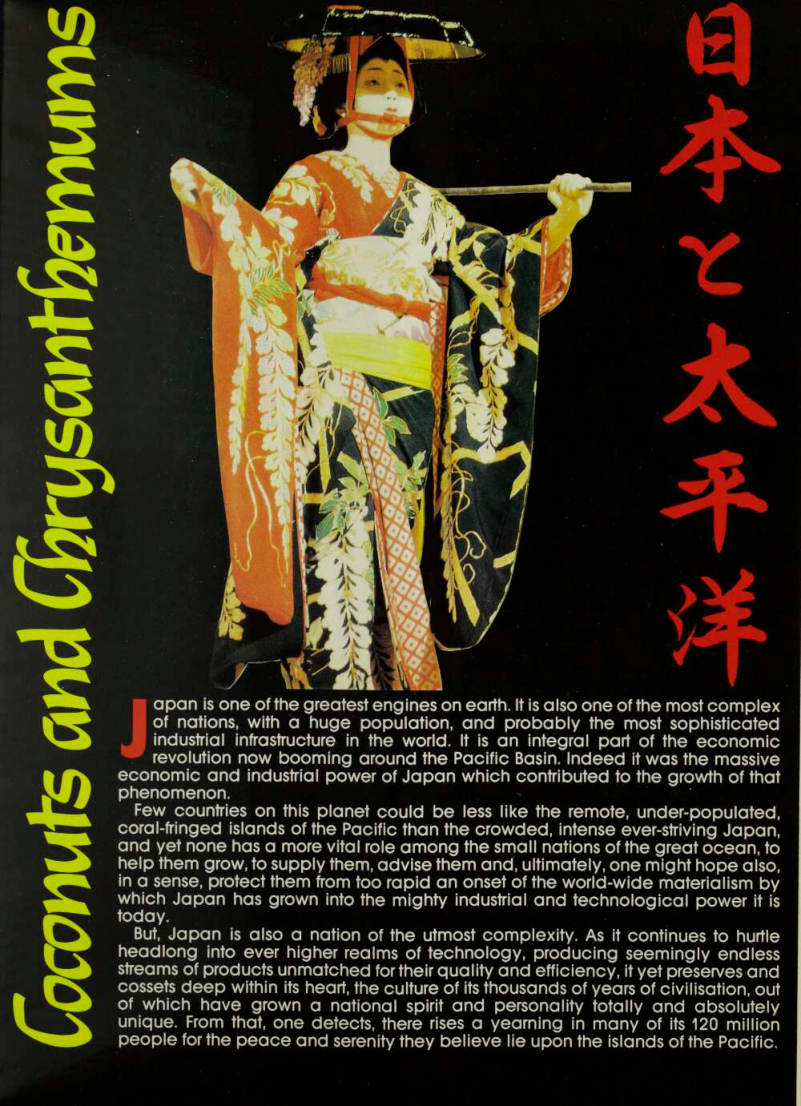
Japan is one of the greatest engines on earth. It is also one of the most complex of nations, with a huge population, and probably the most sophisticated industrial infrastructure in the world. It is an integral part of the economic revolution now booming around the Pacific Basin. Indeed it was the massive economic and industrial power of Japan which contributed to the growth of that phenomenon.
Few countries on this planet could be less like the remote, under-populated, coral-fringed islands of the Pacific than the crowded, intense ever-striving Japan, and yet none has a more vital role among the small nations of the great ocean, to help them grow, to supply them, advise them and, ultimately, one might hope also, in a sense, protect them from too rapid an onset of the world-wide materialism by which Japan has grown into the mighty industrial and technological power it is today.
But, Japan is also a nation of the utmost complexity. As it continues to hurtle headlong into ever higher realms of technology, producing seemingly endless streams of products unmatched for their quality and efficiency, it yet preserves and cossets deep within its heart, the culture of its thousands of years of civilisation, out of which have grown a national spirit and personality totally and absolutely unique. From that, one detects, there rises a yearning in many of its 120 million people for the peace and serenity they believe lie upon the islands of the Pacific.
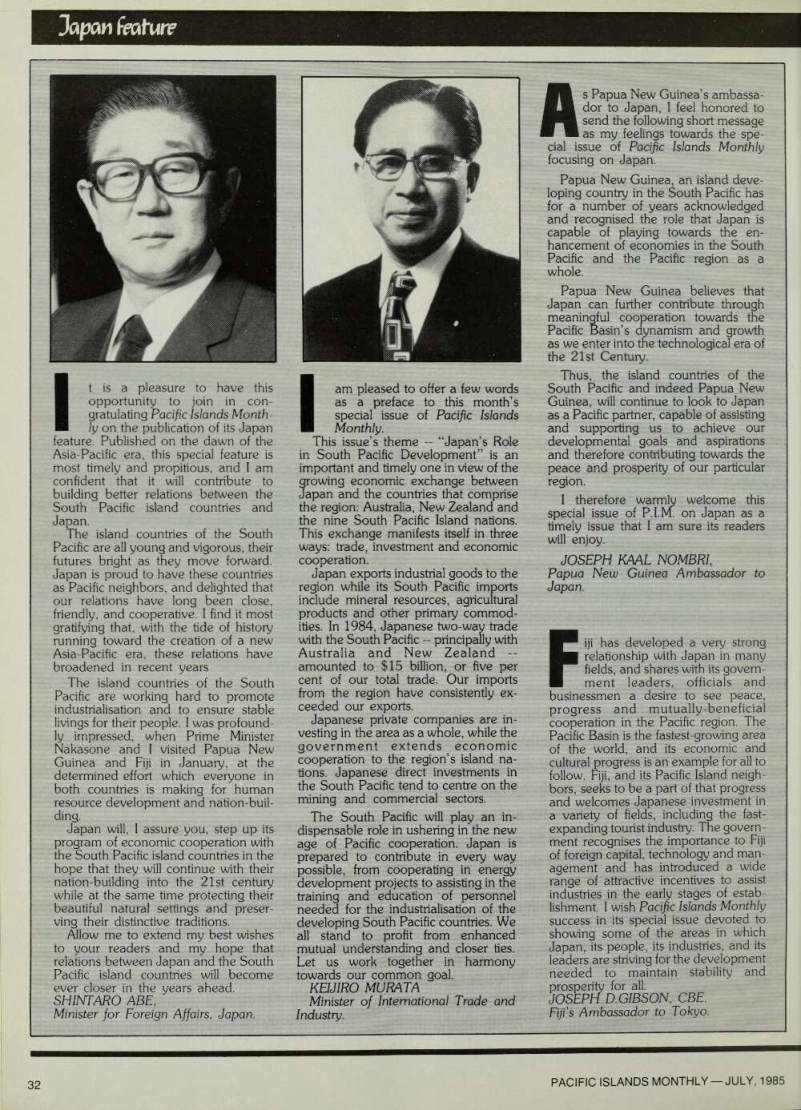
It is a pleasure to have this opportunity to join in con gratulating Pacific Islands Month ly on the publication of its Japan feature. Published on the dawn of the Asia-Pacific era, this special feature is most timely and propitious, and 1 am confident that it will contribute to building better relations between the South Pacific island countries and Japan.
The island countries of the South Pacific are all young and vigorous, their futures bright as they move forward.
Japan is proud to have these countries as Pacific neighbors, and delighted that our relations have long been close, friendly, and cooperative. I find it most gratifying that, with the tide of history running toward the creation of a new Asia-Pacific era, these relations have broadened in recent years The island countries of the South Pacific are working hard to promote industrialisation and to ensure stable livings for their people. I was profound ly impressed, when Prime Minister Nakasone and I visited Papua New Guinea and Fiji in January, at the determined effort which everyone in both countries is making for human resource development and nation-buil ding.
Japan will, I assure you, step up its program of economic cooperation with the South Pacific island countries in the hope that they will continue with their nation-building into the 21st century while at the same time protecting their beautiful natural settings and preser ving their distinctive traditions.
Allow me to extend my best wishes to your readers and my hope that relations between Japan and the South Pacific island countries will become ever closer in the years ahead.
Shintaro Abe .
Minister for Foreign Affairs, Japan.
I am pleased to offer a few words as a preface to this month’s special issue of Pacific Islands Monthly.
This issue’s theme - “Japan’s Role in South Pacific Development” is an important and timely one in view of the growing economic exchange between Japan and the countries that comprise the region: Australia, New Zealand and the nine South Pacific Island nations.
This exchange manifests itself in three ways: trade, investment and economic cooperation.
Japan exports industrial goods to the region while its South Pacific imports include mineral resources, agricultural products and other primary commod ities. In 1984, Japanese two-way trade with the South Pacific - principally with Australia and New Zealand -amounted to $l5 billion, or five per cent of our total trade. Our imports from the region have consistently ex ceeded our exports.
Japanese private companies are in vesting in the area as a whole, while the government extends economic cooperation to the region’s island na tions. Japanese direct investments in the South Pacific tend to centre on the mining and commercial sectors.
The South Pacific will play an in dispensable role in ushering in the new age of Pacific cooperation. Japan is prepared to contribute in every way possible, from cooperating in energy development projects to assisting in the training and education of personnel needed for the industrialisation of the developing South Pacific countries. We all stand to profit from enhanced mutual understanding and closer ties.
Let us work together in harmony towards our common goal.
Keijiro Murata
Minister of International Trade and Industry.
As Papua New Guinea’s ambassa dor to Japan, I feel honored to send the following short message as my feelings towards the spe cial issue of Pacific Islands Monthly focusing on Japan.
Papua New Guinea, an island deve loping country in the South Pacific has for a number of years acknowledged and recognised the role that Japan is capable of playing towards the en hancement of economies in the South Pacific and the Pacific region as a whole.
Papua New Guinea believes that Japan can further contribute through meaningful cooperation towards the Pacific Basin’s dynamism and growth as we enter into the technological era of the 21st Century.
Thus, the island countries of the South Pacific and indeed Papua New Guinea, will continue to look to Japan as a Pacific partner, capable of assisting and supporting us to achieve our developmental goals and aspirations and therefore contributing towards the peace and prosperity of our particular region.
I therefore warmly welcome this special issue of P.I.M. on Japan as a timely issue that I am sure its readers will enjoy.
Joseph Kaal Nombri,
Papua New Guinea Ambassador to Japan.
Fiji has developed a very strong relationship with Japan in many fields, and shares with its govern ment leaders, officials and businessmen a desire to see peace, progress and mutually-beneficial cooperation in the Pacific region. The Pacific Basin is the fastest-growing area of the world, and its economic and cultural progress is an example for all to follow. Fiji, and its Pacific Island neigh bors, seeks to be a part of that progress and welcomes Japanese investment in a variety of fields, including the fast expanding tourist industry. The govern ment recognises the importance to Fiji of foreign capital, technology and man agement and has introduced a wide range of attractive incentives to assist industries in the early stages of estab lishment. I wish Pacific Islands Monthly success in its special issue devoted to showing some of the areas in which Japan, its people, its industries, and its leaders are striving for the development needed to maintain stability and prosperity for all.
Joseph D. Gibson, Cbe
Fiji’s Ambassador to Tokyo.