have problems"
pp. 41-45 · Read in the full issue


“Pacific fisheries have problems"
One of the bigger on ground involvements between Japan and the Pacific Islands is be tween the Taiyo Fishery Com pany, of Tokyo, and the gov ernment of Solomon Islands.
The operation, which gives equal shares to each partner, was started in 1976, and has been the basis of a very happy relationship ever since.
The only really major hic cough came when the U.S. invoked the Magnusson Act in retaliation for the arrest of the big purse seine ship Jeanette Diana and sales of Solomons- Taiyo canned fish in America were abruptly stopped.
Taiyo executives in Tokyo said it was a serious setback for the little company. If it had been entirely a Solomon Is lands company the trade ban could have spelled disaster. As it was Taiyo used its world-wide marketing network to find buyers for the fish, principally on this occasion in Thailand.
But the prices obtained~were low and the company suffered as a consequence, I was told.
In general, however, Solo mons-Taiyo has been a successful operation with fish, principally skipjack tuna, pro cessed by smoking, freezing or canning, exported to several parts of the world, including Japan and, now again, the U.S.A. In normal times about 80 per cent of the Solomons product goes to the U.S., 10 per cent to Japan, and the rest to a variety of buyers, including the U.K., Belgium, Switzerland, and West Germany.
Taiyo chose the Solomons principally, they say, because of the resource available. The is lands are at a sort of crossroads of tuna fishing, near to migra tion routes.
“About 12 years ago we sent seven small skipjack vessels to research the grounds,” said Mr Hiroshi Fujii, general manager of Taiyo’s overseas operations department. “We knew it should be good because the tuna circulate around the Solo mons. ”
Solomons-Taiyo manages a fleet of 35 ships. Of these 10 are pole and line ships owned by Solomons-Taiyo. There are 12 more such boats under
charter to Solomons-Taiyo, and one small purse seiner, as well as two long-line ships catching high quality tuna for the lucra tive, though very competitive, Japanese sashimi and sushi market.
These last two boats are not owned by Solomons-Taiyo, but by the Solomons Fisheries De velopment Company, which is a jointly-financed operation, 75
continued on page 45
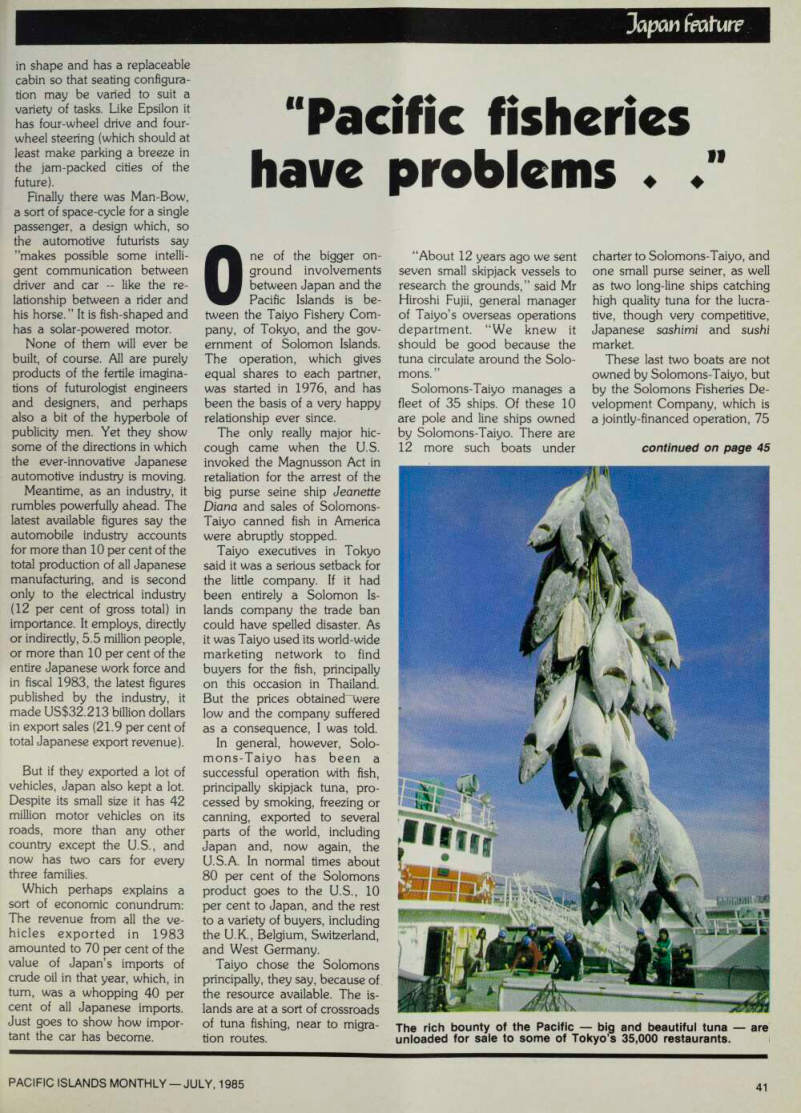
The rich bounty of the Pacific big and beautiful tuna - are unloaded for sale to some of Tokyo’s 35,000 restaurants.
per cent owned by the Solo mons government and 25 per cent by the Solomons-Taiyo company. This company also operates 10 pole and line boats.
Taiyo handles the catch and markets it in Japan.
“This fleet handles an annual catch of around 38,000 tonnes of fish,” Mr Fujii said.
“We have had many prob lems in our 12 years there.
There always seem to be prob lems, but we are persisting with it. Market fluctuations are our biggest problem.
“The price is dependent upon what the Americans are catching, and on the rate of their consumpion of tuna. It is a world market, governed by the level of catches in every ocean.
This year we have good prices, because the world catch is very poor. But, ironically and unfor tunately, we also have a poor catch in the Solomons, so we have trouble taking advantage of the better prices.”
Is the world taking too much fish? How do companies like Taiyo monitor their catches?
Should there be better control?
“It all depends upon the American purse seiners,” Mr Fujii said. “The Americans con sume about 600,000 tonnes of fish a year. The price goes up and down according to how successful those big ships are.
“We are very unhappy about the manner in which these huge ships fish. Japan has some of these big seiners Taiyo has five of them of 500 gross tonnes and there are 35 of them based in Japan,” Mr Fujii said. But they are small compared with the 1500 gross tonnes of a ship like the Jeanette Diana which also employs a helicopter to spot the schools of tuna.
The Japanese are not opti mistic about the chances of controlling this sort of fishing until it is possibly too late until real damage is done to the industry and to the stocks of fish. Running fishing boats is very expensive. There are eco nomies of scale, certainly in
terms of wages and other costs, in the very big boats. With fish prices as they are now, fishery companies are looking to save every dollar or yen they can so that they can survive in an extremely competitive and de manding industry.
Mr Fujii considers that changes in the huge American market have caused many of the problems. “In the old days the fish packing companies owned their own vessels, or guaranteed a price to charter boats. But the price became very volatile and so even the big packers, like Seakist and Van Camp, no longer continue to operate their own boats.
“The big companies are out, but the boat owners still in the business are also having prob lems of very high fuel costs and other charges.
“The Americans are also changing their strategy. They are expanding their offshore base facilities, for example in American Samoa. Pago Pago is their main base in the Pacific. In
the Atlantic it is Puerto Rico.
“A total of 140 purse seiners are now operating in the South Pacific. That is too many. They are currently mostly in the eastern part of the ocean, but if the fish stocks become depleted there, we are afraid they will move into our western side,” he said.
Do you think high costs might eventually drive the big purse seiners out of business?
“I hope so,” Mr Fujii said smartly, “but nobody is saying yet.”
There is very great need to keep order in Pacific fisheries, and indeed, all over the world, he said. “The American policy about following migratory fish, regardless of exclusive econo mic zones, causes problems. It has led to disorder.
“I cannot understand Amer ican policy, allowing U.S. own ers to intrude into another nation’s waters, even to landing helicopters on islands without permission,” he said.
“The island nations have to
defend themselves, so incidents happen such as when the Solo mons hired a fast gunboat from Australia and arrested the Jeanette Diana. That cost the Americans $680,000.
“It is a situation which is somewhat unstable.”
Is there anything Japan can do towards bringing a better order into the Pacific fishing industry?
“The Japanese Tuna Boat Association does not have a strong lobby, ” said Mr Fujii with a laugh, obviously referring to the great political strength gen erally attributed to the Amer ican Tuna Boat Association.
But, he said, the lack of order in the industry was damaging to Japanese fishing companies, not only the purse seiners, but also the long-line boats with their selective method of catch ing high grade tuna.
It is, in fact, they say, en dangering the whole future of the industry, and yet, so far, no-one can see a way out of the impasse.