loom in Pacific
pp. 22-23 · Read in the full issue
Media woes still loom in Pacific
This may be the Age of the Satellite, but John Lamani’s communications concerns are down-to-earth. The quiet but intense Solomon Islander is the founder and editor of the three year-old Solomon Star, a 3000-circulation weekly news paper that is the only indepen dent press voice in that country.
Lamani’s worries are “simple”: paper, ink, training for his small staff, and a government he says has little interest in an active, free press.
“The banning of the (U.S.) 60-Minutes television team (that wanted) to film the cap tured American tuna boat, the Jeanette Diana; the deportation order issued to Australian Associated Press and Australian Broadcasting Corporation rep resentatives; restrictions on lo cal journalists covering impor tant visitors; and a circular from the Office of the Prime Minister requesting ministers, perma nent secretaries and govern ment subordinates not to re lease directly any information to the private media will give you some idea what the situation is like in the Solomon Islands,”
Lamani says.
A former government in formation officer, Lamani be lieves better trained journalists are the key to ensuring freedom of the press in the Solomons.
“Unless drastic changes are made in the training of journal ists to pressure government to alter its attitude toward the media, the country will slide
backward instead of going for ward in its media deve lopment,” Lamani warns.
Editor Lamani, who also acts as the Star’s advertising mana ger, administrator and janitor, made his comments recently to men and women who share his hopes and frustrations. He was one of 55 island journalists, broadcasters, information offic ers and observers who gathered in Suva on May 14 to 17. They met for the Pacific Media Con ference 1985 at the Town House Apartment Hotel.
The conference agenda was two-fold: allow Pacific journal ists, most of whom carry out their work isolated from pro fessional colleagues, to ex change observations and con cerns in a supportive atmos phere; and to consider the future of the Pacific Islands News Association (PINA), the 11-year-old organisation that still holds great promise for professional development and a free press.
Underwritten by a U 5519,775 grant from The Asia Foundation, a private San Francisco-based group that has become increasingly interested in the Pacific Islands, the Pacific Media Conference was by all accounts a success.
Tom Lloyd, the colorful co editor (along with his wife, Tim) of the 20-year-old Norfolk Islander, put it best when he said mid-way through the con ference: “I think it is important that we have a chance to meet.
We find out, at conferences like this, what each other is doing.
It’s very helpful and it recharges our batteries.”
The conference acted, in some ways, like a religious revival meeting. It was a chance to hear “horror stories,” hear how others cope with hostile governments, poor shipping, high duty on newsprint and supplies, and still manage to print newspapers. In an en vironment where adversity is stressed, journalists recommit themselves to the ideals of their profession. Recharge their bat teries, as it were.
Consider the case of Tom Lloyd and his 1250-circulation weekly on Norfolk Island. “The role of the Norfolk Islander has been to act as the island consci ence,” Lloyd told the gathering, “a safety valve for people to blow off steam in the letters to the editor columns and, when the need arises, to take the commonwealth and local gov ernments to task when we learn of actions they are contemplat ing which are not, in our opin ion, for the betterment of Nor folk.”
That approach is not without its hazards. Noted Lloyd: “Over the years the role has not been an easy one. We have been threatened to be thrown, prin ting press and all, into the sea.
We have had swastikas painted on the walls of the printery. And to cap it all, just five years ago our premises were burnt to the ground by arsonists.”
Lloyd suspects the torching was brought on by a particu larly hot exchange of letters to the editor concerning “a certain government official. No culprits were ever brought to justice, but the community pitched in and rebuilt the print shop. The
Norfolk Islander resumed publication and, Lloyd added, “although we might be a little charred around the edges and the hair that is left is gradually turning whiter, we would not, as the Australians say, ’swap it for quids.’”
As was the case in past regional media conferences, a major concern of journalists, both print and broadcasting, was the need for training. A particularly forceful plea for such programs was made by Papiloa Foliaki, business woman-turned-editor, who puts out the independent Ton ga Times.
“The saying that the blind lead the blind applies to us,” she told the conference. “None of us knows how to write, especially in English. Neverthe less, in our country, we believe that half a loaf is better than none.”
Three encouraging notes were sounded on the training front. First, the University of the South Pacific’s External Services is looking to develop, in conjunction with PINA, a journalism certificate program.
While USP does not now have courses in the subject, officials there believe basic and mid career tracks can be establish ed.
Second, the Commonwealth Press Union, through Bob Pearce of the New Zealand Herald, announced its willing ness to include Pacific Islanders in a six-month training program at Rotorua. Participants would be chosen with PINA assist ance.
Third, the East-West Center’s Institute of Culture and Com munication has indicated its willingness to organise, with PINA cooperation, a seminar for senior journalists. The com mitment was made by institute Director Dr. Mary Bitterman, who attended the entire confer ence. The institute will also compile a list of training and educational opportunities. That work will be done by journalism professor, Dr. Jim Richstad, now of the University of Okla homa, who was the guiding spirit that brought PINA to gether in the early 19705.
PINA also established a train ing committee to act as a clearing house for professional opportunities. How well it works in the coming months
remains to be seen. All too often, it seems, the spirit and enthusiasm at conference venues are worn down by the passage of time and the chores of daily living.
That will also be a test for PINA in general, which was given a new lease on life at the Pacific Media Conference.
While not all participants were PINA members, the group acted as a “general assembly” for the organisation. The up shot of many decisions is this: There is support for con tinuing PINA at least in its present low-key style, with the understanding that a revitalised organisation must evolve in the not-too-distant future.
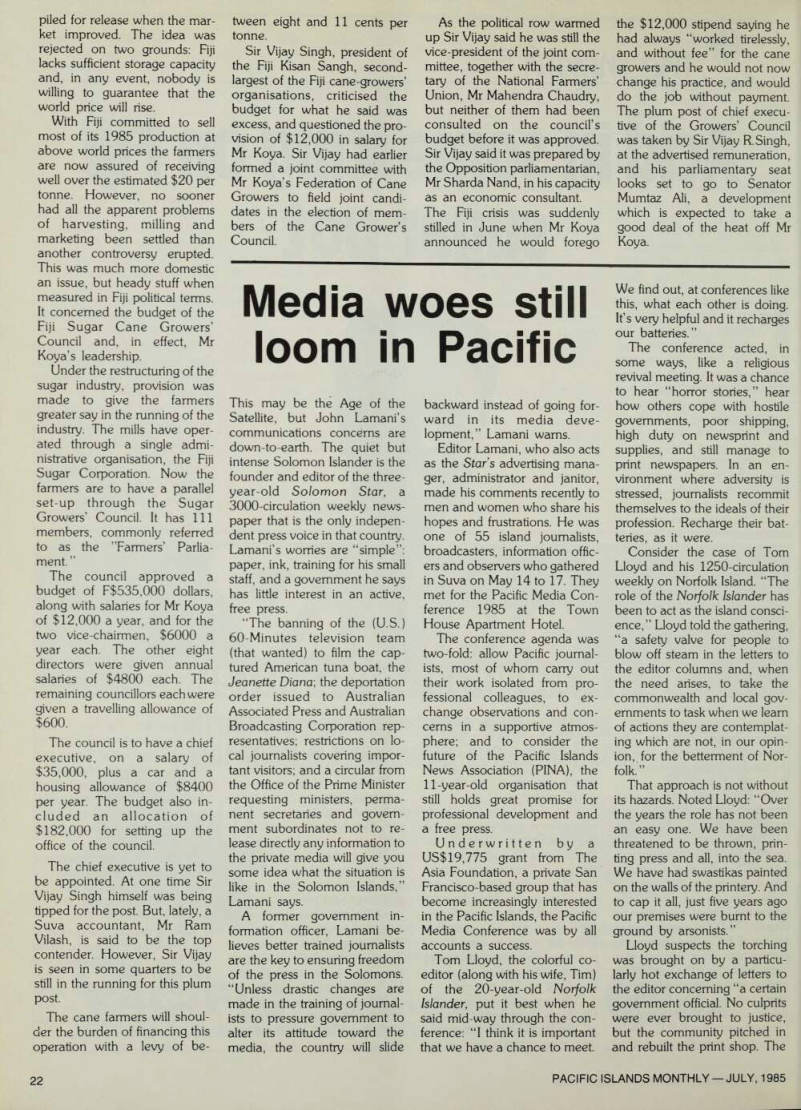
To accomplish that, the con ference chose Tavake Fusima lohi, director of the Tonga Broadcasting Commission, to become PINA’s new executive director. He replaces organising director Len G. Usher of Fiji, who nearly singlehandedly has kept PINA alive since its incep tion. Usher had expressed his desire to step down from PINA’s helm.
The conference did not allow Usher to step down quietly. It approved a resolution which praised the veteran newsman for carrying out his PINA duties “with distinction,” and for “pro viding irrepressible spirit and wise leadership.” He was also made a lifetime member of the organisation, and given a posi tion on the resurrected Man
agement Board as councillor.
In addition to Usher, the board, which is to work with Fusimalohi to build PINA, is comprised of Fata Pito Fa’alogo (Samoa Times, Western Samoa), chairman; John Lamani ( Solomon Star), Lazar usa Vusoniwailala (general manager designate, Fiji Broad casting Commission); Marjorie Crocombe (USP); Vijendra Kumar ( Fiji Times ; Peter Lomas (Fiji Sun); Floyd K. Takeuchi (Honolulu Advertiser); Paul Cox (Communication Dept., Papua New Guinea); Tom Lloyd (Norfolk Islander); Batiri Bataua (Kiribati Broadcasting and Publications Authority); and Sitiveni Vete (SPEC).
Vete, Cox and Fa’alogo, along with Fusimalohi, make up a new Finance Committee.
Theirs is the most difficult im mediate job: to find funds, estimated at about US$4O,OOO annually for five years, to allow PINA to become a major force in regional journalism and com munications.
Such was the spirit of the Pacific Media Conference that Samoa’s Fa’alogo, along with his colleagues Sano Malifa of the Samoa Observer and Ati Ilaoa of the Samoa Broadcas ting Service, established a target date of May-June, 1986, for a general meeting of PINA in Western Samoa. It is an ambitious goal, but the confer ence encouraged Fa’alogo to proceed with planning.
While many topics were dis cussed, in formal sessions and afterwards over meals or, more often than not, a beer or two, there was a sense of the need to maintain a Pacific way of journalism. The prognosis for such a view differed with each individual, but Norfolk Island’s Lloyd perhaps captured the feelings of most when he told the conference: “We need our own (trained journalists) to keep alive the traditional ways of looking at local problems because, as has been proved by two other newspapers that have started in opposition to the Norfolk Islan der in recent times, the main land way of reporting with big, black headlines, and a sensatio nal way of presenting local news, does not rest easy on the shoulders of what is basically a very conservative community. ”
Hoyd K. Takeuchi in Suva.
Len Usher... Fiji’s best-known newspaperman, honored by P.I.N.A. for untiring service.