sugar pot
pp. 21-22 · Read in the full issue
the month
Acid in some icing on Fiji sugar pot
Fiji’s sugar industry, its main foreign exchange earner, is presently rid dled with problems. First, it was the harvesting program which did not start on time because farmers refused to har vest their crops, claiming the forecast price of F 517.50 per tonne was below their produc tion cost.
Despite appeals by the chair men of the Sugar Commission, Mr Gerald Barrack, and the Growers’ Council, Mr Siddiq Koya (the two bodies set up by a reorganisation of the Fiji sugar industry), farmers continued their boycott as the deadline for Fiji to supply the first shipment of 18,000 tonnes to the E.E.C. under the Lome Convention drew near.
The farmers sought other financial relief from the Fiji Sugar Corporation and the government. They asked for the removal of basic and in come tax. However, the gov ernment said the country’s eco nomy was in poor state and they could not afford to abolish the taxes and give other relief to the cane farmers.
Mr Koya and Mr Barrack travelled to the cane areas and held a meeting to explain that $17.50 a tonne was only a forecast price. They also urged farmers to commence harves ting in the national interest.
Fiji has an annual quota under the Lome Convention to supply 174,000 tonnes of sugar to the E.E.C. The European community pays almost five times more than the world free market price for sugar. How ever, because of the harvesting delay it was feared that Fiji’s contract with the E.E.C. could be put in jeopardy. At a time
when the world sugar market is deeply depressed it is seen in Fiji as essential to meet long term contract obligations, which offer better prices than the free world market.
After almost two weeks of negotiations and meetings on the submissions made by the Sugar Cane Growers’ Council, the Sugar Commission agreed to a five-point plan to resolve the dispute. It agreed that the new estimated final price for the 1985 crop will be more than Fs2o per tonne; an extra $1.50 per tonne to be paid to farmers with the first delivery payment to take it to $l2 a tonne.
Other incentives included the Fiji Sugar Corporation agreeing to pay in advance harvesting and transportation cost at the
same rate as last year, plus a delay in repayment of loans farmers had taken out under the crop rehabilitation program.
However, only some farmers accepted the terms of the settle ment while others continued with their boycott, despite pleas by Mr Koya and Mr Barrack.
This action in some quarters was seen as a rebuff to Mr Koya who has been under severe pressure in his position as lead er of the parliamentary opposi tion and boss of the National Federation Party. Koya was accused of placing his suppor ters on the Growers’ Council for political ends.
Although the farmers were assured their other grievances were being looked into it was almost a week before harves
ting commenced in all cane sectors and the mills began normal crushing.
The F.S.C. initially was faced with poor supply of cane and the mills ran at half capacity for a week or so.
Fiji’s total sugar production this year is expected to be around 470,000 tonnes of which Fiji has to sell about 170.000 on the world free market. Of the remainder, Fiji benefits from long-term con tracts at prices well above the free world price. In the case of the E.E.C. it is five times more.
Malaysia also pays almost five times more than the world price.
Fiji has just negotiated sale of 40.000 tonnes to China, also above the world price, and negotiations are almost con cluded for sale of 61,000 ton nes to New Zealand at a pre mium over the free market price.
In addition Fiji has a pre ferential market of 12,500 ton nes with the United States and 60.000 tonnes to Malaysia. It has contract obligations to sup ply Portugal and Singapore, 28.000 tonnes each, and it has a guaranteed market in Japan for 28,000 tonnes.
Besides all these obligations Fiji has to make provision for supply of 35,000 tonnes for Pacific Island markets and its own consumption.
Among the political gyrations put forward during the row was one from the president of the Fiji Kisan Sangh, Sir Vijay R.Singh, who suggested giving farmers a better return by sell ing only enough sugar to satisfy the long-term contracts. The rest, he said, should be stock
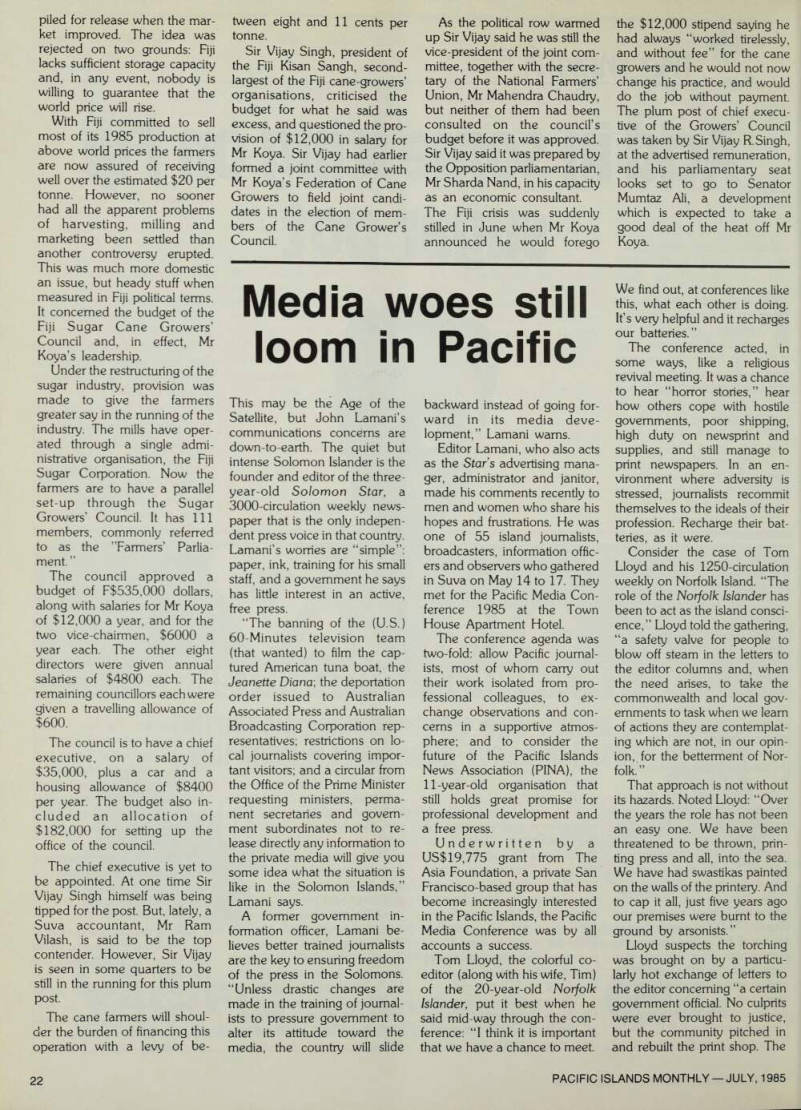
Sir Vijay Singh chief of new sugar growers’ council.
piled for release when the mar ket improved. The idea was rejected on two grounds: Fiji lacks sufficient storage capacity and, in any event, nobody is willing to guarantee that the world price will rise.
With Fiji committed to sell most of its 1985 production at above world prices the farmers are now assured of receiving well over the estimated $2O per tonne. However, no sooner had all the apparent problems of harvesting, milling and marketing been settled than another controversy erupted.
This was much more domestic an issue, but heady stuff when measured in Fiji political terms.
It concerned the budget of the Fiji Sugar Cane Growers’
Council and, in effect, Mr Koya’s leadership.
Under the restructuring of the sugar industry, provision was made to give the farmers greater say in the running of the industry. The mills have oper ated through a single admi nistrative organisation, the Fiji Sugar Corporation. Now the farmers are to have a parallel set-up through the Sugar Growers’ Council. It has 111 members, commonly referred to as the ’’Farmers’ Parlia ment.”
The council approved a budget of F 5535,000 dollars, along with salaries for Mr Koya of $12,000 a year, and for the two vice-chairmen, $6OOO a year each. The other eight directors were given annual salaries of $4BOO each. The remaining councillors each were given a travelling allowance of $6OO.
The council is to have a chief executive, on a salary of $35,000, plus a car and a housing allowance of $B4OO per year. The budget also in cluded an allocation of $182,000 for setting up the office of the council.
The chief executive is yet to be appointed. At one time Sir Vijay Singh himself was being tipped for the post. But, lately, a Suva accountant, Mr Ram Vilash, is said to be the top contender. However, Sir Vijay is seen in some quarters to be still in the running for this plum post.
The cane farmers will shoul der the burden of financing this operation with a levy of be
tween eight and 11 cents per tonne.
Sir Vijay Singh, president of the Fiji Kisan Sangh, second largest of the Fiji cane-growers’ organisations, criticised the budget for what he said was excess, and questioned the pro vision of $12,000 in salary for Mr Koya. Sir Vijay had earlier formed a joint committee with Mr Koya’s Federation of Cane Growers to field joint candi dates in the election of mem bers of the Cane Grower’s Council.
As the political row warmed up Sir Vijay said he was still the vice-president of the joint com mittee, together with the secre tary of the National Farmers’
Union, Mr Mahendra Chaudry, but neither of them had been consulted on the council’s budget before it was approved.
Sir Vijay said it was prepared by the Opposition parliamentarian, Mr Sharda Nand, in his capacity as an economic consultant.
The Fiji crisis was suddenly stilled in June when Mr Koya announced he would forego
the $12,000 stipend saying he had always “worked tirelessly, and without fee” for the cane growers and he would not now change his practice, and would do the job without payment.
The plum post of chief execu tive of the Growers’ Council was taken by Sir Vijay R.Singh, at the advertised remuneration, and his parliamentary seat looks set to go to Senator Mumtaz Ali, a development which is expected to take a good deal of the heat off Mr Koya.