Wage freeze spurs
pp. 19-20 · Read in the full issue

Fiji Unions Sire New Party
Wage freeze spurs union action
Fiji is to have a new political party, drawing its power base from the trades unions. It will be known as the Fiji Labor Party and will be officially launched later this year.
The birth of the party has come about because of the labor movement’s dissatisfac tion with the Alliance Party which, under Ratu Sir Kamisese Mara, has ruled Fiji since inde pendence. The unions have been unhappy and their leaders have complained that they were badly let-down by the government when it unilaterally imposed the wage freeze in last year’s budget.
Union leaders say that while the country has had the Tri partite Forum to deal with such issues, by discussion among the government, the unions and the employers, to hammer out an annual agreement, the wage freeze was brought down with out any such consultation.
They also accuse the govern ment of adopting a non-com promising attitude on the issue.
Since the wage freeze, they say, their approaches to gov ernment, and the representa tions made by the Fiji Trades Union Congress (F.T.U.C.), have been largely ignored.
In May the union leaders met in Suva at a workshop organ ised by the F.T.U.C. to which most Fiji unions are affiliated. In a paper entitled “Fiji Trades Unions and Party Politics” Mr James Raman, the F.T.U.C. national secretary, explained how the congress had remained politically neutral in the past and why recent events had made it necessary for that to change.
He said there was “a real threat” that political power would be used in “a brutal and unmitigated mannner” to sup press the trade unions.
Mr Raman said the move ment had to find a means to cushion itself from this “on slaught” if it was to save itself from the “mounting attacks” which could lead to eventual destruction of everything that the trades unions had built through several years of sacri fice.
To avoid being “victims of the arrogant use of political power,” he said, the move ment’s involvement in the mainstream of politics seemed the only avenue open to them.
Simione Durutalo, a lecturer in sociology at the University of the South Pacific, in his paper presented to the workshop, re viewed the involvement of labor movements in politics in Britain, Australia, and New Zea land. He said the labor move ment, with trade unions at the
centre, was “the only force” which could provide momen tum and drive and give them a forceful political voice.
The delegates generally agreed that the interests of the common people were not being served by the existing political structure and said they believed the new Labor Party would “promote the principles of democratic socialism” in Fiji.
They agreed that the F.T.U.C. and the Fiji Labor Party should operate auto monously. However, it was agreed that there would be “inevitable overlap” in action membership.
The Labor Party will be open to all sections of society, and not just to trade unionists. Dele gates agreed that special efforts should be made to bring into the fold the entire working group, urban and rural.
The new Labor Party sees itself as appealing to all races. It hopes to cut across the traditio
nal support enjoyed by the two major parties, the Alliance and the opposition National Federa tion Party. The Alliance is pre dominantly backed by the na tive Fijians while the N.F.P. has its base in the Indian commun ity of Fiji. Indeed, Fiji politics are entirely bound up in the racial and communal differences which are such a feature of the country, and the appearance of a multi-racial organisation, while probably inevitable as an effect of the passage of time and social and economic change, is bound to have very far-reaching consequences.
Political pundits in Fiji see the new party’s arrival not only as an expression of dissatisfaction with the existing system, but also as a criticism of the N.F.P. which, in many more politically aware eyes is now seen, under the leadership of Suva lawyer Siddiq Koya, to have failed to remain united and effective.
Since Mr Koya resumed the N.F.P. leadership after the res-
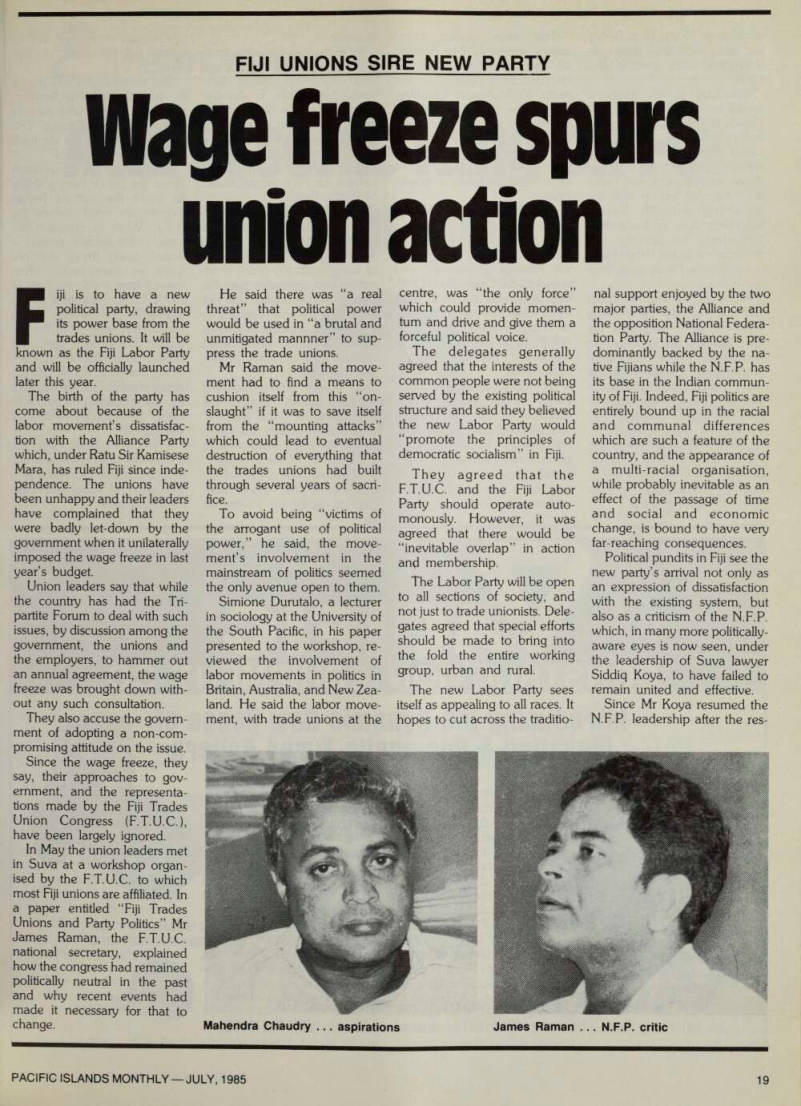
Mahendra Chaudry ... aspirations
James Raman ... N.F.P. critic
ignation of Mr Jai Ram Reddy the party has once again di sintegrated into warring fac tions.
Speaking in an interview broadcast by Radio Fiji, Dr David Routledge, lecturer in history at the USP. said the new Labor Party would definitely make inroads on the N.F.P. and draw away supporters who have become fed-up with the in-fighting and Mr Koya’s autocratic style of leadership.
Conversely, he said, he saw little chance of the Labor Party wooing many Fijians away from the Alliance.
However, he said, he could not see the new party being ready to fight every seat the next election, due to be held in two years ... at least not with any chance of supplanting the N.F.P., and indeed might not even win a single seat at its first time out on the hustings.
However, what it would do, he said, was water down the N.F.P. support and give the Alliance Party an even bigger majority, especially in the marginal national seats.
The union leaders them selves, especially Mr Raman, and the man who is said to be the main force behind the new party, Mr Mahendra Chaudry, head of the powerful Fiji public service union, say they have their eyes on the election of 1997 for their big chance. Up to then, they said, they would work to consolidate a power base.
Already in the last par liamentary session veterans such as Sir Vijay R.Singh, formerly Attorney-General in the Alliance government and now with the Opposition N.F.P. after a notable row with Ratu Mara some years ago, speaking on a motion introduced by the N.F.P. to lift the wage freeze, welcomed the new party’s appearance.
Sir Vijay said the Labor Party, which had economic concepts as its base, would remove racial components from Fiji politics. Initially, political parties were formed to serve certain factional interests, he said, but it was time now there was a shift away from racial
divisions.
Mr Mahendra Chaudry, who is the general secretary of the 7000-strong Fiji Public Ser vants’ Association, is also the assistant national secretary of the F.T.U.C. and secretary of the National Farmers’ Union, a cane-growers’ association which has its stronghold in Labasa, on Fiji’s second island of Vanua Levu.
Mr Chaudry is regarded as one of the most interesting figures in Fiji politics. He is aggressive, ambitious, and seen as being politically much more radical and aggressive than the current crop of leaders. He has been for some time regarded by many as the principal rival to Mr James Raman, for union-based political and industrial power and influence.
Sir Vijay Singh is president of the Fiji Kisan Sangh, the second-largest cane-growers’ organisation, which has mem bers in the sugar areas on both main islands of the country.
Mr Koya, boss of the N.F.P., is leader of the largest cane growers’ body, the Federation
of Cane-growers. (See further report on Fiji sugar in this issue).
The new Labor Party hopes to work through the farmers’ organisations to make inroads in the rural electorates. The cane farmers are the die-hard supporters of the N.F.P.
But there is also a question about the Labor Party’s ability to avoid the sort of Indian factionalism which infests the N.F.P. While to outsiders the trade union leaders present a united front, things are not quite so harmonious when viewed from inside the halls of the F.T.U.C. Rumbles of an argument are already being heard over who is to be the leader of the new party. Mr Raman is the national secretary of the Congress, but Mr Chaud ry is a powerful personality who has been building his influence within the union movement for some time.
F.T.U.C. officials say the leader will not be named until after the official launching later this year. From our Suva Correspondent.