Indonesia raises ante
pp. 16-17 · Read in the full issue
Png Border Worries
Indonesia raises ante on OPM "terrorists"
Spurred by steadily in creasing Indonesian sensitivities over the issue, the PNG gov ernment has begun a military campaign against units of the Operasi Papua Merdeka (OPM, or Free West Papua Movement, alleged to have established camps in some of the most remote areas of the wild border country. It has also begun, for the first time, referring to the OPM as a “terrorist organisa tion.”
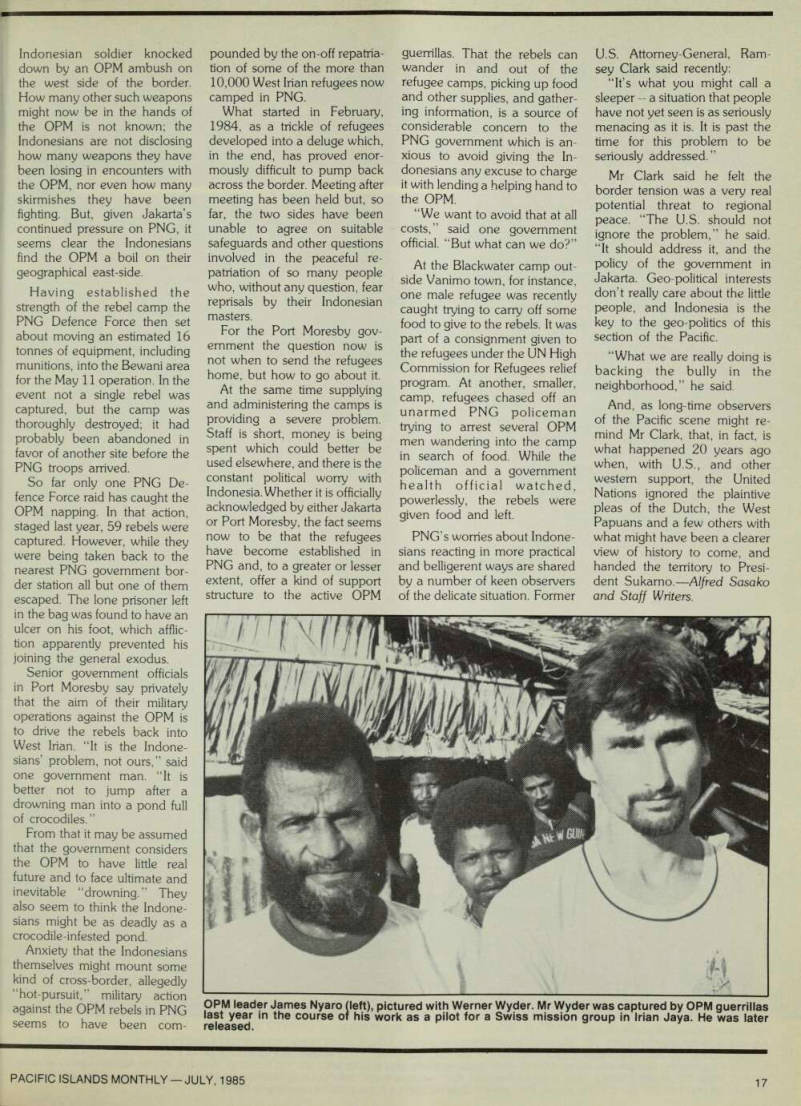
The terrorism label is seen to be justified by a number of armed hold-ups staged by OPM units last year, including the abduction of the Swiss bush pilot, Wemer Wyder, who was later released unharmed.
But, essentially, the very careful action now being under taken by PNG military units is designed to show Indonesia, which has persistently accused the Port Moresby government of providing sanctuary to the rebels, that PNG is not pre pared to allow the OPM to use its soil as a base, either political or military, for activities back in Irian Jaya.
And, underneath it all, may be remembered the words of the self-styled president of Free West Papua, James Nyaro who, 16 months ago, warned that PNG might some day be invaded by the Indonesians.
Few people in the government took that warning seriously at the time. But, today, senior officials are rethinking their views.
Far from diminishing, the border problem has grown in delicacy, with the Indonesians displaying continued irritation
Papua New Guinea has begun to send troops into the remote jungle areas along the West Irian border where, it is alleged, Free West Papua movement “terrorists” have established camps. It is an exercise of the utmost delicacy and the PNG government, conscious of Indonesian sensitivities about the OPM, as well as of Melanesian sympathies among its own people east of the border, is treading with extreme care. At the same time, the OPM guerrillas appear to be “digging in” and, according to recent reports, are now equipped with better rifles, includ ing some modern weapons, like M-16 Armalites.
PIM correspondent ALFRED SASAKO reports here from Port Moresby on how the PNG government is handling this very delicate political and communal problem.
with the increasingly establish ed presence in PNG not only of the 10,000 and more genuine refugees, but also of active OPM dissidents, some of them armed and aggressive.
Port Moresby has been at considerable pains to avoid a confrontation with Jakarta and to maintain close diplomatic relations. In their view it is their best insurance against trouble with a much larger neighbor with something of a reputation for volatility. Thus might be staved off any thought by the Indonesians of sending troops into PNG territory to deal with the troublesome OPM units.
Raids on the OPM’s “illegal hideouts” (distinct from the genuine refugee camps spread along the border zone), have been going on sporadically for some time. Success has been limited, partly because of the very difficult nature of the mountainous terrain, and also
because of the OPM’s quite efficient “bush telegraph” in telligence system. Sympathy for the OPM members rises naturally from among their Melanesian wantoks in PNG and particularly alongside the border.
The most recent operation, code-named “Operation Rausim” took place on May 11 when 200 PNG Defence Force soldiers raided a camp behind Bewani, one of PNG’s border posts in West Sepik province.
The operation was planned for weeks, an elaborate ambush was set, and then the troops stormed in. But the OPM guer rillas had gone. Government officials later conceded that it had been a “clumsy opera tion.”
Operation Rausim was a re sponse to an armed hold-up of a PNG helicopter installing two way emergency radios at re
mote schools and health centres inside PNG, along the 800 km border. The project, funded by aid from the New Zealand government, is part of the Border Improvement Prog ram, itself, in a sense, part of the overall social and political campaign affected by the West Irian situation.
The hold-up took place when a helicopter, carrying five people, including two expatri ates, set down in a clearing close to some habitation. The helicopter crew was looking for a village called Skotiau. Instead they found an OPM hideout.
The guerrillas swarmed out, carrying a variety of small arms, surrounded the chopper, seized the logbook and threatened to kill the pilot and the radio technicians. They accused them of being spies for the Indone sian government.
After two hours of argument and explanation the helicopter was allowed to leave with its crew complete, and its ears ringing with OPM warnings to keep silent about the guerrilla camp.
In the third week of April a platoon of the PNG Defence Force went into the area on a foot patrol to establish the strength of the OPM camp.
They estimated 160 guerrillas, one of them seen with an M-16 automatic rifle, which fact caused considerable dismay in Port Moresby where it was believed that the OPM’s weaponry was strictly limited to bows and arrows and elderly and unreliable shotguns.
Initial thought is that the M-16 came from some luckless
Indonesian soldier knocked down by an OPM ambush on the west side of the border.
How many other such weapons might now be in the hands of the OPM is not known; the Indonesians are not disclosing how many weapons they have been losing in encounters with the OPM, nor even how many skirmishes they have been fighting. But, given Jakarta’s continued pressure on PNG, it seems clear the Indonesians find the OPM a boil on their geographical east-side.
Having established the strength of the rebel camp the PNG Defence Force then set about moving an estimated 16 tonnes of equipment, including munitions, into the Bewani area for the May 11 operation. In the event not a single rebel was captured, but the camp was thoroughly destroyed; it had probably been abandoned in favor of another site before the PNG troops arrived.
So far only one PNG De fence Force raid has caught the OPM napping. In that action, staged last year, 59 rebels were captured. However, while they were being taken back to the nearest PNG government bor der station all but one of them escaped. The lone prisoner left in the bag was found to have an ulcer on his foot, which afflic tion apparently prevented his joining the general exodus.
Senior government officials in Port Moresby say privately that the aim of their military operations against the OPM is to drive the rebels back into West Irian. “It is the Indone sians’ problem, not ours,” said one government man. “It is better not to jump after a drowning man into a pond full of crocodiles.”
From that it may be assumed that the government considers the OPM to have little real future and to face ultimate and inevitable “drowning.” They also seem to think the Indone sians might be as deadly as a crocodile-infested pond.
Anxiety that the Indonesians themselves might mount some kind of cross-border, allegedly “hot-pursuit,” military action against the OPM rebels in PNG seems to have been com
pounded by the on-off repatria tion of some of the more than 10,000 West Irian refugees now camped in PNG.
What started in February, 1984, as a trickle of refugees developed into a deluge which, in the end, has proved enor mously difficult to pump back across the border. Meeting after meeting has been held but, so far, the two sides have been unable to agree on suitable safeguards and other questions involved in the peaceful re patriation of so many people who, without any question, fear reprisals by their Indonesian masters.
For the Port Moresby gov ernment the question now is not when to send the refugees home, but how to go about it.
At the same time supplying and administering the camps is providing a severe problem.
Staff is short, money is being spent which could better be used elsewhere, and there is the constant political worry with Indonesia. Whether it is officially acknowledged by either Jakarta or Port Moresby, the fact seems now to be that the refugees have become established in PNG and, to a greater or lesser extent, offer a kind of support structure to the active OPM
guerrillas. That the rebels can wander in and out of the refugee camps, picking up food and other supplies, and gather ing information, is a source of considerable concern to the PNG government which is an xious to avoid giving the In donesians any excuse to charge it with lending a helping hand to the OPM.
“We want to avoid that at all costs,” said one government official. “But what can we do?”
At the Blackwater camp out side Vanimo town, for instance, one male refugee was recently caught trying to carry off some food to give to the rebels. It was part of a consignment given to the refugees under the UN High Commission for Refugees relief program. At another, smaller, camp, refugees chased off an unarmed PNG policeman trying to arrest several OPM men wandering into the camp in search of food. While the policeman and a government health official watched, powerlessly, the rebels were given food and left.
PNG’s worries about Indone sians reacting in more practical and belligerent ways are shared by a number of keen observers of the delicate situation. Former
U.S. Attorney-General, Ram sey Clark said recently: “It’s what you might call a sleeper - a situation that people have not yet seen is as seriously menacing as it is. It is past the time for this problem to be seriously addressed.”
Mr Clark said he felt the border tension was a very real potential threat to regional peace. “The U.S. should not ignore the problem,” he said.
“It should address it, and the policy of the government in Jakarta. Geo-political interests don’t really care about the little people, and Indonesia is the key to the geo-politics of this section of the Pacific.
“What we are really doing is backing the bully in the neighborhood,” he said.
And, as long-time observers of the Pacific scene might re mind Mr Clark, that, in fact, is what happened 20 years ago when, with U.S., and other western support, the United Nations ignored the plaintive pleas of the Dutch, the West Papuans and a few others with what might have been a clearer view of history to come, and handed the territory to Presi dent Sukarno. —Alfred Sasako and Staff Writers.
OPM leader James Nyaro (left), pictured with Werner Wyder. Mr Wyder was captured by OPM guerrillas last year in the course of his work as a pilot for a Swiss mission group in Irian Jaya. He was later released.