The big freedom
pp. 24-25 · Read in the full issue
race of ’85
On September 8, 1984, the fate of the inhabitants of French Polynesia seemed to be sealed: on that date a new constitution (or statute) came into force. Its essential aim was to preserve the colonial set-up, and ensure that nuclear testing can go on at Moruroa and Fangataufa at least until the year 2000. As usual French officialdom and the mass media hailed this new piece of sleight of hand as an histone milestone, and the beginning of the penod of internal self-government. In fact the supposedly epoch-making new statute resembles the previous one - introduced with similar fanfare in 1977 as closely as two coconuts from the same tree.
Ironically, the only person to reap some small benefit from this slight rewnbng of the former statute - a few prerogabyes previously held by the Temtonal Assembly have been transferred to the Government Council is the local Gaullist
leader, and head of the Gov ernment Council since 1982, Gaston Flosse. The irony is that Flosse is a determined adver sary of President Mitterrand and the socialist government except on one particular, and to the French Government all important, matter; he favors continued nuclear testing in French Polynesia, Flosse , s moUves for thjs stand not be of the hi hest mora| and Wotic ord as sed b his overridi concem to extract as much bl(X)d m from the French mi)ita as he ibl can Last for exam le he d customs duties id b the for jmports of material; . food, wjne and s irits to CFPSBO o million (about SASO milljon) But to be fair it shou , d be noted that , he sensi , Hve business o( sou |. searching is an activity seldom indulged in b poi mdans of any stripe , , The strongest opposition to
the phony new statute might have been expected to come from the leaders of the so-called autonomist parties, Here aia and Ea api, who ever since 1965 had fought valiantly for a system of self-government on the Cook Islands model. But, by 1984, the old freedom fighters Pouvanaa and Teariki were dead, the 72-year-old for mer vice-president Francis San ford was in retirement, and their successors were involved in a fierce leadership struggle which had left their parties consider ably weakened.
So it happened that the most vocal opposition to continued colonial and military rule came from the three young assembly men of the pro-independence la mana te nunaa party, and from the leader of the Front de Liberation de la Polynesia, Oscar Temaru, who since 1983 has been mayor of Faaa, Tahi ti’s second biggest town. They asked: Why pretend that we’ve got internal self-government when the Paris government still controls defence, foreign affairs, the police, the courts, radio and TV, municipal affairs, in ternational communications, higher education, scientific re search, immigration, citi zenship, foreign exchange,
Postmark Papeete
currency, credit and monetary policies, overseas trade, invest ments, air and sea traffic, and the wealth of the ocean around French Polynesia’s islands?
Some activist groups, like Taata Tahiti Tiama, led by the erstwhile gadfly Charlie Ching, showed their exasperation by organising protest meetings and marches. Time and again their demonstrations were banned by the High Commissioner, and when they ignored the bans they were finally rounded up by the police and packed off to jail, where Charlie Ching and half a dozen of his followers, at time of writing, have been for three months awaiting trial.
In the meantime, the more sedate opposition party Ea api was being quietly reorganised under the leadership of Senator Daniel Millaud, who in his capa city as proxy took over Pouva naa’s seat in the French Upper House on the latter’s death in 1977, and who was re-elected in 1980 for another nine-year term. Local journalists, accus tomed to Senator Millaud’s generally suave manner, were somewhat jolted by the hard hitting and straightforward style in which he spoke at a press conference in Papeete at the end of March. The message was the same as that which other autonomist leaders had formulated, but less boldly, in December 1983 (PIM Feb. ’B4 p 64). In other words, Millaud gave an unqualified “yes” to independence.
These are the key passages
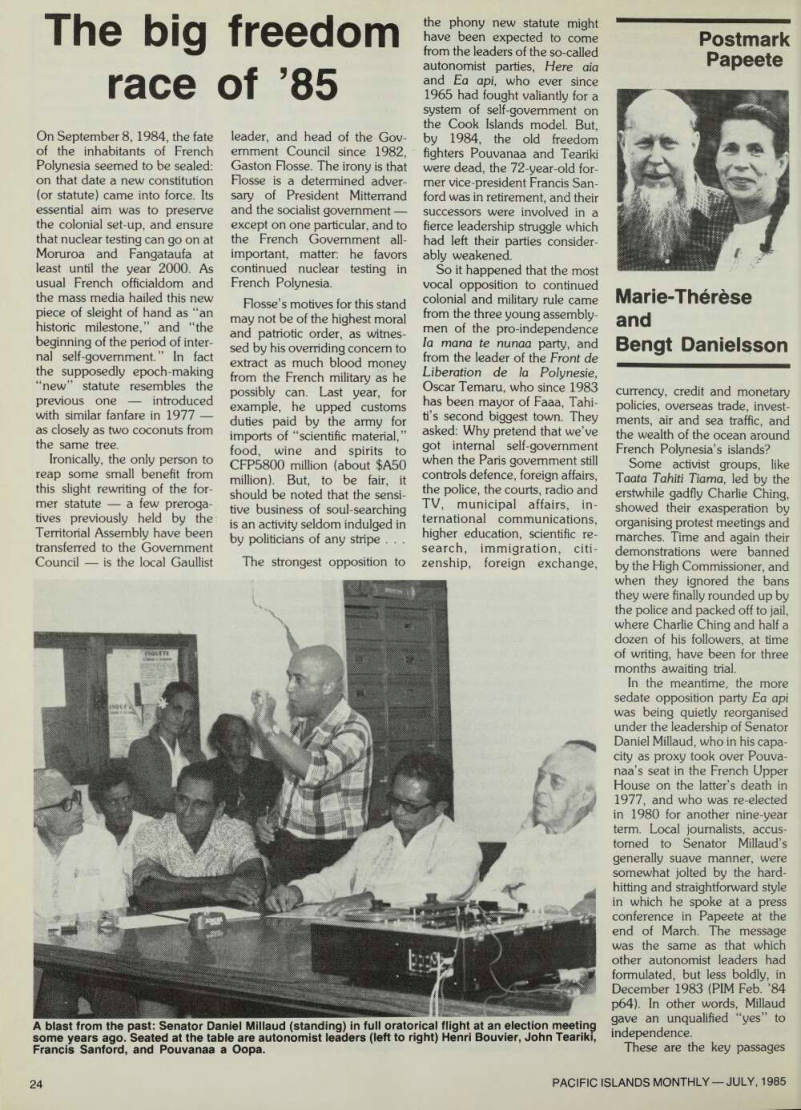
A blast from the past: Senator Daniel Millaud (standing) in oratorical flight at an election meeting some years ago. Seated at the table are autonomist leaders (left to right) Henri Bouvier, John Teariki, Francis Sanford, and Pouvanaa a Oopa.
Marie-Therese and Bengt Danielsson
from Senator Millaud’s state ment, which he had taken the trouble to put into writing, so that journalists would not miss any part of it: “The French Government is forever trying to scare us people in the overseas territories with talk about the disasters that independence would bring down upon our heads.
Although it concedes that the 1958 constitution allows us to determine our own fate, at the same time it warns us that if we use this right to achieve inde pendence, there will be no more French aid.
“It is simply despicable for a country like France to adopt this attitude, particularly if we bear in mind the fact that the preambles to both the 1946 and 1958 national constitutions lay upon France the duty and historic responsibility of leading the peoples of her overseas territories to independence.
“As the Ea api party and I myself understand these texts, we do not even have to ask or to vote for independence, as France has this constitutional and historical obligation to guide us towards independence by creating in the economic, social and cultural spheres the conditions necessary for a smooth transition.
“This is why Ea api and I have decided to propose, already at this stage, a formula of association between the two sovereign states, Polynesia and France, to be defined by con ventions and treaties specifying the types of association, co operation and mutual ex changes they desire.”
Chatting with journalists afterwards, Senator Millaud fur ther scandalised a number of them by praising Britain for the exemplary manner in which it had prepared its Pacific col onies for independence, and mentioning the Common wealth as the sort of post colonial association he had in mind.
Senator Millaud’s public de claration that he will henceforth fight might and main for inde pendence will have its most important repercussions and greatest effect in France. For while all other pro-independ ence leaders are firmly tied to their Polynesian constituencies, the senator spends most of his
time in Paris, where he serves as a sort of ambassador for French Polynesia as a whole.
What we next witnessed was a replay of the political drama which unfolded back in 1980, when the then minority leader Gaston Flosse, who had always staunchly defended French rule, suddenly came out in favor of autonomie interne (in ternal self-government), an event which we described at the time as “a political U-tum” (PIM May ’BO p 27). Senator Millaud mocked him then for his slow-wittedness, while House Speaker Teariki accused him of stealing the main plank in the autonomists’ platform as well as their voters!
This accusation arose again in the debate which has deve loped now, more than four years later, when Flosse, in a new surprise move, not only voiced his deep dissatisfaction with the present statute, but also called for another form of government altogether, which would make Polynesia virtually independent. What made his radical stand even more news worthy was the fact that he expressed his views during an audience with President Mitter rand in the Elysee Palace on May 7. As Flosse readily told
the press afterwards, Mitterrand had replied with a faint smile; But wasn’t it a bare eight months ago that Polynesia was given this new statute which you now want to change?
Yes, Mr President, con ceded Flosse, but I hope that you will start examining my request soon. The ideal statute, in my opinion, is the one they have in the Cook Islands.
Mitterrand, who probably hadn’t done much homework on the Cooks constitution, chose to give a non-committal reply: It is still a little early to modify the new statute.
Bearing in mind the gradual extension since 1965 of the already very wide powers granted the Cook Islands by New Zealand the Rarotonga Government, for instance, now also handles foreign affairs, de fence and immigration, even when the applicants are New Zealanders French Polynesia, by adopting a similar statute, would in practice be come an independent state.
And it would still receive gen erous economic and technical assistance.
Why has Flosse burnt the gods he still worshipped so short a time ago? The answer is in all likelihood quite simply
that during the past eight months he has discovered how utterly impossible it is to govern the territory on the basis of the present hybrid statute, and with the grudging help of a French type administration, dominated by expatriates.
The only major political lead er who has declared himself perfectly happy with the ex isting statute is “Sheriff” Ver naudon, whose Aia api party polled 11 per cent of the votes in the last territorial election in May 1982. Even if we assume that he can still command the same number of votes, which is far from certain, it can safely be said that the overwhelming majority of Polynesian voters are today backing one or other of the athletes taking part in the great 1985 freedom race. What their preferences are will not be known exactly until June 1986, when the next general election is to be held. Everything seems to indicate, however, that the spectators cheering the front runners, with the single word INDEPENDENCE emblazoned across their striped red and white T-shirts, are now just as numerous as those of the fast sprinting Gaston Flosse, still clad in his French tricolor track suit. Marie-Therese and Bengt Danielsson.