Rarotonga Golf Club - all
pp. 43-45 · Read in the full issue
tropicalities
Rarotonga Golf Club - all set for the third Pro-Am
The Rarotonga Golf Club has had a chequered history. Towards the end of the 1939-45 war the first airport was constructed on the island, and it is said that Alf Bailey, who was a very competent golfer, had in mind its alternative use as a golf course, as he became involved in the construction work. Alf, who was a long-driving left hander, is alleged to have de signed the layout of the course so that his natural slice took his shots back on to the fairways.
The strip, which had grass surrounds, was of compacted coral and for golfing purposes was regarded as a lake. On several of the 18 holes which were eventually established, balls coming to rest on the strip had to be played as if they were in a water hazard. There were also several very deep drains down which many an unwary or careless player disappeared, sometimes to emerge many shots later, frustrated and defe ated by the chasms.
It was very easy to put balls outside the boundaries of the course and there they would disappear into the coconut groves. There were other in teresting factors to influence play. The golfers had to share their course with the require ments of aviation. If during play the fire engine, siren blaring, travelled up the strip, players were required to retire to the fence line until the all-clear was sounded. If any planes were parked near the airport admin istration buildings the players were required to play away from the area until their balls were clear of the aircraft.
The course was rated by the New Zealand Golfing Associa tion, and Alf Bailey was club champion on many occasions.
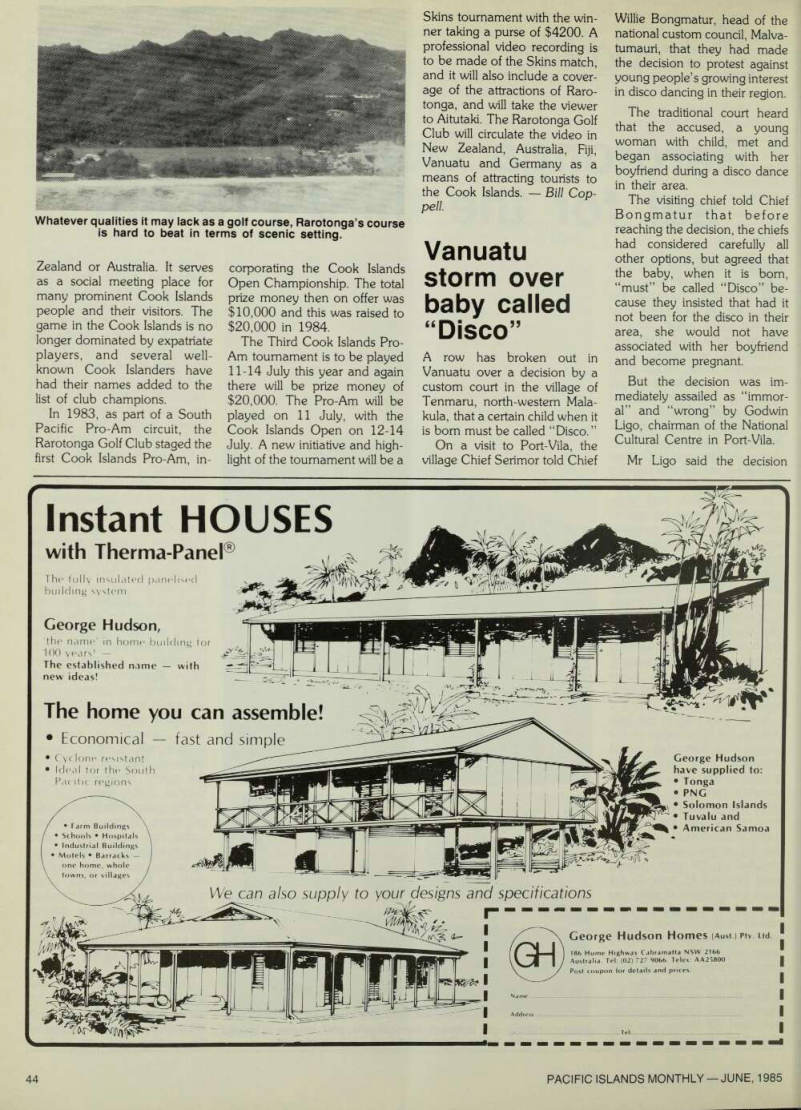
From the small but comfortable clubhouse above the aircraft hurricane shelter, the Raroton ga golf course looked to be a “piece of cake” to many low handicap golfers visiting the island for the first time. The first shot, across the road, over the airstrip and onto a pocket handkerchief sized green, hard up against the boundary fence, usually brought them undone and introduced them to a course which had many tricks in its locker.
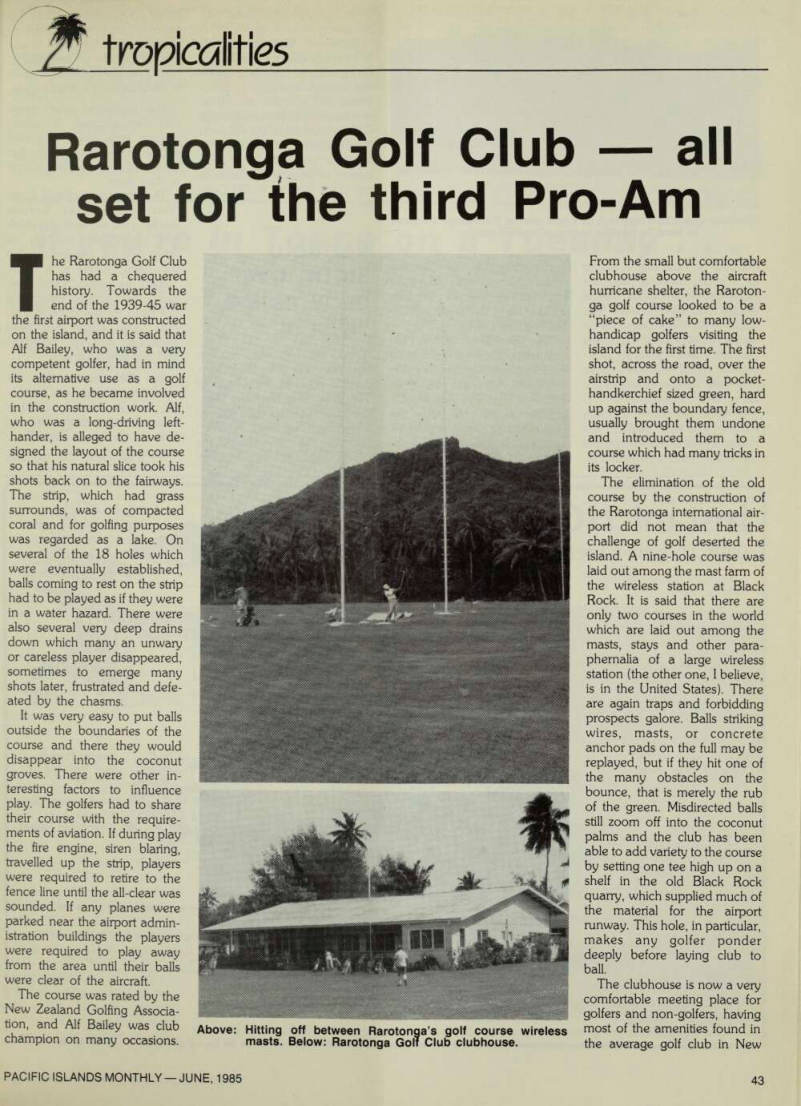
The elimination of the old course by the construction of the Rarotonga international air port did not mean that the challenge of golf deserted the island. A nine-hole course was laid out among the mast farm of the wireless station at Black Rock. It is said that there are only two courses in the world which are laid out among the masts, stays and other para phernalia of a large wireless station (the other one, I believe, is in the United States). There are again traps and forbidding prospects galore. Balls striking wires, masts, or concrete anchor pads on the full may be replayed, but if they hit one of the many obstacles on the bounce, that is merely the rub of the green. Misdirected balls still zoom off into the coconut palms and the club has been able to add variety to the course by setting one tee high up on a shelf in the old Black Rock quarry, which supplied much of the material for the airport runway. This hole, in particular, makes any golfer ponder deeply before laying club to ball.
The clubhouse is now a very comfortable meeting place for golfers and non-golfers, having most of the amenities found in the average golf club in New
Above: Hitting off between Rarotonga’s golf course wireless masts. Below: Rarotonga Golf Club clubhouse.
Zealand or Australia. It serves as a social meeting place for many prominent Cook Islands people and their visitors. The game in the Cook Islands is no longer dominated by expatriate players, and several well known Cook Islanders have had their names added to the list of club champions.
In 1983, as part of a South Pacific Pro-Am circuit, the Rarotonga Golf Club staged the first Cook Islands Pro-Am, in
corporating the Cook Islands Open Championship. The total prize money then on offer was $lO,OOO and this was raised to $20,000 in 1984.
The Third Cook Islands Pro- Am tournament is to be played 11-14 July this year and again there will be prize money of $20,000. The Pro-Am will be played on 11 July, with the Cook Islands Open on 12-14 July. A new initiative and high light of the tournament will be a
Skins tournament with the win ner taking a purse of $4200. A professional video recording is to be made of the Skins match, and it will also include a cover age of the attractions of Raro tonga, and will take the viewer to Aitutaki. The Rarotonga Golf Club will circulate the video in New Zealand, Australia, Fiji, Vanuatu and Germany as a means of attracting tourists to the Cook Islands. Bill Cop pell.
Vanuatu
storm over
baby called
“Disco”
A row has broken out in Vanuatu over a decision by a custom court in the village of Tenmaru, north-western Mala kula, that a certain child when it is bom must be called “Disco.”
On a visit to Port-Vila, the village Chief Serimor told Chief
Willie Bongmatur, head of the national custom council, Malva tumauri, that they had made the decision to protest against young people’s growing interest in disco dancing in their region.
The traditional court heard that the accused, a young woman with child, met and began associating with her boyfriend during a disco dance in their area.
The visiting chief told Chief Bongmatur that before reaching the decision, the chiefs had considered carefully all other options, but agreed that the baby, when it is born, “must” be called “Disco” be cause they insisted that had it not been for the disco in their area, she would not have associated with her boyfriend and become pregnant.
But the decision was im mediately assailed as “immor al” and “wrong” by Godwin Ligo, chairman of the National Cultural Centre in Port-Vila.
Mr Ligo said the decision
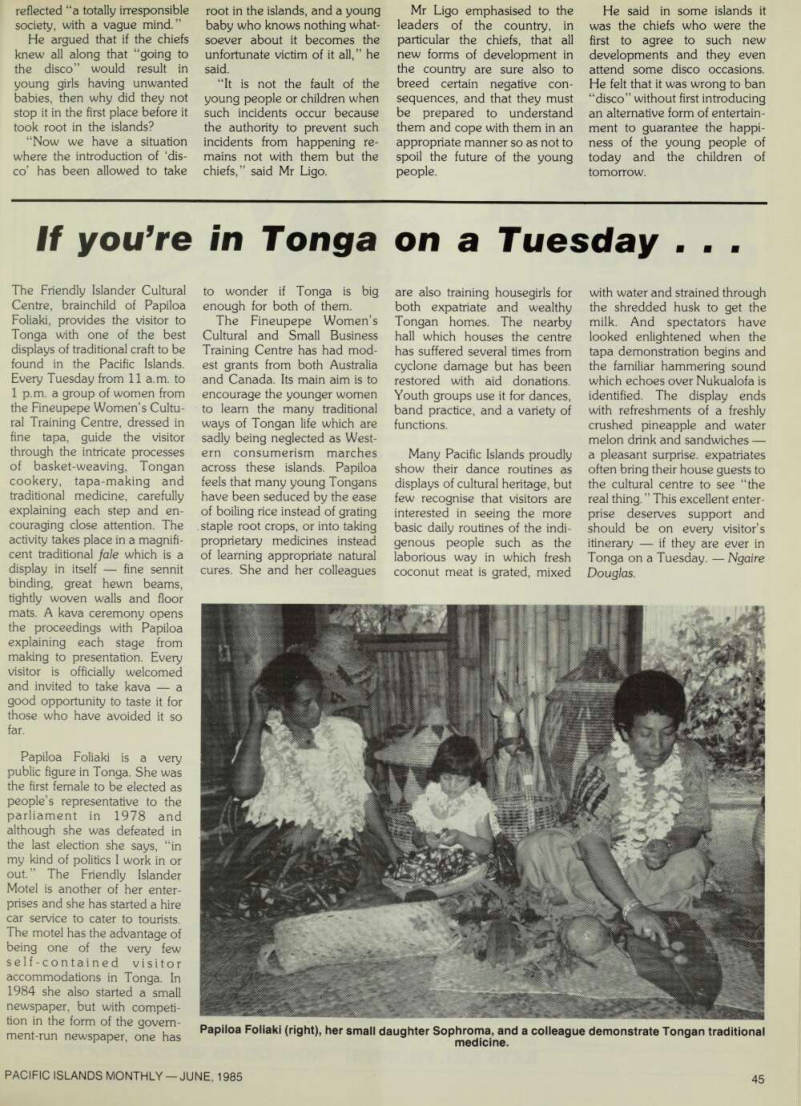
Whatever qualities it may lack as a golf course, Rarotonga’s course is hard to beat in terms of scenic setting.
reflected “a totally irresponsible society, with a vague mind.”
He argued that if the chiefs knew all along that “going to the disco” would result in young girls having unwanted babies, then why did they not stop it in the first place before it took root in the islands?
“Now we have a situation where the introduction of ‘disco’ has been allowed to take
root in the islands, and a young baby who knows nothing what soever about it becomes the unfortunate victim of it all,” he said.
“It is not the fault of the young people or children when such incidents occur because the authority to prevent such incidents from happening re mains not with them but the chiefs,” said Mr Ligo.
Mr Ligo emphasised to the leaders of the country, in particular the chiefs, that all new forms of development in the country are sure also to breed certain negative consequences, and that they must be prepared to understand them and cope with them in an appropriate manner so as not to spoil the future of the young people.
He said in some islands it was the chiefs who were the first to agree to such new developments and they even attend some disco occasions, He felt that it was wrong to ban “disco” without first introducing an alternative form of entertain ment to guarantee the happi ness of the young people of today and the children of tomorrow.