secret of flying lady Earhart
pp. 40-42 · Read in the full issue
Flying Lady in a quest for the secret of flying lady Earhart
The Flying Lady had been a twinkle in the eye of Ralph and Cheryl Baker ever since the completion of their first boat, the Least Tern , a traditional cutter rig which they built them selves. This first vessel, how ever, was too small for the adventures Ralph and his wife Cheryl had in mind, and so when the opportunity arose for them to purchase a half finished hull of ocean-going dimensions, and of a design they had dreamed of, it seemed almost too good to be true.
In September 1979 on the shores of Seattle, Washington, lying in a shed and in need of much love and attention, was the beginning of Sailing Vessel Flying Lady. Her keel was already laid and her bent oak frames were planked with the best Douglas fir. She was de signed by Pete Culler, famous for his sailing craft of the 1840 s.
Her dimensions are 10.9 m on deck, 3.5 m beam, and she draws 2.1 m. Her overall length is 16.1 m so one does not have to be a mathematical wizard to figure out the length of the very
JULIAN PUTLEY here tells the story of a 1983 expedition which led to the discovery of a previously unknown island, believed to be the scene of the 1937 crash in which Americans Amelia Earhart and Fred Noonan disappeared. Their plane has never been found.
A Peaceful Discovery claim in relation to the island has been submitted to the U.S. State Department. The island will be called Gervais Island after the expedition leader, and has been claimed for the United States in accordance with procedures set forth in the American Guano Act of August 18, 1856. Major Joe Gervais has claimed this island as his personal property by right of discovery. It will be recorded in Notice to Mariners.
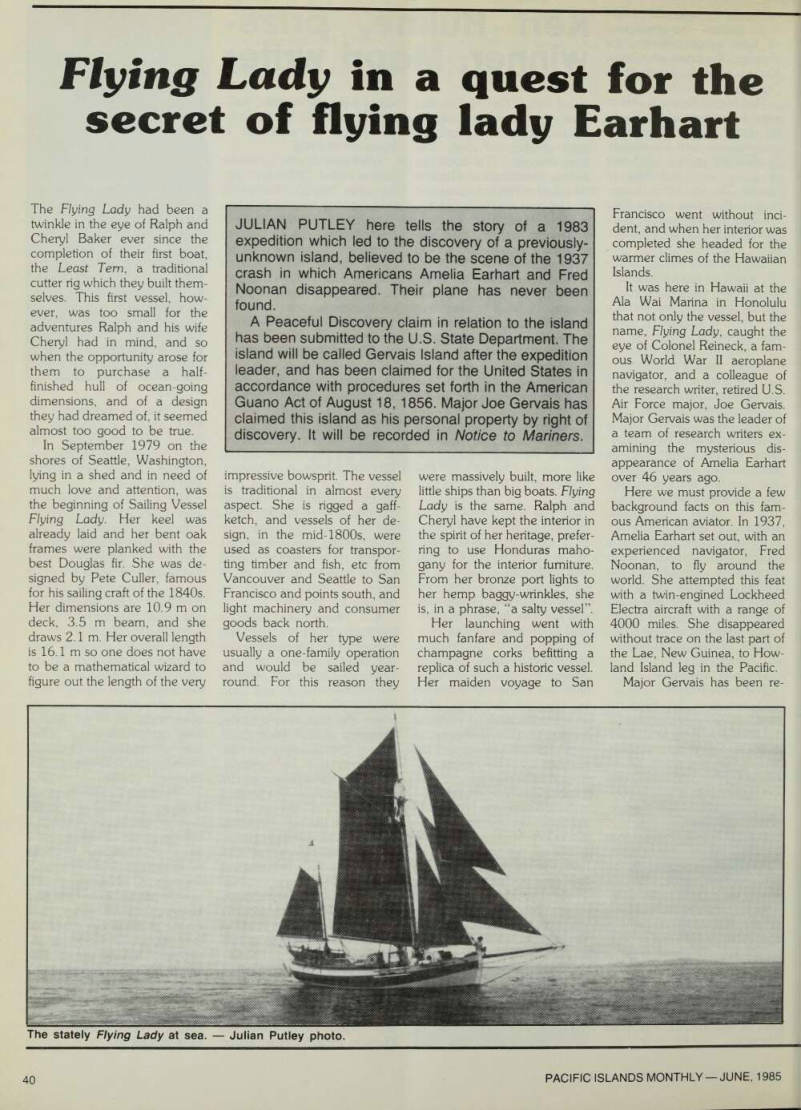
impressive bowsprit. The vessel is traditional in almost every aspect. She is rigged a gaff ketch, and vessels of her de sign, in the mid-1800s, were used as coasters for transpor ting timber and fish, etc from Vancouver and Seattle to San Francisco and points south, and light machinery and consumer goods back north.
Vessels of her type were usually a one-family operation and would be sailed year round. For this reason they
were massively built, more like little ships than big boats. Flying Lady is the same. Ralph and Cheryl have kept the interior in the spirit of her heritage, prefer ring to use Honduras maho gany for the interior furniture.
From her bronze port lights to her hemp baggy-wrinkles, she is, in a phrase, “a salty vessel”.
Her launching went with much fanfare and popping of champagne corks befitting a replica of such a historic vessel.
Her maiden voyage to San
Francisco went without inci dent, and when her interior was completed she headed for the warmer climes of the Hawaiian Islands.
It was here in Hawaii at the Ala Wai Marina in Honolulu that not only the vessel, but the name, Flying Lady, caught the eye of Colonel Reineck, a fam ous World War II aeroplane navigator, and a colleague of the research writer, retired U.S.
Air Force major, Joe Gervais.
Major Gervais was the leader of a team of research writers ex amining the mysterious dis appearance of Amelia Earhart over 46 years ago.
Here we must provide a few background facts on this fam ous American aviator. In 1937, Amelia Earhart set out, with an experienced navigator, Fred Noonan, to fly around the world. She attempted this feat with a twin-engined Lockheed Electra aircraft with a range of 4000 miles. She disappeared without trace on the last part of the Lae, New Guinea, to How land Island leg in the Pacific.
Major Gervais has been re-
The stately Flying Lady at sea. - Julian Putley photo.
searching this enigma for at least 25 years. The following are some of the facts leading up to what is now known as “The Gervais Island Expedition,” to find an uncharted island which Major Gervais believes to be the resting place of the crashed plane.
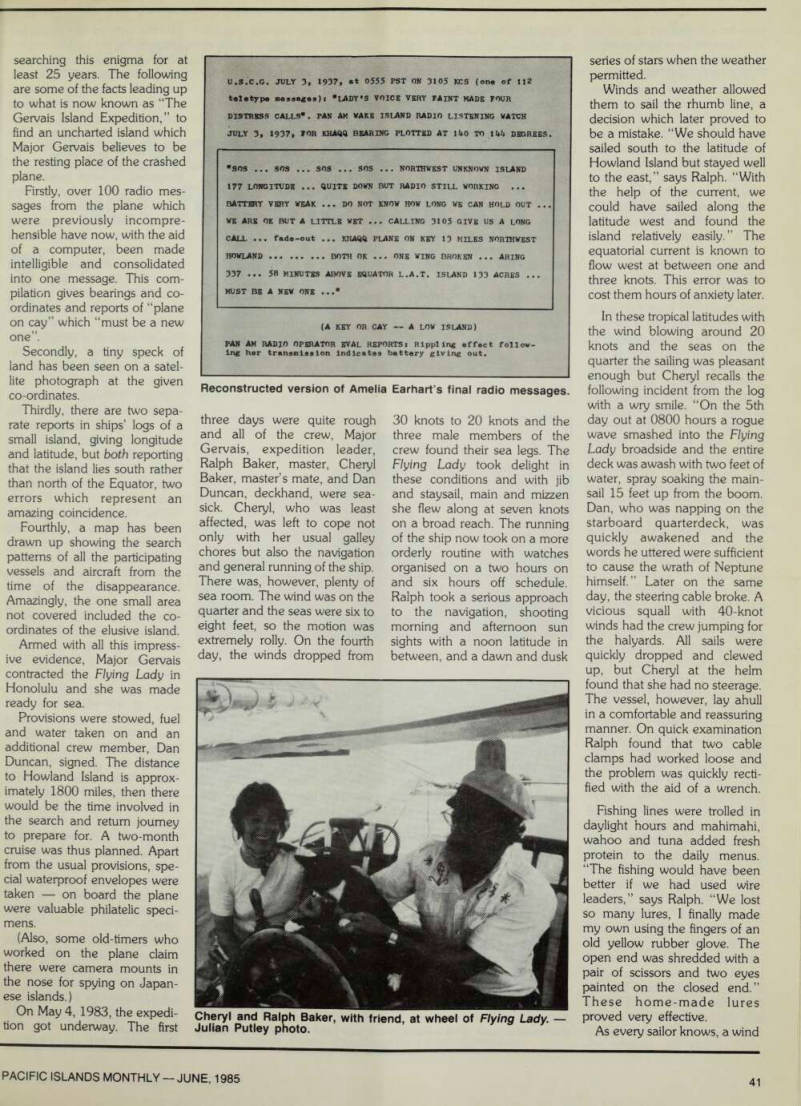
Firstly, over 100 radio mes sages from the plane which were previously incompre hensible have now, with the aid of a computer, been made intelligible and consolidated into one message. This com pilation gives bearings and co ordinates and reports of “plane on cay” which “must be a new one”.
Secondly, a tiny speck of land has been seen on a satel lite photograph at the given co-ordinates.
Thirdly, there are two sepa rate reports in ships’ logs of a small island, giving longitude and latitude, but both reporting that the island lies south rather than north of the Equator, two errors which represent an amazing coincidence.
Fourthly, a map has been drawn up showing the search patterns of all the participating vessels and aircraft from the time of the disappearance.
Amazingly, the one small area not covered included the co ordinates of the elusive island.
Armed with all this impress ive evidence, Major Gervais contracted the Flying Lady in Honolulu and she was made ready for sea.
Provisions were stowed, fuel and water taken on and an additional crew member, Dan Duncan, signed. The distance to Howland Island is approx imately 1800 miles, then there would be the time involved in the search and return journey to prepare for. A two-month cruise was thus planned. Apart from the usual provisions, spe cial waterproof envelopes were taken on board the plane were valuable philatelic speci mens. (Also, some old-timers who worked on the plane claim there were camera mounts in the nose for spying on Japan ese islands.) On May 4, 1983, the expedi tion got underway. The first
three days were quite rough and all of the crew, Major Gervais, expedition leader, Ralph Baker, master, Cheryl Baker, master’s mate, and Dan Duncan, deckhand, were sea sick. Cheryl, who was least affected, was left to cope not only with her usual galley chores but also the navigation and general running of the ship.
There was, however, plenty of sea room. The wind was on the quarter and the seas were six to eight feet, so the motion was extremely roily. On the fourth day, the winds dropped from
30 knots to 20 knots and the three male members of the crew found their sea legs. The Flying Lady took delight in these conditions and with jib and staysail, main and mizzen she flew along at seven knots on a broad reach. The running of the ship now took on a more orderly routine with watches organised on a two hours on and six hours off schedule.
Ralph took a serious approach to the navigation, shooting morning and afternoon sun sights with a noon latitude in between, and a dawn and dusk
series of stars when the weather permitted.
Winds and weather allowed them to sail the rhumb line, a decision which later proved to be a mistake. “We should have sailed south to the latitude of Howland Island but stayed well to the east,” says Ralph. “With the help of the current, we could have sailed along the latitude west and found the island relatively easily.” The equatorial current is known to flow west at between one and three knots. This error was to cost them hours of anxiety later.
In these tropical latitudes with the wind blowing around 20 knots and the seas on the quarter the sailing was pleasant enough but Cheryl recalls the following incident from the log with a wry smile. “On the sth day out at 0800 hours a rogue wave smashed into the Flying Lady broadside and the entire deck was awash with two feet of water, spray soaking the main sail 15 feet up from the boom.
Dan, who was napping on the starboard quarterdeck, was quickly awakened and the words he uttered were sufficient to cause the wrath of Neptune himself.” Later on the same day, the steering cable broke. A vicious squall with 40-knot winds had the crew jumping for the halyards. All sails were quickly dropped and clewed up, but Cheryl at the helm found that she had no steerage.
The vessel, however, lay ahull in a comfortable and reassuring manner. On quick examination Ralph found that two cable clamps had worked loose and the problem was quickly recti fied with the aid of a wrench.
Fishing lines were trolled in daylight hours and mahimahi, wahoo and tuna added fresh protein to the daily menus.
“The fishing would have been better if we had used wire leaders,” says Ralph. “We lost so many lures, I finally made my own using the fingers of an old yellow rubber glove. The open end was shredded with a pair of scissors and two eyes painted on the closed end.”
These home-made lures proved very effective.
As every sailor knows, a wind
Reconstructed version of Amelia Earhart’s final radio messages.
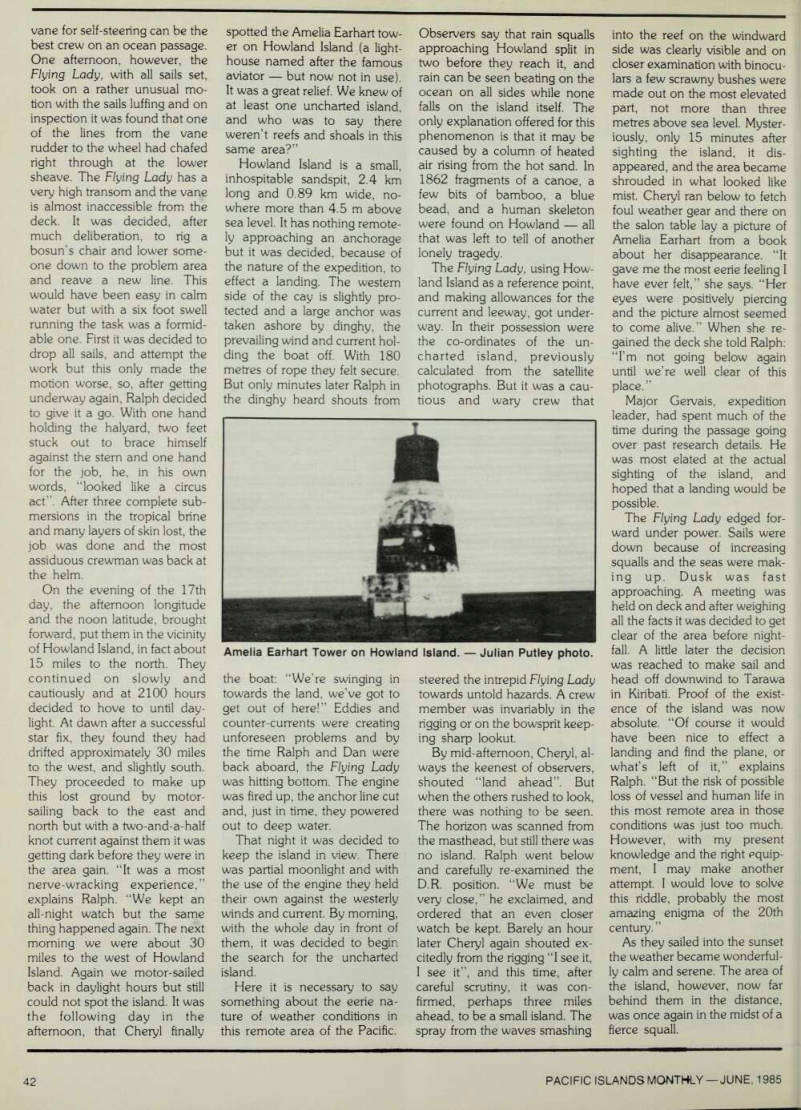
Cheryl and Ralph Baker, with friend, at wheel of Flying Lady.- Julian Putley photo.
vane for self-steering can be the best crew on an ocean passage.
One afternoon, however, the Flying Lady, with all sails set, took on a rather unusual mo tion with the sails luffing and on inspection it was found that one of the lines from the vane rudder to the wheel had chafed right through at the lower sheave. The Flying Lady has a very high transom and the vane is almost inaccessible from the deck. It was decided, after much deliberation, to rig a bosun’s chair and lower some one down to the problem area and reave a new line. This would have been easy in calm water but with a six foot swell running the task was a formid able one. First it was decided to drop all sails, and attempt the work but this only made the motion worse, so, after getting underway again, Ralph decided to give it a go. With one hand holding the halyard, two feet stuck out to brace himself against the stem and one hand for the job, he, in his own words, “looked like a circus act”. After three complete sub mersions in the tropical brine and many layers of skin lost, the job was done and the most assiduous crewman was back at the helm.
On the evening of the 17th day, the afternoon longitude and the noon latitude, brought forward, put them in the vicinity of Howland Island, in fact about 15 miles to the north. They continued on slowly and cautiously and at 2100 hours decided to hove to until day light. At dawn after a successful star fix, they found they had drifted approximately 30 miles to the west, and slightly south.
They proceeded to make up this lost ground by motor sailing back to the east and north but with a two-and-a-half knot current against them it was getting dark before they were in the area gain. “It was a most nerve-wracking experience,” explains Ralph. “We kept an all-night watch but the same thing happened again. The next morning we were about 30 miles to the west of Howland Island. Again we motor-sailed back in daylight hours but still could not spot the island. It was the following day in the afternoon, that Cheryl finally
spotted the Amelia Earhart tow er on Howland Island (a light house named after the famous aviator but now not in use).
It was a great relief. We knew of at least one uncharted island, and who was to say there weren’t reefs and shoals in this same area?”
Howland Island is a small, inhospitable sandspit, 2.4 km long and 0.89 km wide, no where more than 4.5 m above sea level. It has nothing remote ly approaching an anchorage but it was decided, because of the nature of the expedition, to effect a landing. The western side of the cay is slightly pro tected and a large anchor was taken ashore by dinghy, the prevailing wind and current hol ding the boat off. With 180 metres of rope they felt secure.
But only minutes later Ralph in the dinghy heard shouts from
the boat: “We’re swinging in towards the land, we’ve got to get out of here!” Eddies and counter-currents were creating unforeseen problems and by the time Ralph and Dan were back aboard, the Flying Lady was hitting bottom. The engine was fired up, the anchor line cut and, just in time, they powered out to deep water.
That night it was decided to keep the island in view. There was partial moonlight and with the use of the engine they held their own against the westerly winds and current. By morning, with the whole day in front of them, it was decided to begin the search for the uncharted island.
Here it is necessary to say something about the eerie na ture of weather conditions in this remote area of the Pacific.
Observers say that rain squalls approaching Howland split in two before they reach it, and rain can be seen beating on the ocean on all sides while none falls on the island itself. The only explanation offered for this phenomenon is that it may be caused by a column of heated air rising from the hot sand. In 1862 fragments of a canoe, a few bits of bamboo, a blue bead, and a human skeleton were found on Howland all that was left to tell of another lonely tragedy.
The Flying Lady, using How land Island as a reference point, and making allowances for the current and leeway, got under way. In their possession were the co-ordinates of the un charted island, previously calculated from the satellite photographs. But it was a cau tious and wary crew that
steered the intrepid Flying Lady towards untold hazards. A crew member was invariably in the rigging or on the bowsprit keep ing sharp lookut.
By mid-afternoon, Cheryl, al ways the keenest of observers, shouted “land ahead”. But when the others rushed to look, there was nothing to be seen.
The horizon was scanned from the masthead, but still there was no island. Ralph went below and carefully re-examined the D.R. position. “We must be very close,” he exclaimed, and ordered that an even closer watch be kept. Barely an hour later Cheryl again shouted ex citedly from the rigging “I see it, I see it”, and this time, after careful scrutiny, it was con firmed, perhaps three miles ahead, to be a small island. The spray from the waves smashing
into the reef on the windward side was clearly visible and on closer examination with binocu lars a few scrawny bushes were made out on the most elevated part, not more than three metres above sea level. Myster iously, only 15 minutes after sighting the island, it dis appeared, and the area became shrouded in what looked like mist. Cheryl ran below to fetch foul weather gear and there on the salon table lay a picture of Amelia Earhart from a book about her disappearance. “It gave me the most eerie feeling I have ever felt,” she says. “Her eyes were positively piercing and the picture almost seemed to come alive.” When she re gained the deck she told Ralph: “I’m not going below again until we’re well clear of this place.”
Major Gervais, expedition leader, had spent much of the time during the passage going over past research details. He was most elated at the actual sighting of the island, and hoped that a landing would be possible.
The Flying Lady edged for ward under power. Sails were down because of increasing squalls and the seas were mak ing up. Dusk was fast approaching. A meeting was held on deck and after weighing all the facts it was decided to get clear of the area before night fall. A little later the decision was reached to make sail and head off downwind to Tarawa in Kiribati. Proof of the exist ence of the island was now absolute. “Of course it would have been nice to effect a landing and find the plane, or what’s left of it,” explains Ralph. “But the risk of possible loss of vessel and human life in this most remote area in those conditions was just too much.
However, with my present knowledge and the right equip ment, I may make another attempt. I would love to solve this riddle, probably the most amazing enigma of the 20th century. ”
As they sailed into the sunset the weather became wonderful ly calm and serene. The area of the island, however, now far behind them in the distance, was once again in the midst of a fierce squall.
Amelia Earhart Tower on Howland Island. - Julian Putley photo.