Major promotion in Oz, NZ, for
pp. 27-29 · Read in the full issue

trade winds
Major promotion in Oz, NZ, for Islands fruit, vegetables
Somewhere in the annals of man there is probably an old ad age suggesting that the windows to a man’s sto mach are his eyes.” If there isn’t, then the Sydney-based company, Prinut (Aust), Pty Ltd., is about to launch it, and, at the same time, do some good for Pacific fruit and vegetable growers.
Prinut imports agricultural products from the South Pacific islands, mainly coconuts and coconut products, through its branch in Apia, Western Samoa, and it has linked the sale of its goods to promotion of a cook book, which it will market not through bookshops, but in the vegetable section of supermarkets. Thus, they hope, Australian housewives will be shown, in full, glowing color, the taste delights which await them the moment they leam how to cook and present tropi cal fruits and vegetables.
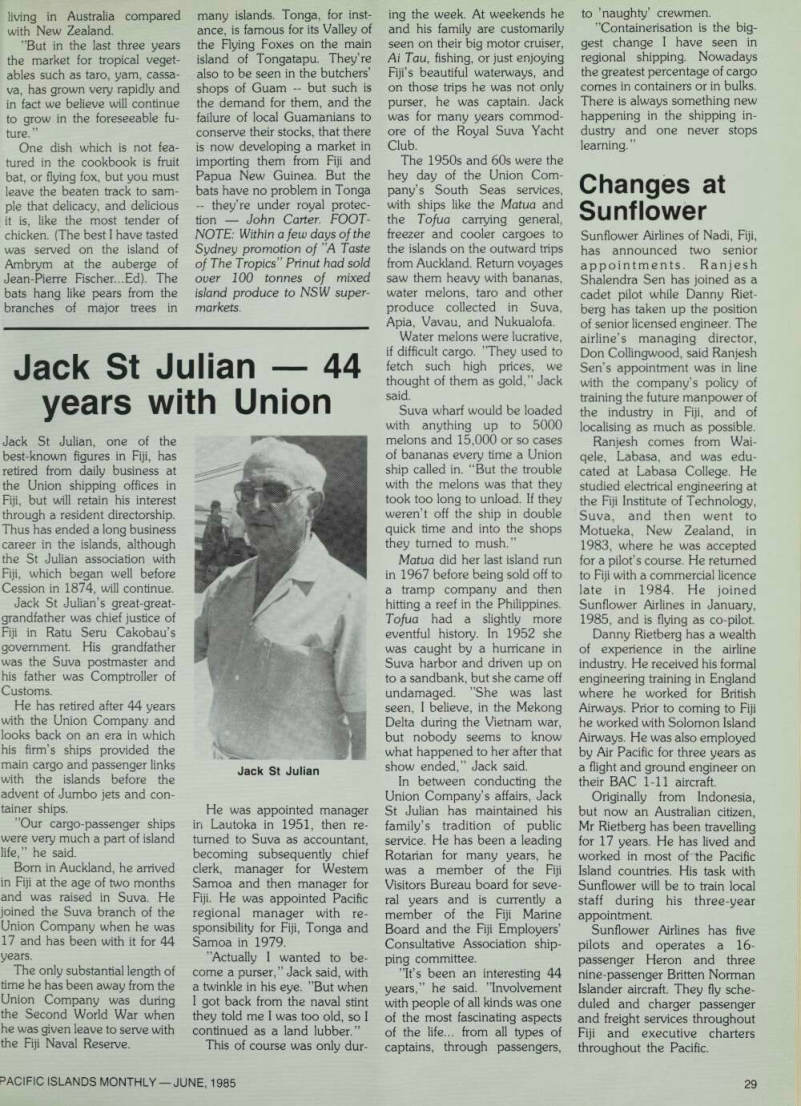
The cook book is A Taste of the Tropics, co-authored by Susan Parkinson and Peggy Stacey, both dieticians and au thors of the Pacific Publications volume, Pacific Islands Cook book, in conjunction with Adrian Mattinson, manager of a major chain of hotels in Fiji. It is an unusual promotion which may be unique in Australian marketing history.
The philosophy behind the venture is the unarguable fact that most Australians don’t know how to treat many of the very wide range of tropical fruits and vegetables how coming on to the market here. The new book will tempt them, and teach them, right on the fruit shelves.
A Taste of the Tropics was designed and produced by Asia Pacific Economic News, Ltd., of Wellington, New Zealand, and is being retailed in Australia for
$4.99, with Prinut, publishers, running the Australian promo tion.
They opened the campaign in April with a ceremony, com plete with a menu from the book, at the Monsoon re staurant in the Sydney suburb of Leichhardt.
The cookbook ranges right across tropical cuisine, starting with hors d’oeuvres, and the modern fad of ’’dips and chips” which demonstrate the versatil ity of such island staples as sweet potato, green bananas, taro (called dalo in Fiji), cassa va, avocado, and coconut. It moves on through cocktails and sauces to soups, salads, fish, meats, vegetables, pancakes
and desserts.
Right in the middle of the book is a complete guide to tropical fruit and vegetables, sponsored by the National Marketing Authority of Fiji, by the use of which even the average non-culinary husband could identify all the produce available from the islands. In deed, it could without doubt also help the novice making his or her first foray into an island market.
For example, it gives space to duruka, or ’’Fiji asparagus”, which is, in fact, a wild sugar cane species, delicious when braised in coconut milk. Its devotees say it leaves aspar agus for dead. Then there are
mango, okra, guava, pawpaw, soursop, yams and others to tickle the taste buds and entice gourmets and gourmands to climb aboard Prinut’s band wagon.
Among those with a keen interest in the promotion are Air Pacific and Polynesian Airlines and if anyone wants to know what airlines are doing pushing cookbooks, try sampling some of the dishes and see if you can resist buying a ticket to see how it’s done on the ground in the islands.
The Australian promotion is the biggest so far, but a similar one is also in train in New Zealand with the support of the government there, and the Ex port Institute. Prinut has 60,000 copies of the book for sale in Australia and the New Zealand marketers have 15,000. The University of the South Pacific has taken 3000 for sale in the islands - all of which adds up to one of the biggest first-off-the ground launchings for any book on an island topic.
Because of the trade the cook book is expected to gener ate between Australia and the islands, the South Pacific Trade Commission, headed by Mr Bill McCabe, and the Fiji Trade Commissioner, Mr Neville Smith, are taking part in the promotion. Of the current trend towards tropical produce Mr McCabe says; ’They are very different mar kets for tropical produce. In New Zealand there is a quite well developed market, espe cially for fruits and vegetables, and demand has been steady and strong for some time.
Tn Australia there has been strong seasonal demand for fruit, but not a strong demand for the vegetables. It is a re latively small market probably because there is only a small community of Pacific Islanders
living in Australia compared with New Zealand. ’’But in the last three years the market for tropical veget ables such as taro, yam, cassa va, has grown very rapidly and in fact we believe will continue to grow in the foreseeable fu ture.”
One dish which is not fea tured in the cookbook is fruit bat, or flying fox, but you must leave the beaten track to sam ple that delicacy, and delicious it is, like the most tender of chicken. (The best I have tasted was served on the island of Ambrym at the auberge of Jean-Pierre Fischer...Ed). The bats hang like pears from the branches of major trees in
many islands. Tonga, for inst ance, is famous for its Valley of the Flying Foxes on the main island of Tongatapu. They’re also to be seen in the butchers’ shops of Guam -- but such is the demand for them, and the failure of local Guamanians to conserve their stocks, that there is now developing a market in importing them from Fiji and Papua New Guinea. But the bats have no problem in Tonga they’re under royal protec tion John Carter. FOOT NOTE: Within a few days of the Sydney promotion of ”A Taste of The Tropics” Prinut had sold over 100 tonnes of mixed island produce to NSW super markets.