Bligh’s cave:
pp. 25-26 · Read in the full issue
196 years on
The cave in' the cliff above Adamstown on Pitcairn, where Fletcher Christian used to sit, staring out over the ocean and brooding over his fate, is often described and illustrated in the numerous books and articles on the famous mutiny on the Bounty which continue to flow from the presses in an ever increasing number. On the con trary, none of the Bounty chro niclers has had anything to say about the beach cave on the Tongan island of Tofua, where Captain Bligh spent the four days following immediately upon the mutiny, that is April 29 until May 2, 1789, con templating his plight, in the company of the 18 unhappy crew members, who had either chosen to go with him in the small, 23ft, launch or been forced by the mutineers to do so.
It should be mentioned, perhaps, in the name of abso lute accuracy, that the Amer ican writer, Luis Marden, in an article about ’’The Friendly Isles of Tonga,” published in the March, 1968, issue of the ’’Na tional Geographic” magazine, claims to have found not only Captain Bligh’s cave, but also the grave of Bounty’s quar termaster, John Norton, killed on the beach in front of the cave, while trying to disengage the anchor during the final struggle with a band of Tongan warriors, which ended with the miraculous escape of Bligh and his 17 companions.
One of the glossy photo graphs illustrating this article shows a huge circle of stones which Marden on dubious grounds was naively led to believe was poor Norton’s grave. But, strangely enough, there is no picture at all of the ’’small, rubble-strewn beach cut off at each end by lava spurs,” which Marden, on somewhat shaky grounds, identifies in the text with the historical cove where Bligh and his men camped before setting out on their epic, 3600-mile voyage across uncharted seas to Timor.
The main weakness of this
isolated attempt to find Bligh’s cove seemed to us, right from the beginning, to be that Mar den placed it on the wind exposed south-east coast of Tofua. But, the main actor himself definitely says in his log that it was located, as one would expect from such an experienced sailor as Captain Bligh, on the much better sheltered north-west coast.
Unfortunately it was not pos sible for us to travel to Tofua for an on the spot verification, as no passenger ships ever called there, and even the captains of the small Tongan inter-island trading vessels were loathe to include it on their itineraries.
As the years passed, the most we managed to do was to catch a fleeting glimpse of Tofua when passing through Tongan waters on the specialised cruise ship Lindblad Explorer.
But, at long last, in March this year, the new cruise director of this ship saw the light and ordered a landfall at this historic spot.
It was early morning when we approached the 1600 ft high island from the north, and as the sea breeze gradually blew away the bitter, sulphurous, smokescreen billowing from the
still active volcano, we could clearly see a gently sloping, lush, green and tree-covered plateau, abruptly cut off at its lower end along the coast by 100 ft high, vertical cliffs.
The narrow beaches which sparingly dotted the coast were all strewn with boulders and lashed by a mighty surf. Almost 200 years ago Captain Bligh noted in a dismal mood that ’’the whole coast we have seen is an entire precipice.”
According to the few and sketchy maps in existence, there should be a village named Hokula somewhere on the northern slope of the volcano.
Through our binoculars we also soon spotted a few huts in a clump of coconut palms, and a shining object which we took for a typical Pacific island church. There was no jetty or protected cove, and we were therefore more grateful than ever that the ship carried flat bottomed Zodiac boats in which we could safely surf through the breakers and somewhat less comfortably crash land on the stony beach.
A narrow path winding up through a ravine took us up to the plateau above, where we found a dozen thatched huts grouped around a plank house with a corrugated iron roof the shiny object we had seen from the ship which turned out not to be a church but a school for six pupils in six different grades (The United
Postmark Papeete
Church in the village was a much more modest structure with a thatched roof).
As the 40 or so surprised villagers, mostly young men without women, little by little drifted in from the fields, where they had been working, they told us (through the school teacher who was the only per son to speak a little English) that they were all recent immigrants from the nearby over-crowded atolls in the Ha’apai group.
Their main, or only, occupation and source of income was to produce kaua, the roots of Piper methysticum a plant re lated to the pepper bush, for
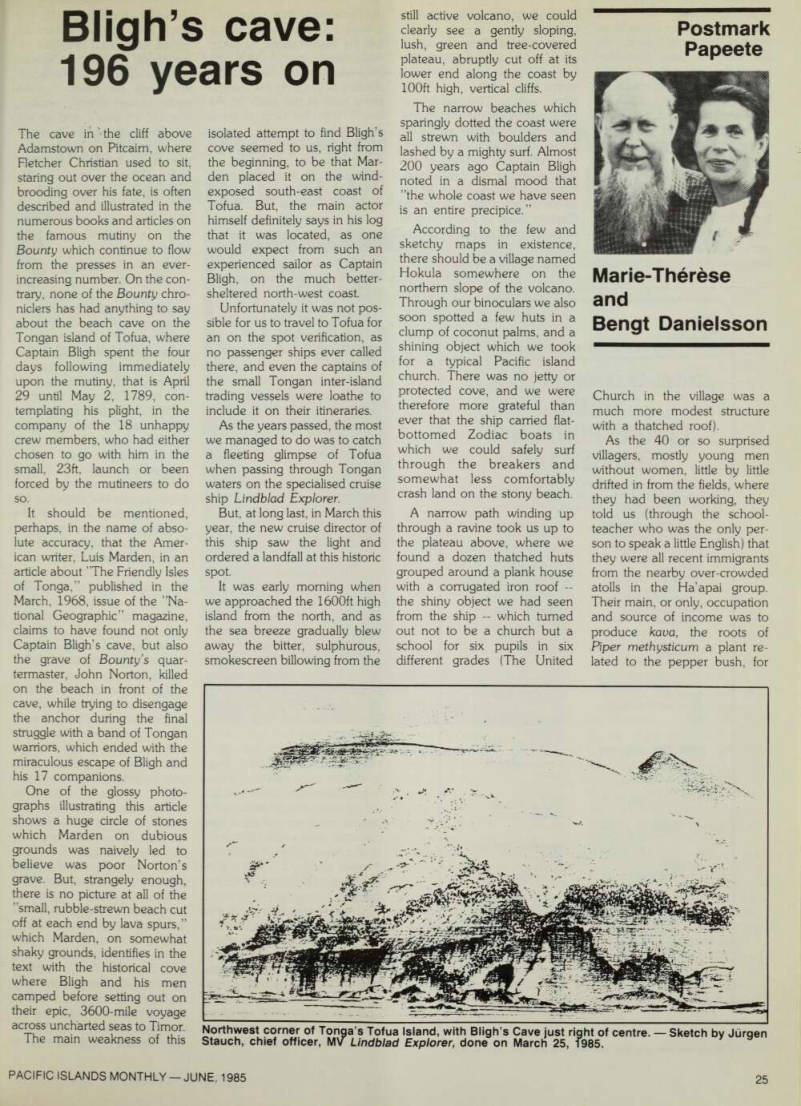
Marie-Thérèse and Bengt Danielsson
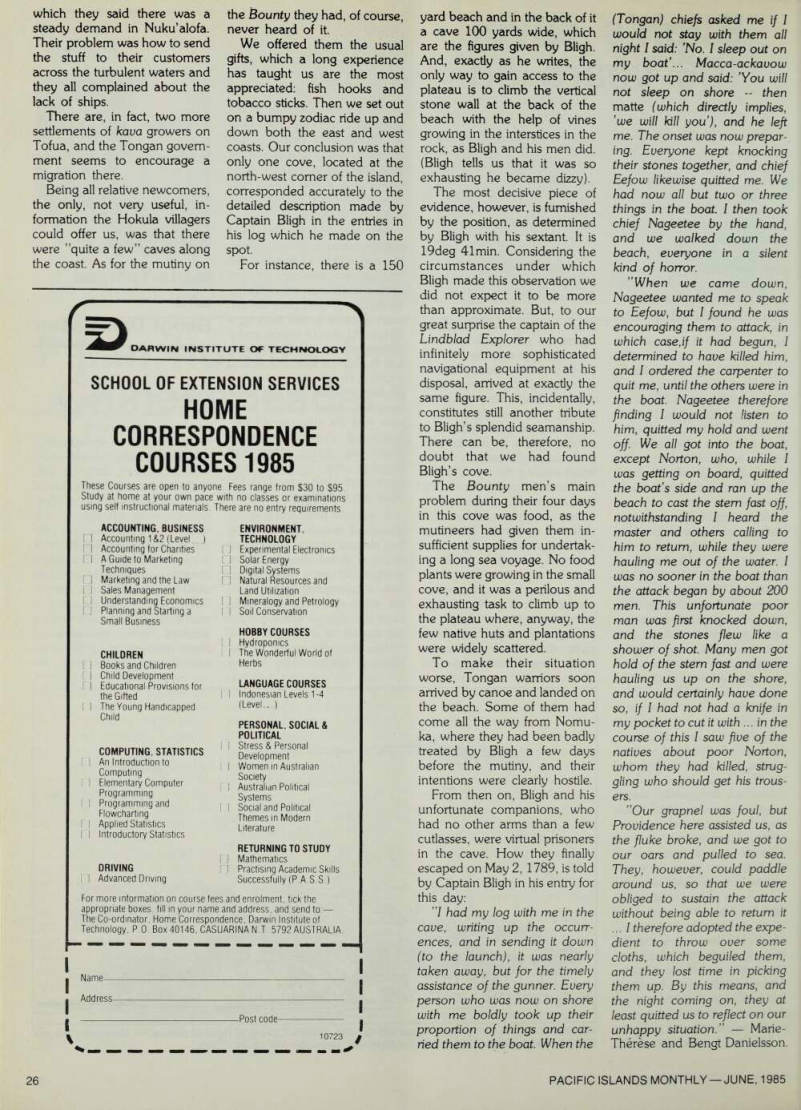
Northwest corner of Tonga's Tofua Island, with Bligh’s Cave just right of centre. - Sketch by Jurgen Stauch, chief officer, MV Lindblad Explorer, done on March 25, 1985.
which they said there was a steady demand in Nuku’alofa.
Their problem was how to send the stuff to their customers across the turbulent waters and they all complained about the lack of ships.
There are, in fact, two more settlements of kava growers on Tofua, and the Tongan govern ment seems to encourage a migration there.
Being all relative newcomers, the only, not very useful, in formation the Hokula villagers could offer us, was that there were ’’quite a few” caves along the coast. As for the mutiny on
the Bounty they had, of course, never heard of it.
We offered them the usual gifts, which a long experience has taught us are the most appreciated; fish hooks and tobacco sticks. Then we set out on a bumpy zodiac ride up and down both the east and west coasts. Our conclusion was that only one cove, located at the north-west comer of the island, corresponded accurately to the detailed description made by Captain Bligh in the entries in his log which he made on the spot.
For instance, there is a 150
yard beach and in the back of it a cave 100 yards wide, which are the figures given by Bligh.
And, exactly as he writes, the only way to gain access to the plateau is to climb the vertical stone wall at the back of the beach with the help of vines growing in the interstices in the rock, as Bligh and his men did. (Bligh tells us that it was so exhausting he became dizzy).
The most decisive piece of evidence, however, is furnished by the position, as determined by Bligh with his sextant. It is 19deg 41 min. Considering the circumstances under which Bligh made this observation we did not expect it to be more than approximate. But, to our great surprise the captain of the Lindblad Explorer who had infinitely more sophisticated navigational equipment at his disposal, arrived at exactly the same figure. This, incidentally, constitutes still another tribute to Bligh’s splendid seamanship.
There can be, therefore, no doubt that we had found Bligh’s cove.
The Bounty men’s main problem during their four days in this cove was food, as the mutineers had given them in sufficient supplies for undertak ing a long sea voyage. No food plants were growing in the small cove, and it was a perilous and exhausting task to climb up to the plateau where, anyway, the few native huts and plantations were widely scattered.
To make their situation worse, Tongan warriors soon arrived by canoe and landed on the beach. Some of them had come all the way from Nomu ka, where they had been badly treated by Bligh a few days before the mutiny, and their intentions were clearly hostile.
From then on, Bligh and his unfortunate companions, who had no other arms than a few cutlasses, were virtual prisoners in the cave. How they finally escaped on May 2, 1789, is told by Captain Bligh in his entry for this day: ”1 had my log with me in the cave, writing up the occurr ences, and in sending it down (to the launch), it was nearly taken away, but for the timely assistance of the gunner. Every person who was now on shore with me boldly took up their proportion of things and car ried them to the boat. When the
(Tongan) chiefs asked me if I would not stay with them all night I said: ’No. / sleep out on my boat’... Macca-ackauow now got up and said: You will not sleep on shore - then matte (which directly implies, ’we will kill you’), and he left me. The onset was now prepar ing. Everyone kept knocking their stones together, and chief Eefow likewise quitted me. We had now all but two or three things in the boat. I then took chief Nageetee by the hand, and we walked down the beach, everyone in a silent kind of horror. ’’When we came down, Nageetee wanted me to speak to Eefow, bat I found he was encouraging them to attack, in which case,if it had begun, I determined to have killed him, and I ordered the carpenter to quit me, until the others were in the boat. Nageetee therefore finding I would not listen to him, quitted my hold and went off. We all got into the boat, except Norton, who, while I was getting on board, quitted the boat’s side and ran up the beach to cast the stem fast off, notwithstanding I heard the master and others calling to him to return, while they were hauling me out of the water. I was no sooner in the boat than the attack began by about 200 men. This unfortunate poor man was first knocked down, and the stones flew like a shower of shot. Many men got hold of the stem fast and were hauling us up on the shore, and would certainly have done so, if I had not had a knife in my pocket to cut it with ...in the course of this I saw five of the natives about poor Norton, whom they had killed, strug gling who should get his trous ers. ”Our grapnel was foul, but Providence here assisted us, as the fluke broke, and we got to our oars and pulled to sea.
They, however, could paddle around us, so that we were obliged to sustain the attack without being able to return it ... I therefore adopted the expe dient to throw over some cloths, which beguiled them, and they lost time in picking them up. By this means, and the night coming on, they at least quitted us to reflect on our unhappy situation.” Marie- Therese and Bengt Danielsson.