rules again
pp. 11-13 · Read in the full issue
Political mayhem rules again in Fiji'S NFP
In Fiji the leader of the Opposition, Mr Siddiq Koya, is now facing the biggest challenge of his political career. His party is split, its established leadership is under threat from a group of young militants, and Mr Koya is under pressure to make good his own threat to resign because of their opposition to him.
Mr Koya, 62, is one of the largest figures in Fiji politics, a maverick, a showman, and a trial lawyer who, on occasion, seems to have sprung straight from a Perry Mason film set. He has been leader of the almost entirely ethnic Indian, National Federation Party, the Fiji par liamentary opposition, since the resignation in 1984 of Jai Ram Reddy, who also underwent a series of challenges to his leadership from a variety of sources, including Mr Koya.
Mr Reddy stood down in angry circumstances after an emotional dispute with the Speaker, Mr Tomasi Vakatora, in May last year. The setting for the present upset, on which Mr Koya’s political fortunes seem to hang was, in fact, the by election for Reddy’s vacated Lautoka City seat.
Indian political leaders in Fiji
Once again the Indian politics of Fiji are in disarray with the National Federation Party, the parliament ary opposition, divided and publicly fighting with its leader, the aggressive and imperious Siddiq Koya.
Though Indians now form a majority group in Fiji, where politics are arranged, by the Constitution, on racial divisions, the NFP has not so far managed to offer itself as a credible alternative to the Alliance which, under Ratu Sir Kamisese Mara, has ruled Fiji since independence nearly 15 years ago.
The present row, essentially a continuation of a struggle for party leadership which goes back to 1977 when the NFP did win a general election but was unable to form a government, has done little to advance the chances of an Indian prime minister appearing in the multi-racial islands. Our Suva Correspondent reports from amidst the political smoke and flame.
are eternally embroiled in dis putes and faction fights, but the tempest hanging over Mr Koya this time is more serious than most. For the first time in its history the NFP political machine has, in effect, lost an Indian communal seat in an election.
Fiji politics are arranged under the Constitution on racially-divided lines. The parliament is made up of mem bers elected to Fijian communal seats, Indian communal seats, and a range of national seats through which a balance is held.
The campaign leading up to the by-election was particularly stormy, with the divisions in the NFP very evident.
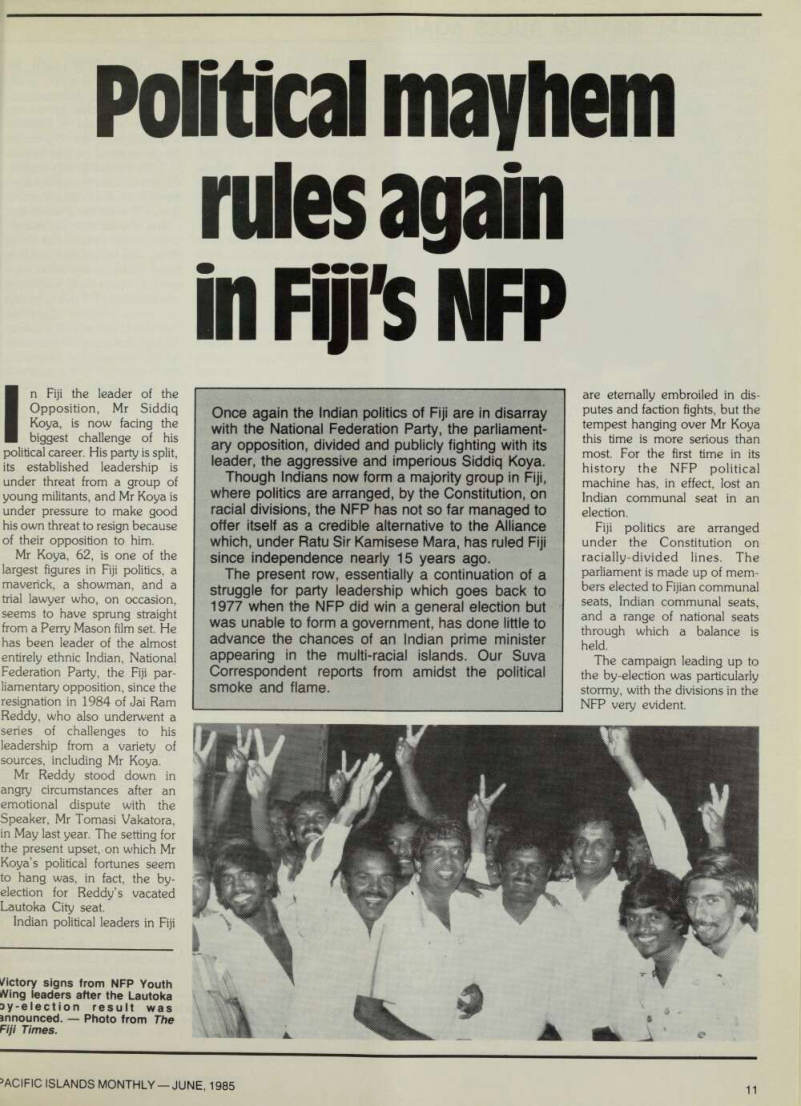
Victory signs from NFP Youth Wing leaders after the Lautoka [?]y-election result was announced. Photo from The Fiji Times.
Speeches on the stump were emotion-charged, and the youth wing’s attack so vicious that Mr Koya was driven to accuse them of “driving a knife” into the entire Indian community. Despite his courtroom canniness and political shrewdness, Mr Koya was goaded into making some
dangerous ripostes, including the one now seen as potentially a spear in his own foot, Mr Koya, a notable and rousing speaker, had told a rally during the campaign that his leadership was on the line. If the official NFP candidate lost the election, he said, he would resign “instantly.”
Mr Koya had to stick his neck out and make the pledge in such strong terms because the official candidate, Dr Balwant Singh Rakha, was opposed not by another political party but by a rebel faction of the NFP itself the Youth Wing - whose candidate was a Mr Davendra Singh. Neither was a major political figure; their importance lay primarily in their backers.
Mr Koya was hoping that his promise to quit politics and the leadership would bring suppor ters of his faction in the NFP rushing to the polls, jostling to lodge ballots for Dr Rakha. That they stayed away by the thousand was a decided slap in the face for Mr Koya. In fact the tum-out for the by-election was so poor it was depressing, both for the NFP and for Fiji politics in general.
The row began last Decem ber when Mr Koya had barred youth wing delegates from the NFP’s working committee meeting at Sigatoka which had selected Dr Rakha as the official candidate. He claimed the Youth Wing was not entitled to attend the meeting and share in selection of the candidate.
It was common knowledge that the NFP Youth Wing was not about to go along with Mr Koya’s choice. They said they wanted someone from Lautoka city itself, not an import. (Dr Rakha lives, and has a medical practice, in Ba, 30 kilometres, and some distance in mental attitudes, away from Lautoka.) Lautoka City is a blue-ribbon seat for the NFP and Mr Rakha should have been a shoe-in, unopposed, because the ruling Alliance Party, with a comfort able majority in the House, had decided not to contest the by election. The Alliance is formed of three elements, one Fijian, one Indian, and the third formed of other races, known as General Electors. Normally a candidate from the Indian Alliance would have stood against an Indian from the NFP.
Soon after the announce ment of Mr Rakha as the candidate the Youth Wing lead
ers, a young Suva lawyer, Mr Anil Singh, who is the presi dent, and Nadi businessman, Mr Himmat Lodhia, rushed into the act and got a Lautoka businessman, Mr Navendra Singh, to stand on their behalf.
Their candidate was a politi cal unknown. He was not seen by anyone as a serious threat to the NFP machine’s nominee.
But the pundits did not re ckon on the force of the Youth Wing who turned what ought to have been a one-horse race into a tough and damaging challenge to Mr Koya’s, always to some degree disputed, leadership of the NFP. Far from being a nonentity Mr Anil Singh swiftly became the fascinating black knight of NFP politics with his lance aimed straight at Sid Koya’s helmet.
They made capital, for inst ance, from the fact that Mr Singh was a Lautoka man, with Lautoka’s special interests at heart -- not an outsider ’’tainted” with the attitudes and political obligations of a man from the national capital.
Factionalism has always been a bane of life in the upper levels of the NFP, and it re-emerged with a vengeance during the Lautoka campaign. The entire party split and formed blocks behind the two candidates, making few bones about the appearance that they had made their decisions on the basis of whether they were pro, or anti, Koya.
Inevitably it became a re enactment of the row in 1977, when Koya was ousted as party leader and replaced by Jai Ram Reddy, and of May last year when Reddy resigned from the leadership, and from parlia ment, to restore Koya to the top spot. Davendra Singh’s youth wing supporters were, essential ly, pro-Reddy. The others were pro-Koya. The old Flower and Dove groups of 1977 seemed to have been reincarnated.
The election was thus turned very swiftly into a vote of no-confidence in Mr Koya’s leadership, a ploy on which he played right into their hands by
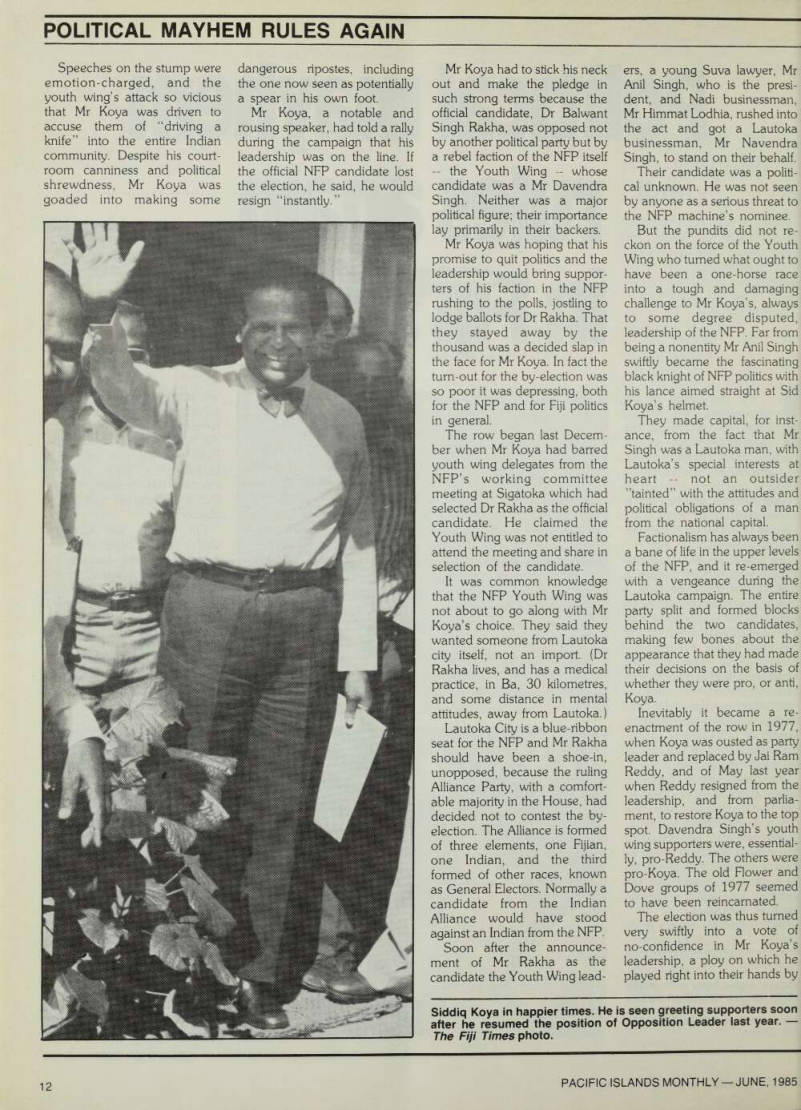
Siddiq Koya in happier times. He is seen greeting supporters soon after he resumed the position of Opposition Leader last year.- The Fiji Times photo.
hanging his future leadership on the electoral decision in Lautoka.
But, while the politics of it all were very damaging to Mr Koya, the results at the hustings were less categorical. Mr Davendra Singh was elected by a mere 13-vote majority in a poll which gave him 2209 votes against Dr Rakha’s 2196. It was a pitiful turnout of only 4421 from the 12,260 registered vo ters in the electorate.
As soon as the vote was announced Mr Koya sprang up to raise “legal objections”, claiming that 60 of the votes credited to Mr Davendra Singh should have been declared in formal. The issue is now before the courts.
But the Youth Wing im mediately demanded that Mr Koya honor his election prom ise and resign the leadership.
Mr Koya publicly ignored them.
However, the former presi dent of the party, Mr Ram Sami Gounder, a staunch Koya supporter and also a member of parliament, said he was “very grieved and surprised” that Mr Reddy did not support Dr Rakha. During the campaign the Youth Wing produced pamphlets, carrying Mr Reddy’s photograph, promoting their “rebel” candidate. Mr Reddy had not publicly dissociated himself from them.
Mr Gounder said that as former party leader Mr Reddy should have given his open and unqualified support to Dr Rakha. Mr Reddy responded tartly, describing Mr Gounder’s comments as “absolute rubb ish.” He said he wanted the party to have a completely free hand, had been in New Zea land at the time of the Sigatoka meeting and had taken no part in the selection of the candi date.
He said the Youth Wing, and Dr Rakha, had approached him several times, but he had “de cided to keep himself complete ly out of the controversy. ” The youth wing was an integral part of the NFF, he said. He did not wish to become involved, parti
cularly when his views had not been sought upon the choice of candidate.
The deputy leader of the NFF, Mrs Irene Jai Narayan, and NFF senior member, Sena tor Mumtaz Ali (who was the likely candidate favored by the youth wing for the by-election if they had been allowed to have their say in Sigatoka), called on Mr Koya to keep his promise, and resign. Mrs Narayan was involved in a particularly nasty inside fight with Mr Koya for the party leadership last May and Mr Koya’s autocratic style of leadership, has done nothing to remove internecine frictions since then.
Mumtaz Ali, a chartered ac countant admired by many Fiji citizens of all races for his urbanity and diplomacy, might have made an admirable com promise candidate for the Lautoka seat, had the party factions been able to agree. On the other hand he was not about to expose himself by taking one ticket or the other in the fight clearly seen to be developing.
The depth of the opposition to Mr Koya was increased when Satendra Nandan, a prominent Suva intellectual and NFF par liamentarian, resigned from Mr Koya’s shadow cabinet where he had been spokesman on education. He said it was no longer possible for him to re main an opposition spokesman if Mr Koya continued as party leader.
This sally was met by equally spirited demands from other prominent NFF members and MPs that Mr Koya not resign.
In short, the bickering and squabbles of the past have once again emerged to harass and hobble the NFF and render Fiji’s opposition party weak and fragmented. The youth wing, riding high, and basking in its electoral success, did nothing to help the image when it announced it had decided to prepare for the next general election.
They claimed the Alliance was planning to call a snap
election within the next six months. Because of this, they said, they would hold a youth wing national convention, sepa rate from the main body of the NFF, at Nadi in May. They said that if a snap election did eventuate they would field candidates to oppose Mr Koya and three of his staunchest supporters, Mr Sharda Nand, Mr Hari Sharma, and Mr Ram Sami Gounder.
Political observers in Suva say Mr Koya has bought badly needed time by taking the election protest to court while he works out how to remain in power. They do not, for a moment, see him surrendering before the youth wing, at least not without a very vigorous fight.
Yet the NFF is already seen to be badly damaged. The success of the youth wing, and its assertion that it will go its own way if it cannot have what it wants, shows clearly how badly the party is divided.
Its claim to be a credible alternative government to the Alliance which, under prime minister Ratu Sir Kamisese Mara, has ruled Fiji since inde pendence 14 years ago, is thereby seriously impeded.
Much now depends upon Mr Koya. He has shown previously how strong a survivor he can be. Further, and despite the success of the youth wing this time, no-one has risen to
actually challenge him for the leadership. Mrs Narayan has said she is not now keen.
The “joker” in the pack is the former Alliance cabinet minis ter, Sir Vijay R.Singh, who has indicated he may be interested in stepping in if a breach deve lops. Most people who know him believe he would greatly enjoy being Fiji’s first Indian prime minister, and he is an astute enough politician, and a large enough figure, to be able to do much to restore the NFP’s now tarnished public image.
Yet Sir Vijay’s attraction at the grassroots level remains in some question. The rank and file of Indian voters still remem ber his attacks upon the NFF while he was with the Alliance, and may not have forgiven him.
Sir Vijay is also tipped to be appointed chief executive of the Sugar Cane Growing Council, a post which would require him to resign from political activity.
The crux of the affair now sits squarely on what Sid Koya does if, or when, the court rules against his electoral protest. Will he then resign, thereby, in the eyes of many Indian voters, keeping his credibility?
The irony of it all is that the by-election which has caused all the trouble for Mr Koya came about because the former NFF leader, Jai Ram Reddy, did honor a promise to resign.
But his political spirit stayed around to haunt his successor.
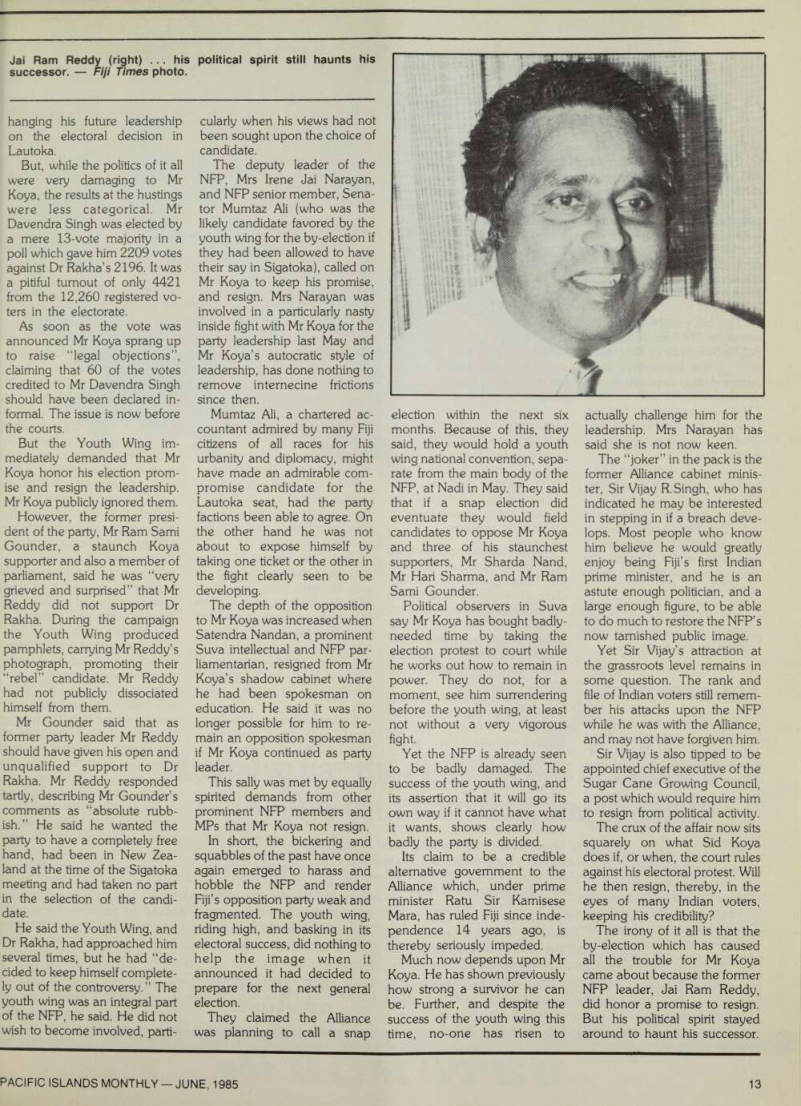
Jai Ram Reddy (right) ... his political spirit still haunts his successor. - Fiji Times photo.