Dutch New Guinea
p. 10 · Read in the full issue
Wartime memories of Dutch New Guinea
Apropos the interest Indone sians now seem to take in the affairs of Papua New Guinea, I thought you might be interested to know that Indonesian sol diers were in PNG territory during the Second World War. 1 served with the 62nd Aust.
Infantry Battalian in Merauke for most of 1943 when we were assigned to guard the airstrip and port from Japanese attack.
There was a battery of U.S. anti-aircraft guns and some construction workers from a Negro battalion, as well as a company of Indonesian troops
under Dutch officers. These were classed as “fighting troops” by the Dutch and this saved them from wharf duties, which we carried out until the unloading of the Soedah, a Dutch vessel carrying mostly drink for their officers’ mess.
Practically all the Australian and U.S. troops got gloriously drunk!
We had to construct “roads” through the swamps pick, shovel, and axe methods and we cut vast numbers of coconut palms to make cordur oy tracks. It was rumored our
government paid Queen Wilhelmina 2 pounds each for these, and this prompted a group of junior officers to write to Dr Evatt, then minister for foreign affairs, and suggest we buy Dutch New Guinea from the Dutch.
We never got a reply. What a lot of trouble it might have saved!
I have often wondered if we really did pay the queen for her trees.
Ron Pechey
“Listening Ridge”
Pechey, via Crows Nest Qld Australia
Paris leaders
disappoint
The French Government con tinues to ignore all petitions and protests from the peoples of the South Pacific about their nuc lear testing program at Moruroa Atoll in French Polynesia At the same time, lives are being lost in New Caledonia, the other major French territory in the Pacific.
Nobody can deny that these islands belong to the French Government, but for those of us living in neighboring coun tries these events are of great concern with regard to the effects of the N-tests on the health of the populations of our islands, and with regard to the possible undesirable outside political effects of the instability in New Caledonia.
It seems that nothing is going to stop the French Government going on with the Moruroa tests.
But as far as New Caledonia is concerned, where is the political know-how required to sort out the mess?
In my country, the United Kingdom had to use all possible ways and means to arrange for a peaceful transition to inde pendence for a multi-racial so ciety. It was done. The docu ments were signed at Marl borough House, there was no atmosphere of crisis, no bloodshed, everything was peaceful.
If in Fiji, why not New Cale donia?
I am disappointed in the quality of French political leadership in these matters of
concern to all of us in the Pacific. It seems to me to be
well, sort of muddy.
Semi Goneyali
Tailevu Fiji.
75 years of
the Mitchell
Library
March 8, 1985, was an impor tant occasion for those with a concern for Pacific Islands liter ature. The date marked the 75th anniversary of the opening of the Mitchell Library in Syd ney. A large and distinguished gathering took place in the Mitchell galleries to honor the Mitchell Library.
A special tribute was paid to the memory of David Scott Mitchell, by Russell Doust, N.S. W. State Librarian. “That a man who was so much of a recluse that no photograph or finished portrait of him exists should be prepared to have his name blessed by posterity is one of the minor wonders of the world.” Mitchell endowed the library with 61,000 books, hundreds of original journals, diaries and letters, and thousands of maps, portraits, book-plates, coins and medals supported by an endowment of 70,000 pounds. Today the Mitchell Library collection en compasses over 450,000 printed books.
The Mitchell is Mecca for a great number of Australian and Pacific Islands researchers. Im plicit in Russell Doust’s con cluding words is the profound significance of the Mitchell to Pacific Islands scholarship: “It was clearly Mitchell’s intent that his Mitchell Library should be the centre for scholars from all over the world to carry out original research in Australian studies. Thousands have done so in the past and even now many hundreds of researchers are busily preparing for the 1988 bicentenary in a way which would not have been possible without David Scott Mitchell’s forethought in preser ving Australia’s recorded heritage.”
Wildon Woolley
Oyster Cove North Sydney, NSW Australia
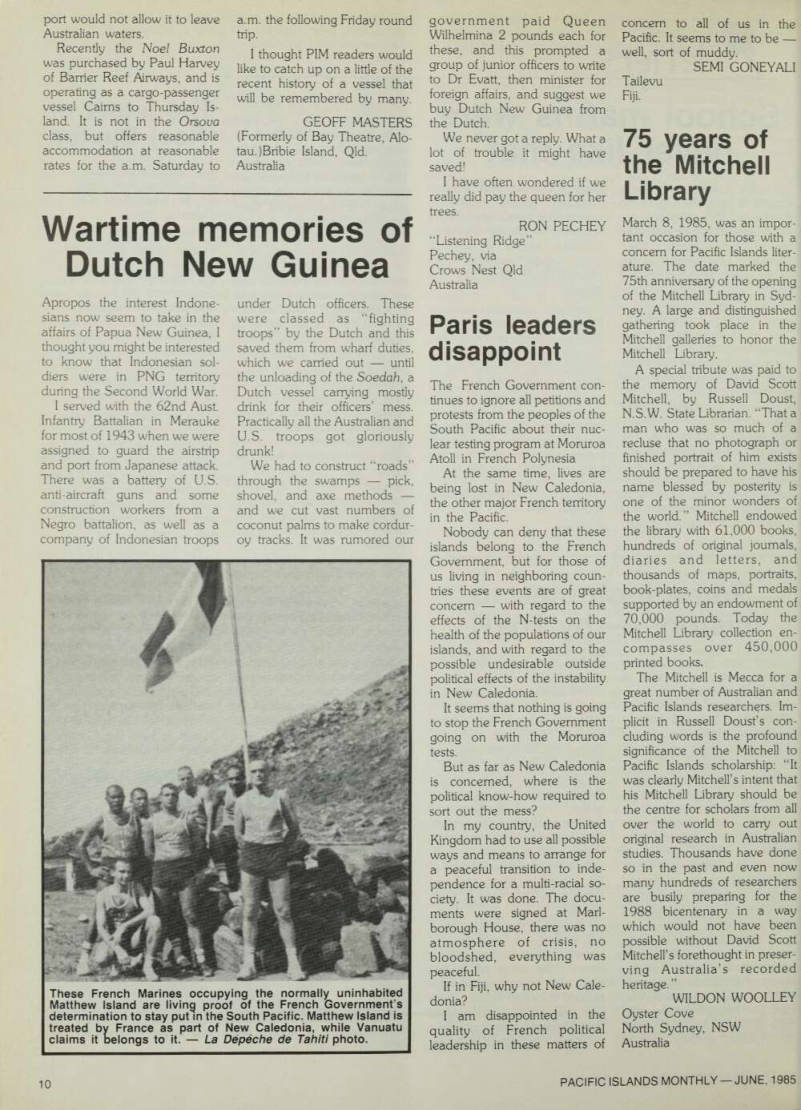
These French Marines occupying the normally uninhabited Matthew Island are living proof of the French Government’s determination to stay put in the South Pacific. Matthew Island is treated by France as part of New Caledonia, while Vanuatu claims it belongs to it. -La Depeche de Tahiti photo.