Making good
pp. 44-58 · Read in the full issue
Air Melanesiae is 25: Making good a promise of John From
What started the whole thing was the problem we were hav ing with the kids. Medical facili ties were zero on Tanna. We didn’t have our own ship at the time, and passing ships were few and far between.
Td bought some cattle in Vila and had them loaded up on this 60-foot boat. We struck some weather on the way down and the cattle were drow ning all over the bloody boat.
They were sliding up and down the deck and wearing their hides out. I was sitting there with one of them, with its head in my lap. It had put its foot up through the skeg in the ship’s launch, which was tied down to he hatch. The propeller comes out there and it was sawing back and forth and slowly cutting the cow’s foot off. I had one of the kids with me and Td locked him in the little cabin.
One of the crew came up and said: ‘Your picaninny’s screaming in there.” So I drop ped the cow and went down.
As I opened the door he hit me with a chunder. First time I’ve ever been sick in my life. I just went wooooah and that was the end of me.
Kath was in Tanna, as only one of us could get away at a time. While I was off on my adventures she was always there picking up the pieces.
When I finally stepped
Vanuatu’s domestic airline, Air Melanesiae, is 25 years old on June 1.
As with many Pacific Island airlines, the story of Air Melanesiae is replete with color and incident.
Indeed, a fair enough claim could be made that, for a variety of reasons, not least the fact that it was established in the highly complex administrative situation of the Anglo-French Condominium of the New Hebrides, it has more color and incident than most such stories.
A second unique feature of Air Melanesiae is the extent to which Pacific Islanders in this case Tannese devotees of the John Frum cult were key actors in the airline’s development.
Here, in an interview with 808 PAUL, founding father of the airline, SHIRLEY FENTON HUIE provides an outline of its first quarter-century of existence.
Mr Paul’s direct comments appear in italic type, and Ms Fenton Huie’s connecting narrative in roman.
ashore at Lenakel I said: ‘ ‘That’s it. We’re going to buy an aeroplane.”
And we did.
Bob and Kath Paul met in Port-Vila at the end of World War II when she was working for the British Government and he was engineer and supercar go on a Burns Philp trading ship. The fell in love at Undine Bay, married and had five children on the island of Tanna in the southern New Hebrides,
then an Anglo-French con dominium. They founded an airline whose original name was New Hebrides Airways.
It began in the 19505. Bob says with a wink that the first name suggested for the fledg ling airline was Condom Air ways, with a windsock as a logo. But the Condominium refused to register it.
They went down to Sydney and were driving to Bankstown Airport where Bob was having
lessons towards his flying licence. They got into conversa tion with a service station atten dant in the suburb of Collaroy.
In the course of chatting about fuel and mileage, Bob ex plained his reasons for going to Bankstown. The attendant, who had a Canadian accent, showed great interest and said: “If you want to start an airline I know the chap you should meet out there. He’s an aircraft engineer. I’m an aero engineer
myself, and also a pilot, and I’m interested too.”
Eventually all three got together and laid plans to form an airline company. Each agreed to put in £3OOO so they could buy an aeroplane. One was to be flight engineer, one the pilot, and Bob was to supply local knowledge and airfields.
IVe came back to the New Hebrides to see the local Resident Commissioner. That’s
when the political trouble started. The French opposed us because they wanted a French carrier. They did everything they could to stop us. The British were nust plain unin terested. They had jost got the Euphrosyne and the Commis sioner said: “.Tue got my own ship now, so I don’t need an aeroplane. And the natives will never travel in one anyway”.
What he really meant was that he’d have to start a new
department, and that would mean more work. Colonial ser vants!
Before they made any prog ress the engineer in Sydney died suddenly. That left two.
The Canadian, Paul Burton, then had his own problems when his property in Mudgee,
New South Wales, was repos sessed. He was declared bank rupt. As the commitment to buy a Dragon Rapide had already been made, the Pauls put themselves into debt to raise the £9OOO. They financed the whole thing themselves and kept Burton on a wage because
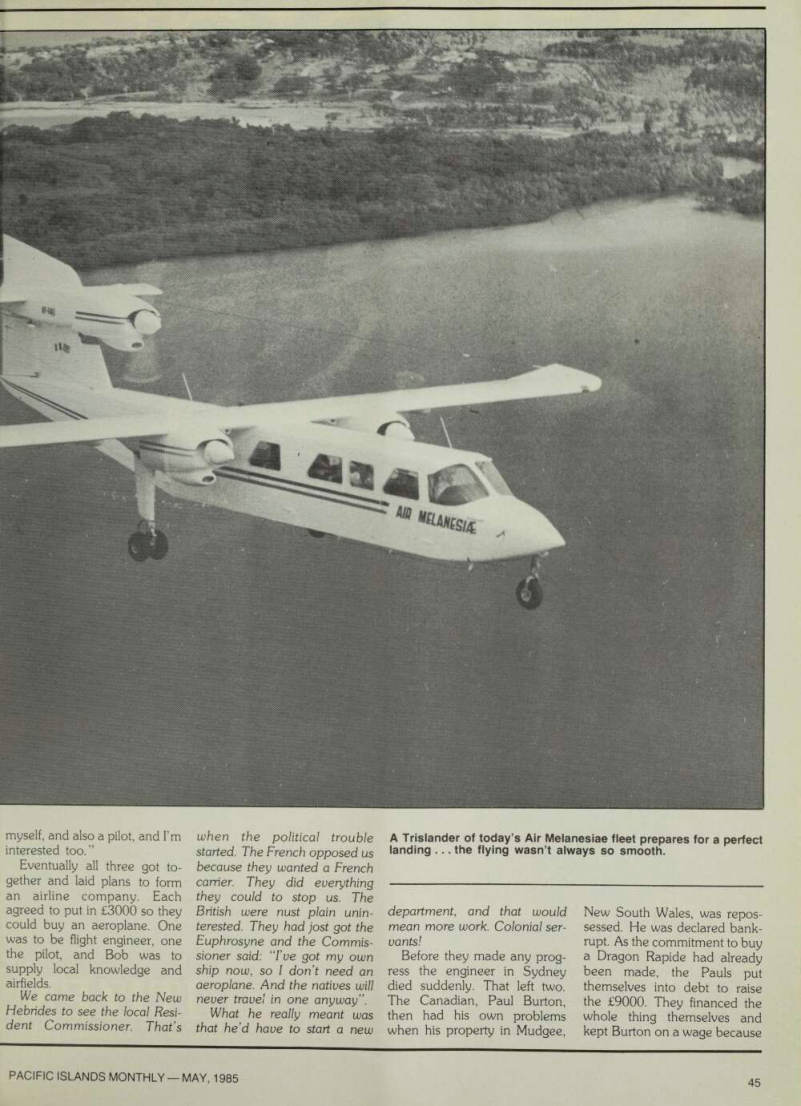
A Trislander of today’s Air Melanesiae fleet prepares for a perfect landing ... the flying wasn’t always so smooth.
they liked him and appreciated his skills.
As far as the local Tannese were concerned, the air service dovetailed with their own John Frum cult. They had already built aerodromes on several parts of the island in readiness for the aeroplane that John Frum had promised them. The Pauls had no suitable land for an aerodrome and the Con dominium Government refused even to talk about allocating any, so Bob decided to talk to the Tannese about it.
“But don’t you know that John Frum is going to bring us a plane?” they said.
“Yes, I know that,” said Bob, “but how would you like to work in with me and get the plane right now instead of waiting?”
They thought it over and agreed to work with Bob. The chief in the area around Lenakel was Willy Au. He own ed the land where Burtonfield is now. There was another group up in the central mountain range who were building their own aerodrome for John Frum’s plane. It is high up on the road to the volcano, just before the descent to Kings Cross. The people there moved thousands of tons of soil to level it all, even though Burton and Bob explained it wasn’t suitable because of its location; there was a great deal of turbulence which made it unsafe.
The budding airline oper ators had Chief Willy Au’s help, but no help from the govern ment. Normally in those days, when a planter or a trader was engaged in some new enter prise, applications were made to the Department of Works for the use of such things as bulldozers, graders and earth moving equipment. Bob made the usual applications, but the officials dug their toes in and refused. The French wanted a French carrier and made noises in that direction but did nothing positive. The British were just indifferent. Their sole contribu tion was a wheelbarrow which is still on nearby Futuna Island.
We set about clearing the land with our bare hands. Just think about clearing a tropical forest with your bare hands.
First of all you cut down a tree with an axe we had no
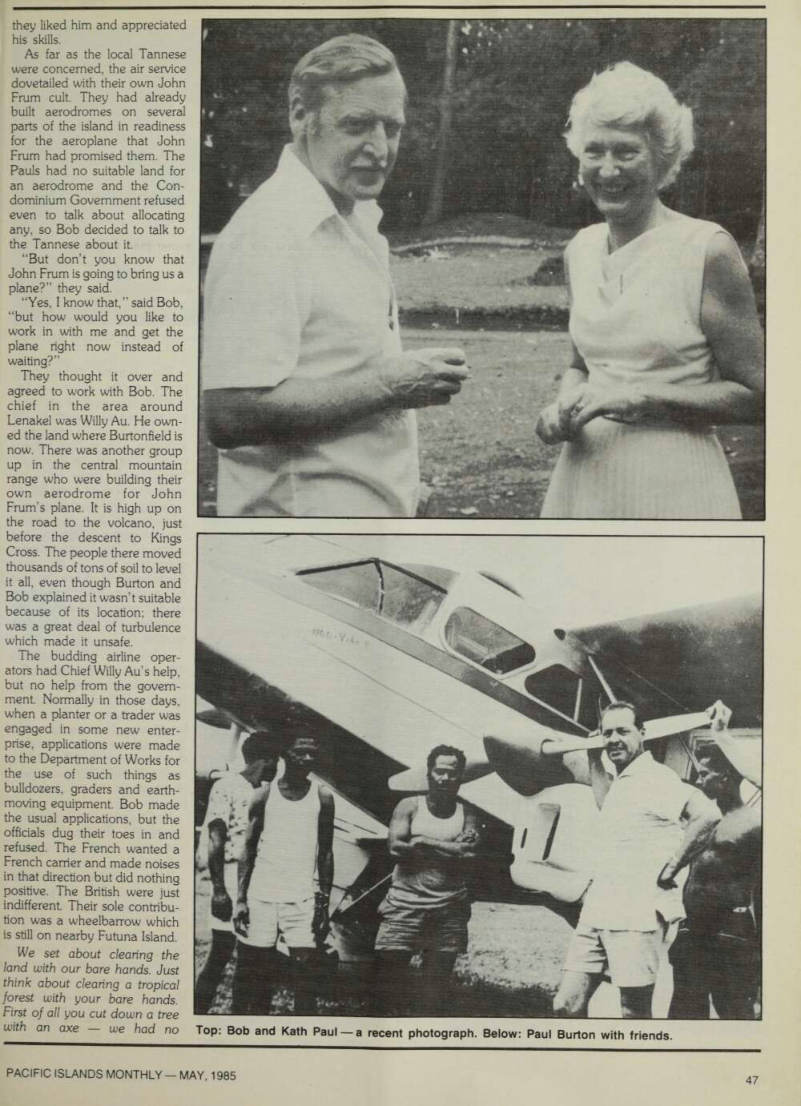
Top: Bob and Kath Paul—a recent photograph. Below: Paul Burton with friends.
chainsaw. Now you’ve felled it, how are you going to move it?
They are enormous, these ba nyan trees. So we had to cut them up into pieces that we could move. We dragged them away using the jeep as a bulldozer. Then we had the stump to get rid of. Some of the stumps are as big as a room, and we had to get in and dig them out by hand. They are enormous and weigh many tons. We had people down in these holes digging away and cutting up the roots. Then, with a hundred or so men pushing, we rolled the stumps up a ramp on to level ground. Sometimes we only advanced a foot or so in a day.
Eventually, after eight months, they had a large cleared area covered with de bris and mud. This they man aged to more or less clear off by using an old truck chassis with a couple of sheets of steel welded on to it. They hooked this contraption on to the jeep and dragged it around using it as a grader.
When they had completed 300 yards Bob went off to Australia to pick up Burton and the aircraft, leaving Kath in charge of the operation. She carried on and got about 400 yards done. She supplied all those working with all the rice they could eat, and they organ ised their own dancing at night.
It rained a lot, which made it very difficult to harden up the strip. They struggled with the mud, patting and pummelling it every time the sun came out.
When the dry season finally came, Kath gave Bob the go ahead to bring in the plane.
They bought an old fabric covered, twin-engined De Havilland Dragon Rapide, which had formerly been used as an aerial ambulance in Cairns. Burton put in a new overhauled engine and prac tically rebuilt it. Bob says admir ingly: “Burton was a very clever man. ”
They took off from Caims for Horn Island on the tip of Cape York and then went on to Port Moresby. From there they flew to Milne Bay and Munda and finally landed at Honiara in the Solomon Islands.
And that’s where they stop-
ped us and wouldn’t let us go any further. My God, the British can be stupid. They wouldn’t register us. I asked to see the High Commissioner and they spent a week trying to find a reason why they wouldn’t re gister us. We were demanding registration under the Colonial Air Navigation Act which en titled us. Eventually we took things into our own hands and cleared off at 3 o’clock in the morning. Without registry. We didn’t have enough money to buy Avgas, so the Shell bloke gave us motor spirit. We took off with a tank full. And the jerry tanks full.
We lost one engine and the result was we damn near went into the water between Honiara and Santo. That was late May, 1960. This really set us back because we had to chuck everything that was loose out into the Coral Sea. All our spore ports went out, cylinder heads, everything. The Santo strip, the old one left over from World War 11, is 500 feet above sea level. They saw us roaring up and down the coast and thought we were having a good time, but we were just trying to bum off everything we could and get up to the strip on one engine. The poor old Rapide was shaking itself to death.
Eventually we made it and that was the aeroplane we started the airline with. And no spare parts.
They repaired the plane in Santo and flew down to Port
Vila, where they were refused permission to land. Furious at this latest obstruction, they de cided to beat up the main street from one end to the other at low altitude, until finally Radio Vila capitulated and gave them permission to land. Stories told later say that the French and British Resident Commission ers, having been disturbed dur ing the siesta, called each other on the phone and said: “What can we do to stop these mad people? Better let them land.
They’ll be on the ground soon, anyway. ”
There was a great crowd to meet the cheeky aviators out at Bauerfield. They emerged from their battered aeroplane, each holding a spanner in his hand.
They weren’t looking for the authorities, only making sure that no inexpert mechanic came near their plane.
After more adjustments and repairs they took off to the south for Tanna to a great welcome. The landing was per fect, but it was several weeks before they could take off, as the strip was too short. The necessary yardage was cleared and they were ready to go.
When the Rapide took off for the first time all the locals who had worked on preparing the field gathered round to watch.
As the plane was lifted by wind currents and inversion they all simultaneously made the huge ’’whooooh” sound as they do when they see a hawk rising.
The Rapide lasted only seven months. When we ar rived in Tanna with it we were not allowed to operate it. We were told we could on/y use it privately. This is how we got around that silly bit of regula tion. People came into our store and bought a packet of cigarettes. This cost them five pounds, but they also got a
”complimentary” flight on our
aeroplane. Passengers coming down from Vila did the same thing in reverse. When they got to Tanna they’d buy some item for five pounds on arrival. We operated like that for five months.
In late 1960, with the British still refusing registration, the Condominium received a visit from the British Parliamentary Under-Secretary of State, Ju lian Amery. He came down to Tanna on the government ship Euphrosyne. Bob requested an audience with him and was reluctantly granted a mere 10 minutes.
Three and a half hours later Amery said: “By God, that’s an interesting story. Leave this with me.”
Within a week they were registered in Fiji. They were legal. They were now required to fly the aircraft to Noumea to have it checked out by a New Zealand airframe surveyor.
When all recommendations were complied with it was flown
Continued on page 57
Wreckage of plane in which Paul Burton and his passengers died on Tanna, October 21, 1966.
Reproduced from New Hebrides Nakamal.
to Fiji to be certified by Fiji Airways. Unfortunately the undercarriage was slightly dam aged on take-off, but they con tinued on to Fiji. In spite of a cautious landing a strut broke leaving the undercarriage dang ling and there was a lot of drama on the tarmac. It didn’t collapse as they eased it in, but it had to be towed off the runway. This was not a good beginning for the new airline.
Bob says: “Next day they ripped all the fabric off the old ‘rag and bag’ and by the time they assessed it, it came to a total of 999 man hours required to fix it. That was the end of us.
We didn’t have the money.”
Undaunted, Bob went back to Tanna and talked to the Tannese who had bought 1300 shares in the company. Their spokesmen were Jack Naivo of lonanen, Willy Au, Philip, Kabarlu and Henry Kosiama.
All 1300 had paid a pound each for their share. In Port-Vila the Commissioner had said: “What are you goir to do about the Tannese now that you’ve got no aeroplane?”
According to Bob they were dead scared of the Tannese.
“I’m going to tell them the truth.”
This is what he did.
“The plane’s buggered-up.
No good. Finished.”
“OK,” they said. “We’ll put in more money to fix it.”
They put in more money.
Sister Heard from the hospital put in money. Mrs Fung Kwan Chee, Peter Allen and Nancy Robb put in money. The Pauls put in a lot too, and so they got together enough for Bob to go back to Fiji and make a deal with Qantas who were then running Fiji Airways. The deal was that they got a Drover from them on lease/purchase. The Drover MKII was suitable with its three engines, and was built like a tank for the Flying Doctor service. Only 21 were ever built, and although the Drover was not meant for passenger work it served the new airline well in the early days when things were rough and tough.
Official hostility, however, continued, and there was a complete lack of ground sup port. Fuel was carted in 44gallon drums and hand pumped into the aircraft. Car headlights were used for emergency night landings.
Radio links were unreliable and sometimes non-existent. Vila Airport closed down at 5 p.m., and did not operate at all on weekends.
When weather conditions were bad some sort of radio beacon was needed on Tanna, so Bob resorted to a World War II device known as a Gibson Girl. This primitive survival sys tem was a transmitter set on a fixed frequency signal and flown high on a child’s kite. It had saved the life of many a downed pilot during the war, but was illegal in peace time.
When wind was high, clouds low, and visibility nil, Bob would race off in his Landrover and fly his kite, thus guiding his plane in to a safe landing.
New Hebrides Airways was flying and the local support was tremendous. Not just financial support but physical support as well. When the plane landed the Tannese would get in, sweep it out, clean it and refuel it. Nobody worked for money.
For a while, when it was feared the French might do something silly, the Tannese would come down from the bush at night and sit around the plane, guar ding it. They would light their fires and sit there all night so it
wouldn’t be sabotaged. That’s how they felt about it. And nobody else was going to guard it. Plen blong mifala.
They were all John Frum people. Every one of them. It tied in with their cult. They were thrilled to bits with it. It’s still very important to them, John Frum tell im i gat plen.
Plen i gat. Plen blong mifala.
The Sulphur Bay crowd were not in it. If they can’t have the limelight they don’t want to be in it. They are not the real John Frum people over there, They’re a breakaway.
The airline’s annual general meetings were held in Bislama.
Later on, when Qantas and British Airways came in, the report would be sent over to London. They got a great kick out of it over there, and wrote back asking for a translation.
Eventually we had three Drovers and then the French decided to get into competition with us and bought a Domier 28 for their new airline, Hebridair. They were in association with Transpac, the French company SFNH, the Bank of Indochina, and Ballande. They had no involvement with the local people and arrived with the Domier and nowhere to go, as we had the airstrips. We said sorry, you can’t use ours. By this time we had extended Burtonfield at Lenakel, Tanna, and built another two at Aniwa and Futuna. Futuna was tricky as the island rises straight up from the sea and is flat on top.
This top area was covered with great coral outcrops so we lit fires on them and eventually reduced the coral to lime. We didn’t even have a pick, but the local support was terrific, We had started to build an airstrip on Aneityum but had run out of money so the French said they would finish it. Henri Martinet of Transpac asked if all these top French people like the head of Ballande, and the French Resident Commission er, could land at Tanna on their way to Aneityum. Considering how obstructionist they had been to us from the beginning, we agreed only reluctantly.
Martinet was embarrassed about it all and stayed with us while all these bigwigs flew off south to Aneityum. They tried to do a STOL landing and broke their plane in half. There is a lot of windshear there. We left them there overnight, in spite of their frantic radio calls, and got them out next day.
They were a miserable lot in the morning. They were dead keen to get into the business but they didn’t have any air fields and didn’t know how to get them. The Tannese and other locals used to roll 44gallon drums onto our airfields everytime we took off to make sure the French couldn’t land, Hebridair!
We then decided to go into Tongoa, up north of Vila. The French offered funds so that Hebridair could use the strip too, and I was up there just after
A group of New Hebrides Airways shareholders.
a hurricane when a relief ship was handing out money. I quickly sold 800 shares in New Hebrides Airways and the strip was built in conjunction with the French. Those shareholders still get their annual dividends.
The French scheduled a service Vila-Tongoa-Vila and didn’t get one single Tongoan.
Not one. It went on for months with Hebridair carrying only French Government officials.
They sent a message to say that if the locals wouldn’t use Hebri dair, then Ballande would lay off Tongoan labor. The next day all the Tongoans walked off the Ballande jobs where they handled and loaded cop ra. They were all our sharehol ders, and they weren’t going to be intimidated.
Unable to get any passen gers, the French then leaned on the British who said they would subsidise us if we both got together. That’s when we formed the first consortium.
That was in early 1966.
It was a disaster from the start and only lasted a couple of years. By this time we had Longana and Walaha on Aoba (Ambae), Sara on Pentecost, which was our best strip and is now closed due to politics, Tongoa, and all the southern ones. The Eromanga strip at Dillons Bay was built by Bureau Miniere; a French min ing crowd who were very loyal to us, and wouldn’t use anyone else.
I criticise the French, but it was only the colonial officials.
One great crowd were Trans pac, who are now Air Caledo nie. They were based at New Caledonia’s domestic airport at
Magenta, and were our rivals as far as the other French were concerned. But we used to go down there for any extra work we needed on the aircraft, and they never charged us a penny.
Henri Martinet was the chair man and they were always most hospitable to us. The manager was a man called Herve Coursin, and he was good to us until we got arrested the last time we flew down there. The charge was illegal entry. We had our passports and our papers were in order, but it was a purely political manoeuvre. It was nothing to do with Martinet or Air Caledo nie. They were aviators and not interested in politics.
On October 21, 1966, Bur ton took off from Tanna to fly to Futuna and never arrived.
We searched for three days over the sea, but could find no trace of him and his planeload of passengers. Eventually some local people found the aero plane up on the big mountain in a gorge between Tukosmeru and Melen at the southern end of Tanna. There were no survi vors. I had lost my partner and right-hand man.
Paul Burton was an amazing man who made a name for himself in the islands for work ing hard and playing hard.
He’d fly all day long and then come back and do all the necessary work on the aircraft himself. Then he would go out on the town and still be ready for work the next morning. He was one helluva guy. The Tan na airfield was later named Burtonfield at the suggestion of my friend Reece Discombe.
I was convinced that the fatal
accident was caused by a sud den downdraft, with which the underpowered Drover couldn’t cope. So the aircraft stalled and crashed. In an attempt to prove this theory I waited until a day arrived with similar conditions of rain and wind, and deliber ately flew the same route as that presumably taken by the Drov er. Sure enough, as we flew up the same valley, we were hit by the downdraft and the Heli courier fell 3000 feet.
Even with the Helicourier’s extra power, we couldn’t get out of that valley. We managed to get round a bend and over a saddle, but we very nearly joined Burton, I can tell you now.
We fumbled on with the airline, but we were so broke. I had a serious back operation and we were in a real mess with the trauma of the crash and everything. The accident sur veyor came up from Sydney about the insurance and we had no plane. Hebridair’s Dor nier was out of action so I chartered a Cessna 310 just to keep the door open.
I flew down to Sydney and Brian (Black Jack) Walker took me in to see Scotty Allan, who was with Qantas and also chair man of Fiji Airways. I told him I wanted to get Qantas into this thing and he said “no way.” He wouldn’t wear it at all.
So I came back and talked to the Resident Commissioner and he talked to Nicholson, the Australian Consul in Noumea.
Nicholson told me to go to Melbourne and talk to Ander son, the head of the Depart ment of Civil Aviation (DCA). I did that, and Anderson sent me to Canberra where I had to talk to all sorts of people behind closed doors and sign in and sign out. There was a lot of hush-hush talk about “the political influence of Australia in the region.” They said they would contact me later, and eventually I was advised that Qantas were coming up to have a look at it.
This they did, and they came in and saved the day.
Qantas bought in. British Air ways bought in. Bums Philp bought in. We refinanced the whole thing, and the French who were still in it went broke.
Because we were a Condomi nium we invited UTA to come in, and so once again we were a consortium, but with much . more powerful backing. Our name was changed to Air Melanesiae.
At this point I said to them: “I run a trading station and I want to get back to where I started.
You’ve got the thing now so go ahead and turn it into an airline, but I want the first option to buy the shares back when the time comes.”
Qantas were absolutely meti culous. They were scrupulous to the last detail about all their agreements with us, and so were the British. The local shareholders all kept their shares, but we had to relinqu ish ours. Kath gave up all her shares and her seat on the board.
With the approach of inde pendence in 1980, Qantas didn’t want to be involved in politics so they offered us back the shares. That was after 10 years. Qantas provided man agement for the first five years, and UTA for the other five.
After Qantas withdrew we had some trouble with the French partner who tried a take-over, but Helle Tschuch nigg and I scuttled them. Helle had come down from Papua New Guinea in November 1980, just before the consor tium agreement was due to change back to us. We offered to continue the agreement with UTA, but they didn’t wont that.
Dennis (Junior) Buchanan of PNG’s Talair then came in and bought out the controlling in terest. We had decided to retire so we sold him most of our shares, and he mopped up the others. He is the main share holder now. I have stayed on as chairman, and Helle manages the operation.
And that’s cutting a long story very short.
At time of writing, the fleet of Air Melanesiae is three Islanders, one Tris lander, two Twin Otters, one Bandeirante and one Aztec, which fly to 22 de stinations.
Boh and Kath Paul now live in retirement at Mount Tamborine, Queensland.
The New Hebrides Airways Dragon Rapide photographed on Tanna on June 1, 1960 — day of its first landing on the island, and the birthday of the airline.