Pacific stamp box
p. 54 · Read in the full issue
In my early youth I entered a competi tion to design an animal stamp for Australia. I can’t remember what ani mal I chose, but I do remember being proud and hopeful for it to be carried around Australia on the comers of millions of letters. Alas, I didn’t win, and thus was blighted, very early on, a brilliant artistic career. Mark you, even the winner hasn't done much good because the Post Office rejected the idea before any stamps were ever printed.
But, despite this early setback, the designing of stamps has continued to fascinate me and it was with great pleasure that I met, recently, Graham Wade, a commercial artist who has designed about 60 stamps for Papua New Guinea. His latest set is to be released on May 1 this year.
Graham told me he had designed exclusively for Australia. ”1 tried Austra lia Post once, but they told me that they knew all the good designers, and so I went away again. However, during Ausipex in Melbourne last year I talked with a number of officials from other Pacific countries, and they were in terested in my work. The Cocos Islands and Solomons Islands, particularly, have exhibited interest.”
Graham began stamp designing when he was making a film for a missionary organisation in PNG and, during the time there, was asked to do a film for PNG Post called ’’Post Mark Impressions.”
"During this work someone said to me, ’why don’t you design some stamps?’ So I did.”
The first set was the 1968 Industrial series, and it led to the now long and happy association between the PNG postal authorities and Graham Wade. ”1 enjoy the challenge of stamp design,” he said. ”1 don’t make a living out of it; it’s just a hobby, but an absorbing and very satisfying one.”
Graham’s job is that of film director for Pilgrim Christian Communications and he is at present working on a film for the PNG Post and Telecommunica tions Corporation.
The list of themes on ydiich Graham has designed stamps for PNG is now long and fascinating. The latest series will feature ceremonial structures, but some of those from the past include the 25th anniversary of the Second World War, the centenary of the PNG mis sions, the introduction of self-govern ment, the year of the child, mission
planes, fishing, healthy foods, world communications, canoes and canoe prows. The list goes on for some time and covers a wide swathe of PNG culture and activities. ”1 think the set of missionary aircraft is my favorite,” said Graham. ”1 de signed them on a vertical format, which is unusual for a subject like aeroplanes, but it allowed me to include views of the countryside over which the planes were flying. It was something different in stamp design.”
Graham begins a design in various ways. ’’Sometimes an idea is sent to
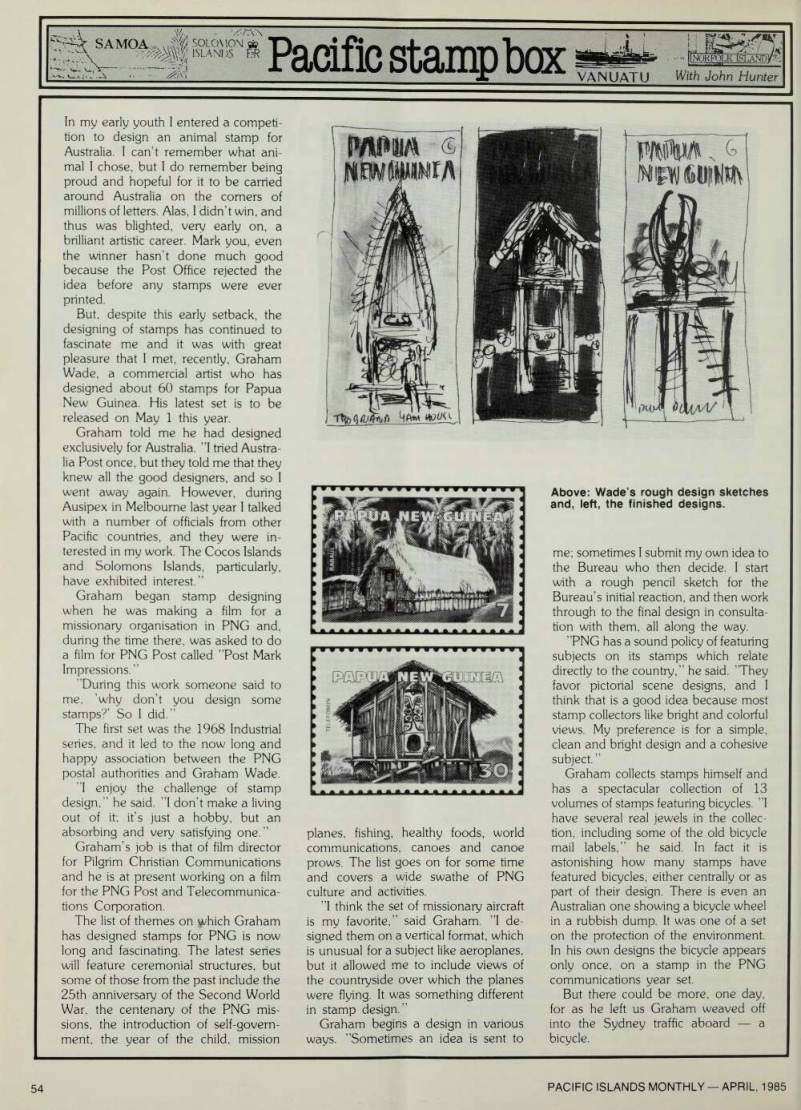
me; sometimes I submit my own idea to the Bureau who then decide. I start with a rough pencil sketch for the Bureau’s initial reaction, and then work through to the final design in consulta tion with them, all along the way. ”FNG has a sound policy of featuring subjects on its stamps which relate directly to the country,” he said. ’They favor pictorial scene designs, and 1 think that is a good idea because most stamp collectors like bright and colorful views. My preference is for a simple, clean and bright design and a cohesive subject. ”
Graham collects stamps himself and has a spectacular collection of 13 volumes of stamps featuring bicycles. ”1 have several real jewels in the collec tion, including some of the old bicycle mail labels,” he said. In fact it is astonishing how many stamps have featured bicycles, either centrally or as part of their design. There is even an Australian one showing a bicycle wheel in a rubbish dump. It was one of a set on the protection of the environment.
In his own designs the bicycle appears only once, on a stamp in the PNG communications year set.
But there could be more, one day, for as he left us Graham weaved off into the Sydney traffic aboard a bicycle.
Above; Wade’s rough design sketches and, left, the finished designs.