intrigue Fiji
p. 53 · Read in the full issue
political currents
Mara’s double deputies intrigue Fiji
In Fiji politics the biggest question is not which side will form the next govern ment, but who will be the next prime minister - probably from the Fijian side. The conun drum was made spicier, in February, by the appointment of a second deputy to Fiji’s first, and so far only, prime minister, Ratu Sir Kamisese Mara.
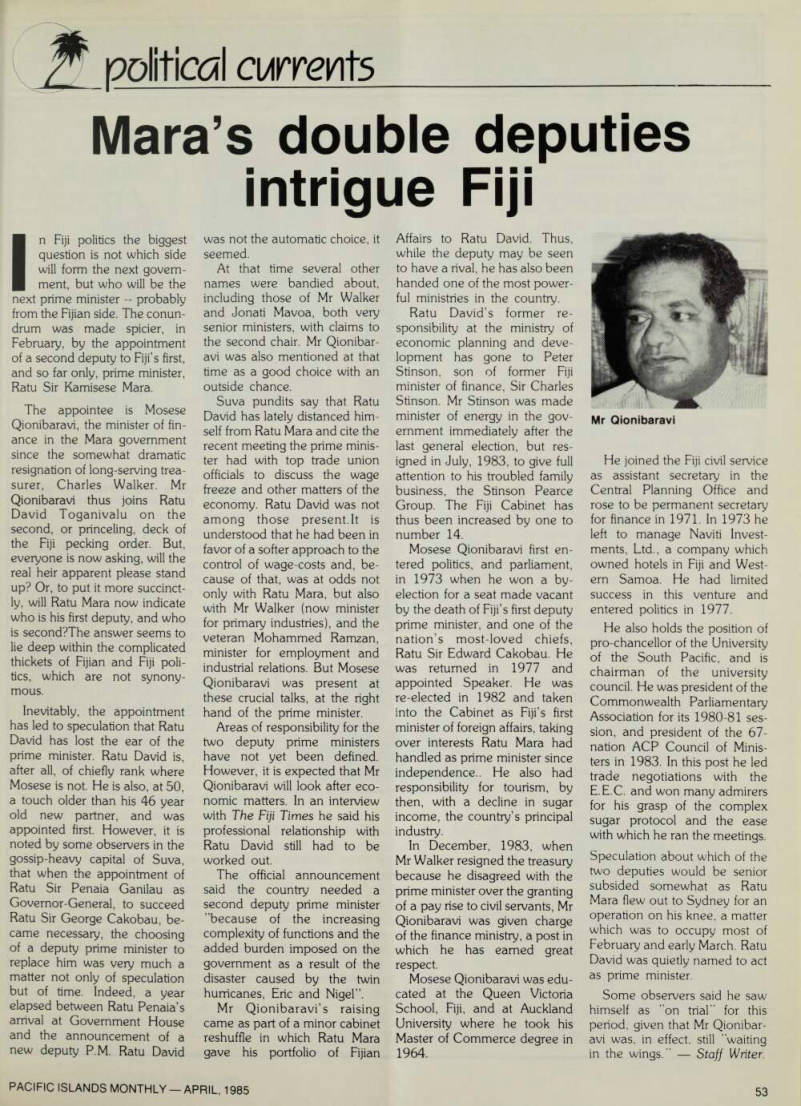
The appointee is Mosese Qionibaravi, the minister of fin ance in the Mara government since the somewhat dramatic resignation of long-serving trea surer, Charles Walker. Mr Qionibaravi thus joins Ratu David Toganivalu on the second, or princeling, deck of the Fiji pecking order. But, everyone is now asking, will the real heir apparent please stand up? Or, to put it more succinct ly, will Ratu Mara now indicate who is his first deputy, and who is second? The answer seems to lie deep within the complicated thickets of Fijian and Fiji poli tics, which are not synony mous.
Inevitably, the appointment has led to speculation that Ratu David has lost the ear of the prime minister. Ratu David is, after all, of chiefly rank where Mosese is not. He is also, at 50, a touch older than his 46 year old new partner, and was appointed first. However, it is noted by some observers in the gossip-heavy capital of Suva, that when the appointment of Ratu Sir Penaia Ganilau as Governor-General, to succeed Ratu Sir George Cakobau, be came necessary, the choosing of a deputy prime minister to replace him was very much a matter not only of speculation but of time. Indeed, a year elapsed between Ratu Penaia’s arrival at Government House and the announcement of a new deputy P.M. Ratu David
was not the automatic choice, it seemed.
At that time several other names were bandied about, including those of Mr Walker and Jonati Mavoa, both very senior ministers, with claims to the second chair. Mr Qionibar avi was also mentioned at that time as a good choice with an outside chance.
Suva pundits say that Ratu David has lately distanced him self from Ratu Mara and cite the recent meeting the prime minis ter had with top trade union officials to discuss the wage freeze and other matters of the economy. Ratu David was not among those present.lt is understood that he had been in favor of a softer approach to the control of wage-costs and, be cause of that, was at odds not only with Ratu Mara, but also with Mr Walker (now minister for primary industries), and the veteran Mohammed Ramzan, minister for employment and industrial relations. But Mosese Qionibaravi was present at these crucial talks, at the right hand of the prime minister.
Areas of responsibility for the two deputy prime ministers have not yet been defined.
However, it is expected that Mr Qionibaravi will look after eco nomic matters. In an interview with The Fiji Times he said his professional relationship with Ratu David still had to be worked out.
The official announcement said the country needed a second deputy prime minister ’’because of the increasing complexity of functions and the added burden imposed on the government as a result of the disaster caused by the twin hurricanes, Eric and Nigel”.
Mr Qionibaravi’s raising came as part of a minor cabinet reshuffle in which Ratu Mara gave his portfolio of Fijian
Affairs to Ratu David. Thus, while the deputy may be seen to have a rival, he has also been handed one of the most power ful ministries in the country.
Ratu David’s former re sponsibility at the ministry of economic planning and deve lopment has gone to Peter Stinson, son of former Fiji minister of finance, Sir Charles Stinson. Mr Stinson was made minister of energy in the gov ernment immediately after the last general election, but res igned in July, 1983, to give full attention to his troubled family business, the Stinson Pearce Group. The Fiji Cabinet has thus been increased by one to number 14.
Mosese Qionibaravi first en tered politics, and parliament, in 1973 when he won a by election for a seat made vacant by the death of Fiji’s first deputy prime minister, and one of the nation’s most-loved chiefs, Ratu Sir Edward Cakobau. He was returned in 1977 and appointed Speaker. He was re-elected in 1982 and taken into the Cabinet as Fiji’s first minister of foreign affairs, taking over interests Ratu Mara had handled as prime minister since independence.. He also had responsibility for tourism, by then, with a decline in sugar income, the country’s principal industry.
In December, 1983, when Mr Walker resigned the treasury because he disagreed with the prime minister over the granting of a pay rise to civil servants, Mr Qionibaravi was given charge of the finance ministry, a post in which he has earned great respect.
Mosese Qionibaravi was edu cated at the Queen Victoria School, Fiji, and at Auckland University where he took his Master of Commerce degree in 1964.
He joined the Fiji civil service as assistant secretary in the Central Planning Office and rose to be permanent secretary for finance in 1971. In 1973 he left to manage Naviti Invest ments, Ltd., a company which owned hotels in Fiji and West ern Samoa. He had limited success in this venture and entered politics in 1977.
He also holds the position of pro-chancellor of the University of the South Pacific, and is chairman of the university council. He was president of the
Commonwealth Parliamentary
Association for its 1980-81 ses sion, and president of the 67nation ACP Council of Minis ters in 1983. In this post he led trade negotiations with the E.E.C. and won many admirers for his grasp of the complex sugar protocol and the ease with which he ran the meetings.
Speculation about which of the two deputies would be senior subsided somewhat as Ratu Mara flew out to Sydney for an operation on his knee, a matter which was to occupy most of February and early March. Ratu David was quietly named to act as prime minister.
Some observers said he saw himself as ”on trial” for this period, given that Mr Qionibar avi was. in effect, still "waiting in the wings.” Staff Writer.
Mr Qionibaravi