The great home-coming
pp. 47-48 · Read in the full issue
tropicalitigs
From Norfolk to Pitcairn: The great home-coming
To meet our distant rela tives from Norfolk was the experience of a life time. Even I, who have no mutineer blood, and have been a Pitcairner for only seven years, felt very deeply about their presence on our island.
Because Pitcairn’s history is part of my husband and chil dren, it is part of me too.
The trip had been planned for months, and arranged by Tom Lloyd on Norfolk Island, expertly assisted by Jimmy Bennett, the Air New Zealand representative in Papeete. They were 26, some with well-known Pitcairn names, like Adams, Buffett, Evans and Nobbs, some with names unknown to us, but they all had a Christian, Young, Quintal, McCoy or Adams among their ancestors.
Since the Pitcairners split, as a result of the 1856 emigration to Norfolk, there has not been much communication between the two islands, apart from a short visit to Pitcairn by some Norfolk Islanders around the turn of the century. So it was certainly high time this “pilgrim age” was organised.
Our visitors flew from Pape ete to Mangareva, where the trading vessel Taporo II was waiting. This vessel, used for inter-island trade in French Polynesia, had been especially chartered.
Weeks before they arrived, Pitcairn houses had been cleaned and painted, flower beds weeded and lawns trim med. Goodies were acquired from ships and stowed away in freezers. Everything had to be the best for our cherished guests who were to be lodged in our homes, their number varying between one and six “pilgrims” per household.
As late as the 1930 s and '4os, Australians and New Zealanders often used to speak of Britain as “home”, even if they had never been there. The Bounty descendants living today on Norfolk Island seem to have a similar sentimental attitude towards Pitcairn with the difference that the lack of regular communications makes it extremely difficult for them to make a pilgrimage.
However, a group of 26 Norfolk Islanders at long last managed to make the trip across the Pacific in October-November, 1984, first by air to Tahiti and Mangareva, and then by a chartered vessel for the last 300 miles across the ocean. Kari from Norway, who married Brian Young seven years ago and has contri buted mightily to the repopulation of Pitcairn by giving birth to two children, has written this account of the great home-coming. Bengt Danielsson.
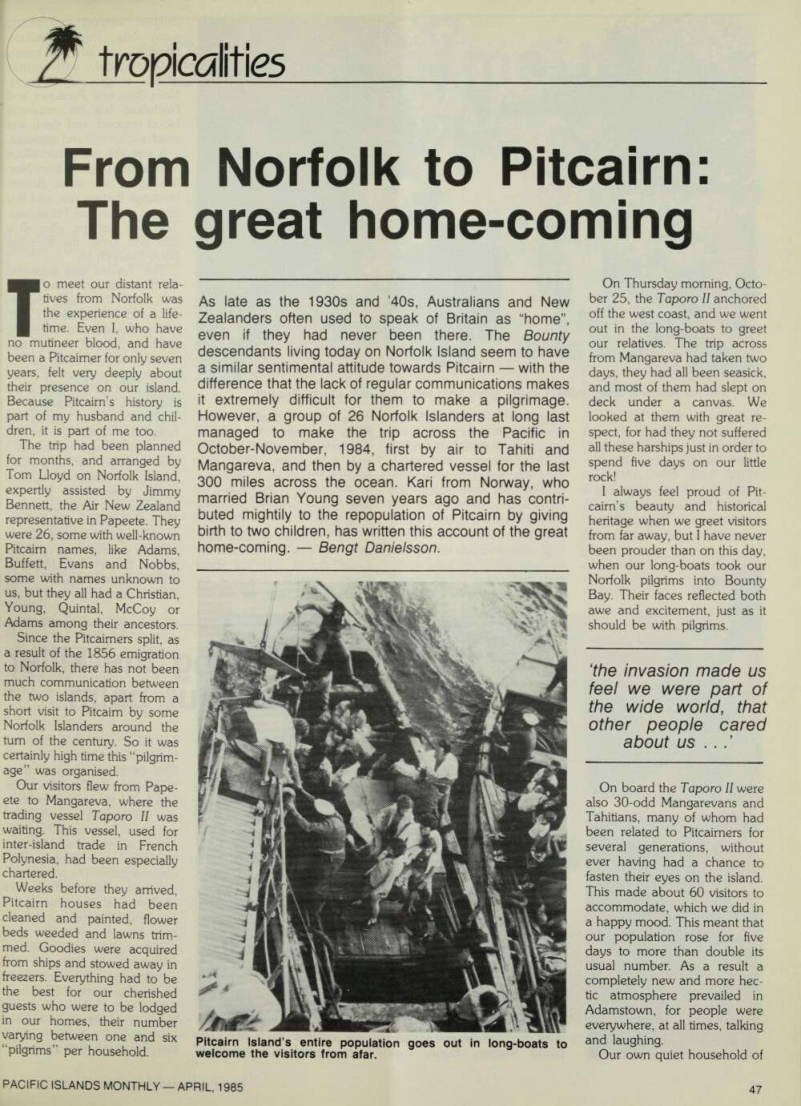
On Thursday morning, Octo ber 25, the Taporo II anchored off the west coast, and we went out in the long-boats to greet our relatives. The trip across from Mangareva had taken two days, they had all been seasick, and most of them had slept on deck under a canvas. We looked at them with great re spect, for had they not suffered all these harships just in order to spend five days on our little rock!
I always feel proud of Pit cairn’s beauty and historical heritage when we greet visitors from far away, but I have never been prouder than on this day, when our long-boats took our Norfolk pilgrims into Bounty Bay. Their faces reflected both awe and excitement, just as it should be with pilgrims.
‘the invasion made us feel we were part of the wide world, that other people cared about us ..
On board the Taporo II were also 30-odd Mangarevans and Tahitians, many of whom had been related to Pitcairners for several generations, without ever having had a chance to fasten their eyes on the island.
This made about 60 visitors to accommodate, which we did in a happy mood. This meant that our population rose for five days to more than double its usual number. As a result a completely new and more hec tic atmosphere prevailed in Adamstown, for people were everywhere, at all times, talking and laughing.
Our own quiet household of
Pitcairn Island’s entire population goes out in long-boats to welcome the visitors from afar.
four people, Brian Young, my husband, myself, and our two children, took in two Buffetts from Norfolk, four Mangare vans, and one American yachtsman. Meals were like a United Nations meeting with conversation in English, Pitcair nese, Norwegian, French and
Polynesian, plus sign language.
Therefore, in spite of the work involved in housing and feeding such a big crowd, the experi ence was incredibly rewarding.
Usually, our little island has only a few visitors at a time, and then only for a couple of hours, or at the most a couple of days.
This invasion made us feel that we were part of the wide world, and that other people cared about us. It made us feel strong and alive, and full of hope for the future, and not isolated and forgotten, as we have often felt in the past, with only three or four supply ships calling from New Zealand each year.
Brian’s grandmother was from Mangareva, and his cousin Paul was staying with us, doing his bit of entertaining at the table, telling the same kind of stories and laughing at the same jokes as Brian and Mer wyn Buffett. Again we felt that we were not alone, that we belonged to a wider commun ity, a wider brotherhood.
It really is a great pity that we have hardly any communica tion with our nearest neighbors in Mangareva, which is only 300 miles away. In the past, we had our own schooners, built here, to carry on trade with Mangareva and even Tahiti.
But today there is only the occasional yacht making trips of this sort.
The Norfolk Islanders traced their ancestors in the Pitcairn Island Registry Book, took
thousands of snapshots and miles of video film, while wandering around the island and Adamstown. They also beat us Pitcairners by one run in a day-long cricket match in Aute Valley, in which everyone took part.
The last night of their stay, there was a public dinner in the Court House, with the usual Pitcairn spread, followed by entertainment, with the school
children singing and doing some skits. The Polynesians provided the last half-hour’s entertainment, with guitar music, songs and dancing.
More than one Pitcairner and Norfolker felt his ancestral blood respond, and there was much excitement and applause.
It was also quite marvellous to hear our relatives from Nor folk speak the same Bounty language that we use, and that we, of course, call Pitcaimese.
This was perhaps, after all is said and done, the strongest bond between us.
The Taporo was anchored off the coast during the whole visit, and the ship’s owners discussed with the Island Coun cil the possibility of a regular shipping service, every four months, such a regular service to bring us supplies. It would mean a lot for our morale if it ever came into existence.
We took our visitors on board the Taporo on the last day, and followed the ship for a little while in our long-boats, singing our traditional farewell hymn. There were few dry eyes, and all faces were sad.
But we console ourselves with the thought that some of our Norfolk relatives will not wait for the Bounty bicentenary in 1990 to visit us again. Kari Boye Young.
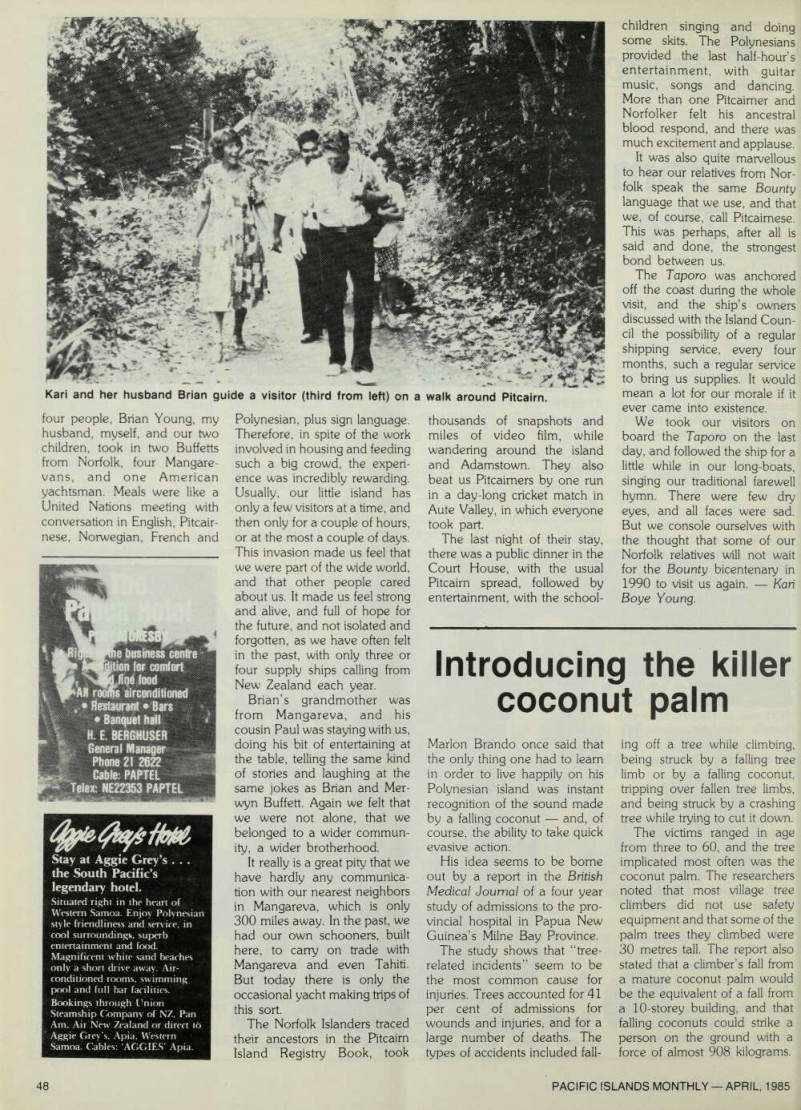
Kari and her husband Brian guide a visitor (third from left) on a walk around Pitcairn.