chief judge to Mau political exile
pp. 43-46 · Read in the full issue

Edwin William Gurr
The final years: From Pago’s chief judge to Mau political exile
In May, 1900, Gurr met Tilley and advised him on the forma tion of the government, and “on Samoan law and customs”.
Wisely, he sought an adminis tration based on the traditional political structure, for the Sa moans already had village gov erning bodies in place. Tutuila had been considered a sub district of Atua on Upolu, so, as a new political entity, it was divided into the eastern, central and western districts, each dis trict with its own governor, the harbor area being Naval prop erty. The only difficulty would be with the Manu’a Group, which had not ceded its authority to the United States, and which, in fact, not only boasted a royal chief as its leader, but hardly considered themselves Samoans at all they were Manu’a People (’O Tagata Manu’a). Gurr would twice be reminded of their differences.
“In 1903,” Masterman wrote in An Outline of Samoan His tory, (“Gurr) was appointed secretary for native affairs, which position he held until 1908. His knowledge of the country, the people and the language was most valuable to the administration ...”
The secretary was responsi ble for the supervision of district governors, judges and police, the administration of the copra industry and the collection of taxes. (The Naval government was a sort of agent or middle man in the copra industry, buying from the Samoans and selling overseas; they also bought handicrafts for export.) As secretary, Gurr was also chief judge. Despite his lack of formal training, Gurr grew into his position, as men occasional ly do. But one case, which was called “O le Ipu o le Tuima nu’a” or “The Cup of the King of Manu’a” would have
JOSEPH THEROUX concludes his three-part series on the life and times of EDWIN WILLIAM GURR. He continues the story as Gurr in 1900 accepts the invitation of U.S. Naval Captain B. F. Tilley to take responsibility for the setting-up of a government and administration in the newly acquired territory of American Samoa.
strained the abilities of a Solomon.
Tuimanu’a Elesara was the last in a long line of kings, or was something akin to a king, as thought of by Westerners.
He was certainly more than a chief or a district governor. A whole sacredness surrounded him: he could not be touched by common men, nor could his food be touched by them. Only
his wife could feed him, and his taupou could make his bed.
Captain Gray wrote in his A merika Samoa: “When he walked abroad, he had to be preceded by two talking chiefs blowing upon conches to warn all within earshot to prostrate themselves upon pain of death.
“A special vocabulary, above and beyond the chiefly lan guage, was connected to the
Tuimanu’a. For instance, the chicken is the family totem of the Tuimanu’a, and for this reason the word moa , the com mon word in Samoa generally, became a tabooed word. Until recently, manu (meaning sim ply “bird”) was used as the everyday word. In this way the common word for cup (ipu) was solely reserved for the Tuimanu’a. Commoners used the word taumafa for cup. Dur ing a kava ceremony the Tuimanu’a serving was always heralded as “Aumai o le ipu o le Tuimanu’a or “Bring the cup of the Tuimanu’a.”
A crisis was precipitated when Mauga Moimoi (1852- 1935), district chief and signer of the Deed of Cession, visited Ofu, Manu’a, in August of 1901. At a kava ceremony there, Mauga demanded to be served an ipu, which horrified the Manu’ans. But Mauga was also a district governor and seemed to be challenging the changing order. Mauga rejected his serving. Gray reports: “If you please,” said some one, “Why not?”
“Because,” Mauga replied, “I demand to be served an ipuh. ”
“Why, Mauga,” it was asked, “do you demand an ipu?”
“Render under each man his due,” said Moimoi, quoting the Bible (Romans 13:7) with ob vious premeditation. “Tribute to whom tribute is due, custom to whom custom; and honor to whom honor.”
The chiefs of Ofu adjourned to argue the wisdom of granting his request. After much discus sion, it was agreed to com promise and call the serving with the words, O le Ipu o le Kouana, “The Cup of the Gov ernor. ” Both parties were pleased with the phrase.
But when the Tuimanu’a heard that his sacred word had been taken in vain, he ordered
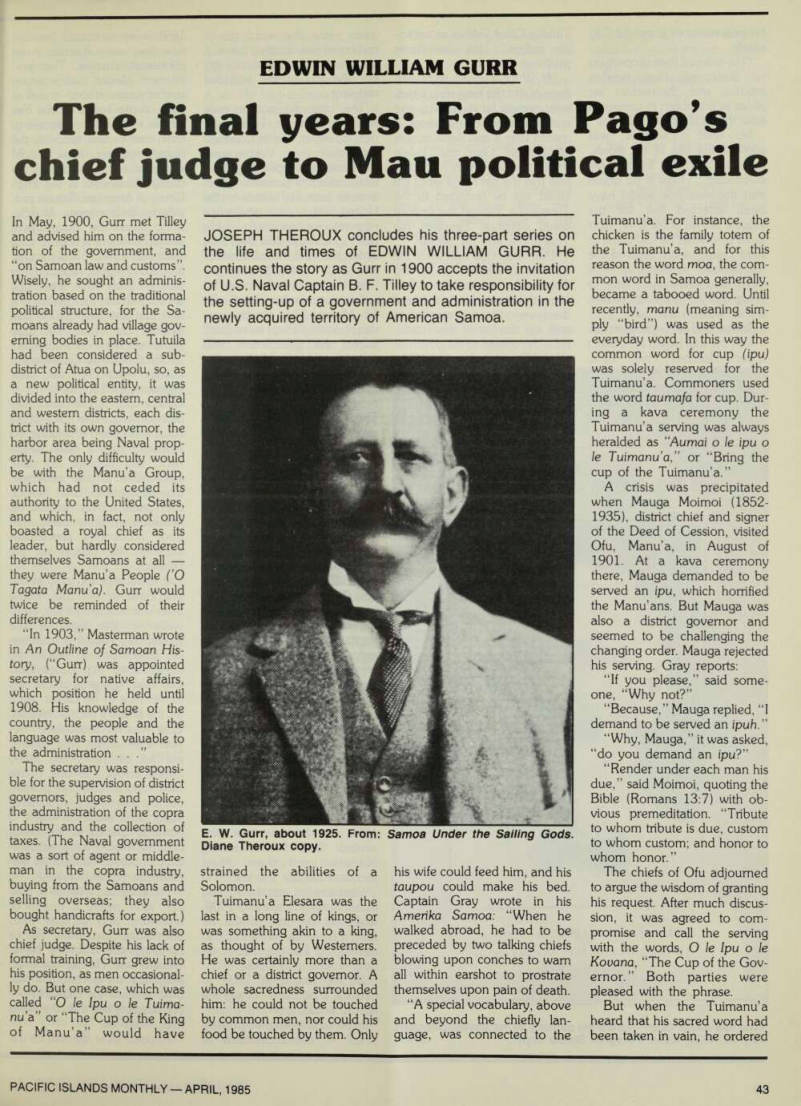
E. W. Gurr, about 1925. From: Samoa Under the Sailing Gods.
Diane Theroux copy.
his policemen to arrest the Ofu chiefs.
“He ordered their property to be destroyed, their families evicted, and themselves set afloat in the ocean in canoes to take their chance of survival.”
No one, it seemed, was allowed the use of his words, even in modified form. Gray continued: “There is no doubt that this sentence would have been effected but for the chance arrival of Mr E.W. Gurr in Ta’u, whither he had come to hold court.” Gurr ordered the Tuimanu’a “to desist at once from his intentions” and to bring charges in a court of law, if that was his intention.
It was, and on September 20, 1901, the trial began at “District Court Number Five, Ta’u, Manu’a. ”
“Judge Gurr presided, and with him sat High Chief Tufele and Talking Chief Tufele and
Talking Chief Tulifua as associ ate judges... the defendants pled not guilty.”
Mr W.H. Yandall translated throughout the long trial, which was marked by discussion and quibbling as to fine meanings. A month later a split decision was announced. Gurr and Tufele found the Ofu chiefs not guilty and that the use of the word ipu could not be restricted to the Tuimanu’a, though the custom could continue between the Tuimanu’a and his people.
Gurr reasoned that since the full kava ceremony of the Tuimanu’a had not been per formed it was indeed the ipu of the kovana that was referred to and not the ipu of the Tuima nu’a. An appeal to the governor (Naval Commandant Uriel Seb ree) resulted in support for Gurr’s decision, and explained: “In giving kava to Tuimanu’a the word ipu alone is used, but
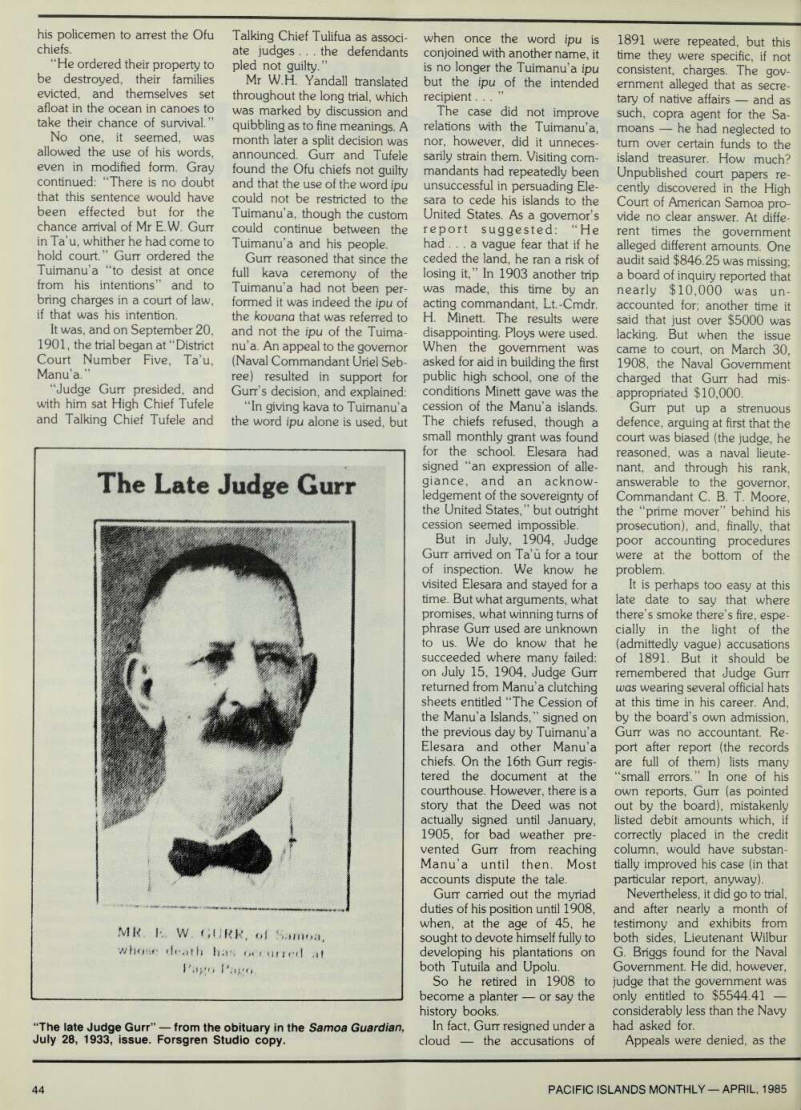
“The late Judge Gurr” from the obituary in the Samoa Guardian, July 28, 1933, issue. Forsgren Studio copy.
when once the word ipu is conjoined with another name, it is no longer the Tuimanu’a ipu but the ipu of the intended recipient...”
The case did not improve relations with the Tuimanu’a, nor, however, did it unneces sarily strain them. Visiting com mandants had repeatedly been unsuccessful in persuading Ele sara to cede his islands to the United States. As a governor’s report suggested: “He had ... a vague fear that if he ceded the land, he ran a risk of losing it,” In 1903 another trip was made, this time by an acting commandant, Lt.-Cmdr.
H. Minett. The results were disappointing. Ploys were used.
When the government was asked for aid in building the first public high school, one of the conditions Minett gave was the cession of the Manu’a islands.
The chiefs refused, though a small monthly grant was found for the school. Elesara had signed “an expression of alle giance, and an acknow ledgement of the sovereignty of the United States,” but outright cession seemed impossible.
But in July, 1904, Judge Gurr arrived on Ta’u for a tour of inspection. We know he visited Elesara and stayed for a time. But what arguments, what promises, what winning turns of phrase Gurr used are unknown to us. We do know that he succeeded where many failed: on July 15, 1904, Judge Gurr returned from Manu’a clutching sheets entitled “The Cession of the Manu’a Islands,” signed on the previous day by Tuimanu’a Elesara and other Manu’a chiefs. On the 16th Gurr regis tered the document at the courthouse. However, there is a story that the Deed was not actually signed until January, 1905, for bad weather pre vented Gurr from reaching Manu’a until then. Most accounts dispute the tale.
Gurr carried out the myriad duties of his position until 1908, when, at the age of 45, he sought to devote himself fully to developing his plantations on both Tutuila and Upolu.
So he retired in 1908 to become a planter or say the history books.
In fact, Gurr resigned under a cloud the accusations of
1891 were repeated, but this time they were specific, if not consistent, charges. The gov ernment alleged that as secre tary of native affairs and as such, copra agent for the Sa moans he had neglected to turn over certain funds to the island treasurer. How much?
Unpublished court papers re cently discovered in the High Court of American Samoa pro vide no clear answer. At diffe rent times the government alleged different amounts. One audit said $846.25 was missing; a board of inquiry reported that nearly $lO,OOO was un accounted for; another time it said that just over $5OOO was lacking. But when the issue came to court, on March 30, 1908, the Naval Government charged that Gurr had mis appropriated $lO,OOO.
Gurr put up a strenuous defence, arguing at first that the court was biased (the judge, he reasoned, was a naval lieute nant, and through his rank, answerable to the governor, Commandant C. B. T. Moore, the “prime mover” behind his prosecution), and, finally, that poor accounting procedures were at the bottom of the problem.
It is perhaps too easy at this late date to say that where there’s smoke there’s fire, espe cially in the light of the (admittedly vague) accusations of 1891. But it should be remembered that Judge Gurr was wearing several official hats at this time in his career. And, by the board’s own admission, Gurr was no accountant. Re port after report (the records are full of them) lists many “small errors.” In one of his own reports, Gurr (as pointed out by the board), mistakenly listed debit amounts which, if correctly placed in the credit column, would have substan tially improved his case (in that particular report, anyway).
Nevertheless, it did go to trial, and after nearly a month of testimony and exhibits from both sides, Lieutenant Wilbur G. Briggs found for the Naval Government. He did, however, judge that the government was only entitled to $5544.41 considerably less than the Navy had asked for.
Appeals were denied, as the
Federal Courts were said to have no jurisdiction over the “colony.” Gurr maintained his innocence.
But to pay the government and court costs, Gurr declared bankruptcy on May 19, 1908.
Several auctions were held.
Most of his land (as opposed to family land held in Fanua’s name) at Faga’alu, Mulinu’u (Coconut Point), and Pugamai sold, along with his cattle, furniture and a rowboat. But it did not raise the needed funds.
His personal library was inven toried by the government and auctioned he lost his whole law library, two sets of encyclo paedias, a set of histories, a set each of Stevenson and Kipling.
Finally, most of his remaining furniture, paintings, candle sticks, family photos (which accounts for the meagre supply now available) and household artifacts were sold off.
Everything down to his inkwell and ashtrays was sold. On February 4, 1911, when the results of the final auction had been paid to the government, Commandant William Crose announced the case closed.
If Gurr’s hand had been in the till, if he was the “rascal”
Moore had said, he did not appear to profit from it. O. F.
Nelson wrote years later that what remained of the estate pieces of furniture would not cover the man’s funeral ex penses. • • • He and Fanua led a quiet life for the next few years. His only dealing with the government came in November, 1913, when he sold part of their adjoining property for the pur pose of the island government to build the first Samoan Hospi tal (buildings which later came to be called the Annex). Gurr was paid $6BOO partly in cash and the rest mortgaged, which was completed in August of 1915.
On April 25, 1916, at the age of 22, Teuila married one H.
Lloyd Haliday. Haliday had been part of the New Zealand expeditionary force that had descended upon German Samoa at the beginning of the war. They had landed in Apia on August 29, 1914 1365
Kiwis in warm woollies, they had no tropical uniforms. Hali day stayed on to become the assistant customs officer in Apia. He had captured, accor ding to the newspaper, “one of the most popular and attractive young ladies in American Samoa. ”
The wedding was conducted in the house at Malaloa. “The bride wore a beautiful dress of white satin with an over dress of shadow lace and a court train with the traditional orange blos soms and carried a bouquet of exquisite flowers,” said the Fa’atonu. A “Grand March” was held, leading the wedding party to a reception at the Pavilion of the Enlisted Men’s Club. The Fitafita Band played until well into the night, pausing only for a 10 o’clock dinner which was served to a hundred people, including Governor Poyer and “his little daughter Miss Mary Poyer. . . Paymaster and Mrs Jennings, and various government officials.
“. . . Judge E. W. Gurr, a well known planter in Tutuila, and Fanua, a member of a promin ent family in Upolu,” were justly famous for their generous parties.
By 1917, Teuila had moved to New Zealand with her hus band. Bernard fought in the trenches of Europe; he would return with a shattered arm, a hand clenched in immobility.
In mid-December, Fanua be came febrile and “Dr Linde of the (adjacent) Samoan Hospital was called to attend her. It was then discovered she was suffer ing from ptomaine poisoning and every effort was put for ward to overcome the attack.”
Gurr was with her, as was indeed the whole hospital staff “in constant attendance ... to save the life of one much loved and respected. For two days Mrs Gurr suffered intense agony but bore up bravely in order to give the treatment all possible chance of restoration.
At 1 o’clock in the afternoon of December 13th, Fanuaea Eleti no, daughter of Aisake and Amalaina, adopted of Seuma nutafa and Fatulia, late taupou of Apia, friend of artist John Lafarge, historian Henry Adams and writer Robert Louis Stevenson, wife of Edwin Gurr, breathed her last.”
Governor Poyer, away on a cruise, cancelled his plans and cabled condolences to Gurr.
The funeral was held “on Sun day, December 16.” The notice in the Fa’atonu of January 1918 continued; “The funeral was attended by the Governor, Naval officers and most residents of Pago Pago; it was very impressive and at the same time pic turesque, taking place at her home and buried amongst the flowers and plants she delighted to rear and cultivate.”
To this day, ti plants, the traditional graveside decora tion, flourish next to her grave.
She was interred on her
grounds, as is Samoan custom, overlooking the harbor of Pago Pago.
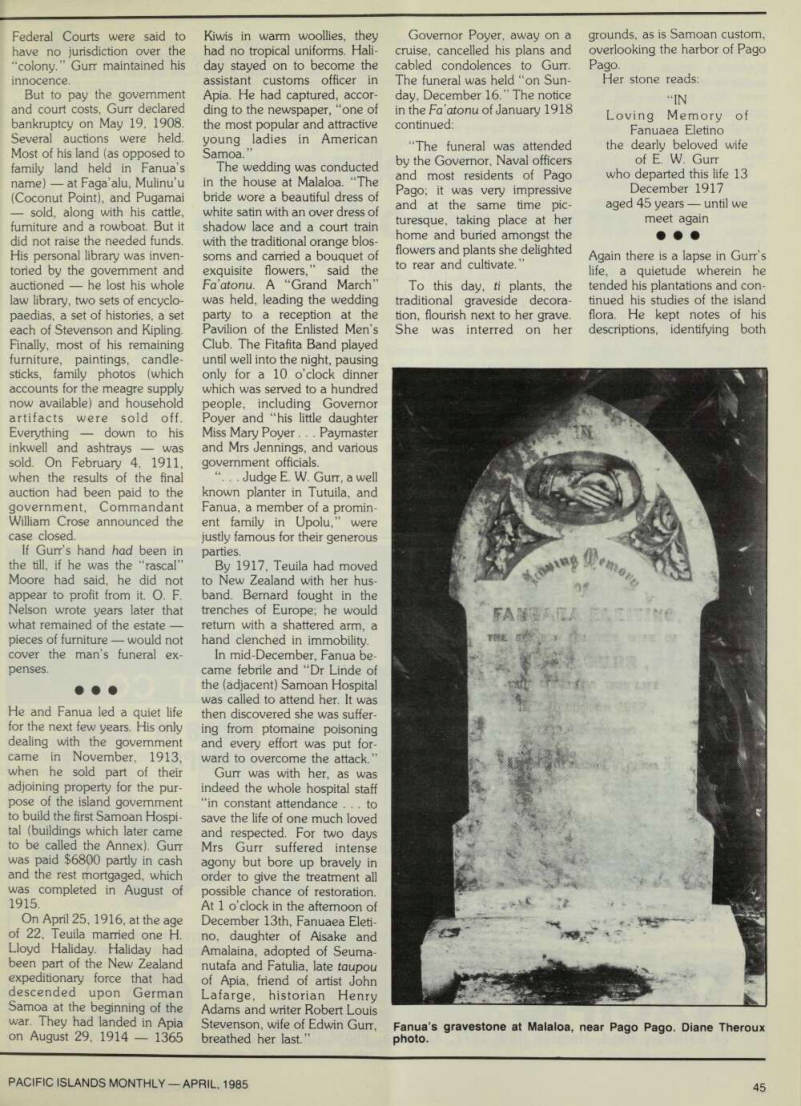
Her stone reads; “IN Loving Memory of Fanuaea Eletino the dearly beloved wife of E. W. Gurr who departed this life 13 December 1917 aged 45 years until we meet again • • • Again there is a lapse in Gurr’s life, a quietude wherein he tended his plantations and con tinued his studies of the island flora. He kept notes of his descriptions, identifying both
Fanua’s gravestone at Malaloa, near Pago Pago. Diane Theroux photo.
the Latin and Samoan names of plants. Later, in a 1927 governor’s report, his notes would be included as a supple ment. Also, at some point, he remarried. Her name was Sasa, though we know little more than that. There were no chil dren.
The chronology of Gurr’s life again becomes documented in the middle ’2os. He had been accused by Major-General George Spafford Richardson (1868-1938) of being “an ac tive member of the Mau,” and indeed began attending Mau meetings with regularity. By this time Gurr had moved to Apia.
On May 26, 1927, he began editing a pro-Mau newspaper, the Samoa Guardian. Again there were rumors Gurr “had fled” the administration though this time the American adminis tration was meant. In August of the same year, the Fa’atonu officially denied that Gurr was “a prohibited immigrant to American Samoa” or “that his record in American Samoa (had) been officially communi cated by the Governor of
American Samoa.” It did say that the “Governor did discuss Mr Gurr’s official career in American Samoa with the Hon orable Minister for External Affairs of New Zealand. ” Sadly, they found he was no criminal.
Nevertheless, the minister, W.
Nosworthy, condemned the efforts of Mau supporters.
Gurr became a contributor to the American Associated Press, and documented the oppres sive policies of Richardson in particular and New Zealand in general.
On December 15, 1927, the 10th anniversary of Fanua’s death, Gurr was threatened with arrest. The threats became reality on the 17th, when he, O.
F. Nelson and A. G. Smyth were sentenced without trial to be deported to New Zealand.
Gurr and Nelson got five years; Smyth, two. The Samoa Guar dian was banned. Before Gurr was exiled on December 25, he wrote a long dispatch to the Associated Press. George Westbrook wrote to Nelson Rowe on February 20, 1928: “Last month a letter of Gurr’s
containing about 12 pages . . . and posted in time for the Lady Roberts, was discovered in the pan of the lavatory at the (Apia) Post Office all wet and had been used as toilet paper.”
Three workers were sus pended for the offence, but Westbrook believed that to be “the last of it.” The issue apparently came up between Westbrook and the pro-admin istration editor of the Samoa Times, a man named Brown.
Westbrook told Rowe: “Brown did not come up to time, re what I gave him for saying that Gurr ought to be in Vaimea Jail.”
On December 28, 1929, when Smyth returned from de portation, there was a welcom ing parade. There was a scuffle, and recent research has shown a planned assassina tion occurred. Tamasese, one of the Mau leaders, was cut down.
Eleven others were wounded.
Gurr wrote to Rowe from Suva, Fiji: “Send any letters to me care of GPO Auckland, NZ.
I cannot tell what I shall be doing or where I shall reside. ”
In other circumstances, he would have stayed with one of his children, but he undoubted ly wished to keep them free of his political entanglements.
Also, he expected to be par doned, to return early to Samoa, before his five years was completed. His lonely exile must have made him mindful of Fanua, of her politics and ex ploits. He yearned to return.
But the New Zealand Gov ernment was determined to keep him out of Samoan affairs.
It was not until May of 1933 that he and 0. F. Nelson were allowed to return to Samoa.
The ship touched first at Pago Pago. There Gurr left the ship and was taken to the Samoan Hospital suffering from a sto mach carcinoma. For two months he languished and on July 1, 1933, he died, aged 70.
He was buried next to Fanua.
But there was no one to erect a stone.
There is still no stone, and the graves are wild and over grown, the ti plants among the weeds.
Misi Kea was gone.