Homeland Project
p. 47 · Read in the full issue
tropicalities
Meet the Lapita Homeland Project
The Lapita Homeland Project is a joint effort of leading Pacific archeologists and the Oceanic Research Foundation Ltd.
Its purpose is to test a prop osition now being entertained by archeologists that Papua New Guinea’s Bismarck Archipelago might have been the immediate homeland of the people who set out about 4000 years ago to colonise the islands of the Pacific to the east.
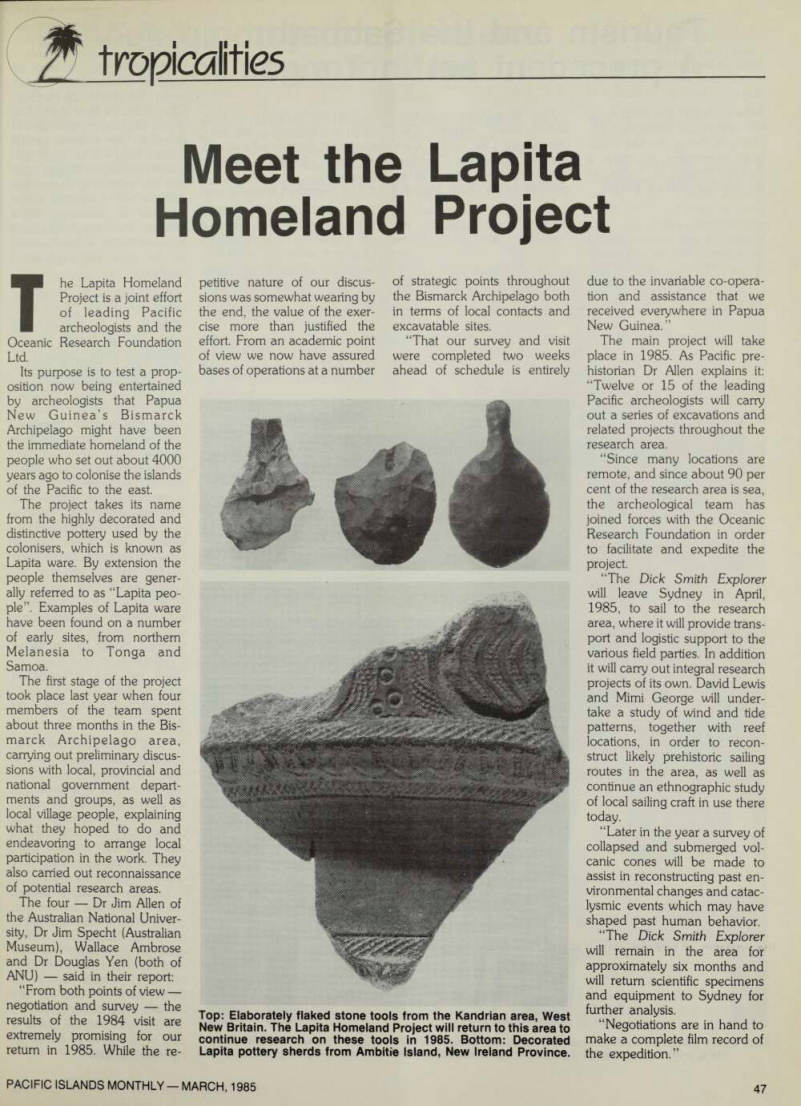
The project takes its name from the highly decorated and distinctive pottery used by the colonisers, which is known as Lapita ware. By extension the people themselves are gener ally referred to as “Lapita peo ple”. Examples of Lapita ware have been found on a number of early sites, from northern Melanesia to Tonga and Samoa.
The first stage of the project took place last year when four members of the team spent about three months in the Bis marck Archipelago area, carrying out preliminary discus sions with local, provincial and national government depart ments and groups, as well as local village people, explaining what they hoped to do and endeavoring to arrange local participation in the work. They also carried out reconnaissance of potential research areas.
The four Dr Jim Allen of the Australian National Univer sity, Dr Jim Specht (Australian Museum), Wallace Ambrose and Dr Douglas Yen (both of ANU) said in their report: “From both points of view negotiation and survey the results of the 1984 visit are extremely promising for our return in 1985. While the re
petitive nature of our discus sions was somewhat wearing by the end, the value of the exer cise more than justified the effort. From an academic point of view we now have assured bases of operations at a number
of strategic points throughout the Bismarck Archipelago both in terms of local contacts and excavatable sites.
“That our survey and visit were completed two weeks ahead of schedule is entirely
due to the invariable co-opera tion and assistance that we received everywhere in Papua New Guinea.”
The main project will take place in 1985. As Pacific pre historian Dr Allen explains it: “Twelve or 15 of the leading Pacific archeologists will carry out a series of excavations and related projects throughout the research area.
“Since many locations are remote, and since about 90 per cent of the research area is sea, the archeological team has joined forces with the Oceanic Research Foundation in order to facilitate and expedite the project.
“The Dick Smith Explorer will leave Sydney in April, 1985, to sail to the research area, where it will provide trans port and logistic support to the various field parties. In addition it will carry out integral research projects of its own. David Lewis and Mimi George will under take a study of wind and tide patterns, together with reef locations, in order to recon struct likely prehistoric sailing routes in the area, as well as continue an ethnographic study of local sailing craft in use there today.
“Later in the year a survey of collapsed and submerged vol canic cones will be made to assist in reconstructing past en vironmental changes and catac lysmic events which may have shaped past human behavior.
“The Dick Smith Explorer will remain in the area for approximately six months and will return scientific specimens and equipment to Sydney for further analysis.
“Negotiations are in hand to make a complete film record of the expedition.”
Top: Elaborately flaked stone tools from the Kandrian area, West New Britain. The Lapita Homeland Project will return to this area to continue research on these tools in 1985. Bottom: Decorated Lapita pottery sherds from Ambitie Island, New Ireland Province.