Times of strife, times of peace
pp. 44-46 · Read in the full issue
and then a move to Pago
The Gurrs’ relations with the Stevensons were close and cor dial. Fanny often had them to dinner. They exchanged Christ mas gifts.
“Today Louis and Lloyd rode down to town, coming back in time for dinner. Lloyd came ahead of Louis, fetching Fanua with him. I had sent her Christmas box by her boy, who brought a note for Belle an embroidered white gown, a very pretty one indeed; I gave her the best I had.”
In a letter to Sidney Colvin, Louis wrote; “. . . we sat down to dinner at the Chinaman’s . . . Gurr and lat each end as hosts; Gurr’s wife, Fanua, late maid of the village; her (adopted) father and mother Seumanu and Faatulua (sic), Fanny, Belle, Lloyd, Austin and Henry Simele ...” (Henry was a sort of foreman at Vailima and a cousin of Fanua’s).
In another letter, he wrote: “A little way back along Muli ni’u (peninsula), Mrs Gurr met us with her husband’s horse; and he and she and Lloyd and I rode back in a heavenly moon light.”
Belle, writing years later in her autobiography, This Life Tue Loved, remembered their first visit. She noted that Fanua was “squeezed into tight corsets.” Fanua, in turn, noticed Fanny and Belle wore the loose-fitting Hawaiian hola ku. She told Belle later: “It was nice to see you and Tamaitai (Fanny) in your pretty white holakus. You looked so cool and comfortable. I told Edwini, ‘Never never will I put on those bad corsets again. The missionaries and traders wives can wear them, but now I know how high chief ladies dress and I will stick to my holaku. ,, ' Belle commented: “It made a great difference in her looks for in the soft flowing lines of that garment she was lovely.”
They were close neighbors
JOSEPH THEROUX contributes the second part of his three-part study of the life and times of EDWIN WILLIAM GURR, a prominent figure in Samoa around the turn of the century.
and visits were back and forth between the large hall of Vaili ma and “the little Gurr cot tage”, in Fanny’s phrase. Once, a fancy dress ball was held in honor of the birthday of the Prince of Wales. “Mr Gurr and Miss Gurr (Edwin’s sister Ethel) are going to take Belle ...”
Fanny wrote. Mrs Thomas Stevenson, Louis’ mother, wrote: “Fanny designed a cos tume for Mrs Gurr (a pretty Samoan girl) as Zenobia, Empress of the East. She wore a Greek dress, made in part of cotton stuff with a gold pattern stamped on it; over this a crimson chuddah (the shawl part of a sari) was correctly draped, with a gold belt, many beads, and an elaborate gold crown. ”
Gurr and Stevenson had a mutual friend and business adviser in Harry Moors, the American who shared their taste for political intrigue. But when Gurr aligned himself with Malietoa years later, he and Moors would have a falling out.
Moors would refer to him as a “rascal”. But in 1891, there were other rascals around.
Years afterwards The Sa moan Herald would report in Gurr’s obituary: “He was (also) connected with the late Mr J. T.
M. Hayhurst in banking and general business.”
Well, about November of 1891, while still lawyering with Carruthers, Gurr was asked to become manager of an Apia bank (which boasted accounts of, among others, RLS and his mother). The owners, a Mr Hayhurst (“I thought him coarse and common,” said Fanny) and a Mr Aspinall (“a black-a-vised vulgarian, with
long white carnivorous teeth,” said Fanny), paid Gurr a visit after he had been at the job for some time. These “ruffians”, according to Fanny, “suspected Gurr of dishonest practices and had thus fallen upon him suddenly that he should have no time for preparation”.
Fanny, in her hectic way, does not explain what the “dishonest practices” were, though embezzlement suggests itself. However, she so insists on the brutality of the owners and the docility of Gurr, their insulting manner and Gurr’s gentlemanliness, that there seems to be no question about where the criminality lay. Fanny wrote that “. . . it would re quire a great deal of proof to make me believe that Gurr had ever been more than unwise. ”
She added that Carruthers had stuck by Gurr throughout it all and had “behaved very gener ously in the matter”.
Gurr evidently had very little money from his supposed theft; for his sister Ethel’s passage home, he had to borrow seven pounds from Stevenson. He returned to work with Car ruthers and severed relations with Hayhurst and Aspinall and Fanny added not a word to the story. Relations between the two families remained strong.
Gurr’s public reputation was not harmed; the following year he was appointed Natives’
Advocate, a post by which he would receive so many suc cesses.
Since about 1860, outland ers (mostly German), had been buying up huge tracts of land, often fraudulently. The Treaty
of Berlin, coming on the heels, or rather the stern, of the hurricane v of 1889, established the Samoan International Land Commission which would arbi trate claims and counter-claims.
However, the first natives’ advocate failed miserably and threw doubt upon the integrity of the commission itself.
Stevenson wrote in A Foot note to History that this man “was succeeded pro tempore by a young New Zealander (sic), E. W. Gurr, not much more versed in law than himself and very much less so in Samoan. Whether by more skill or better fortune, Gurr has been able in the course of a few weeks to recover for the natives several important tracts of land; and the prejudice against the commission seems to be abat ing as fast as it arose.”
How far Gurr succeeded can be judged by statements in the Cyclopedia of Samoa: “He made a record on the commis sion. Out of over a million acres of land claimed by foreigners he succeeded in gaining back for the Samoans over 800,000 acres. . .”
On July 13, 1894, according to an American Samoa Gov ernors report chronology (1927): “Municipal President Schmidt, in a financial state ment to the consuls, said that the continued expense of the salary of the native advocate, Mr E. W. Gurr. . . was a great burden. Mr Gurr, far from giv ing him comfort, threatened to sue the Government for dam ages for non-fulfilment of con tract. The Faipule had reduced his salary to $l5O a month after increasing it to $200.”
Stevenson’s doubts about Gurr’s training in law were echoed in Captain Gray’s Amerika Samoa: “(Gurr) was deeply and sympathetically in terested in the fa a Samoa and there could be no question as to
his experience therein. The ex tent of his legal training is unknown but his papers indi cate considerable knowledge.”
Gurr was involved in Sa moan politics and intrigue.
When Harry Jay Moors smug gled (percussion) caps into the country under the noses of the Germans, he made up a phony box of headgear to irk the Germans, “Mr Gurr contribut ing a smoking cap.”
“Mr Gurr is a very small, slender man,” Fanny reported.
But this did not prevent him from speaking out on the Ger man’s high-handed running of affairs in Apia. He signed petitions along with Stevenson and Moors and spoke at Market Hall assemblies. It was all the more difficult for he had not been well.
During the trying times of the Hayhurst visit and court pro ceedings, Gurr was suffering from “necrosis of the (jaw) bone”, according to Fanny: the bone tissue was dying, possibly because of cancer. It was oper ated on, but several weeks later, by December 16, 1891, he needed another. Fanny noted in her diary: “I fear it looks serious. His cheek is to be cut open again and a tooth and a piece of the jaw to be chiselled out.” But by Decem ber 28, she was writing; “(Fanua) says Mr Gurr is now able to eat with a spoon.
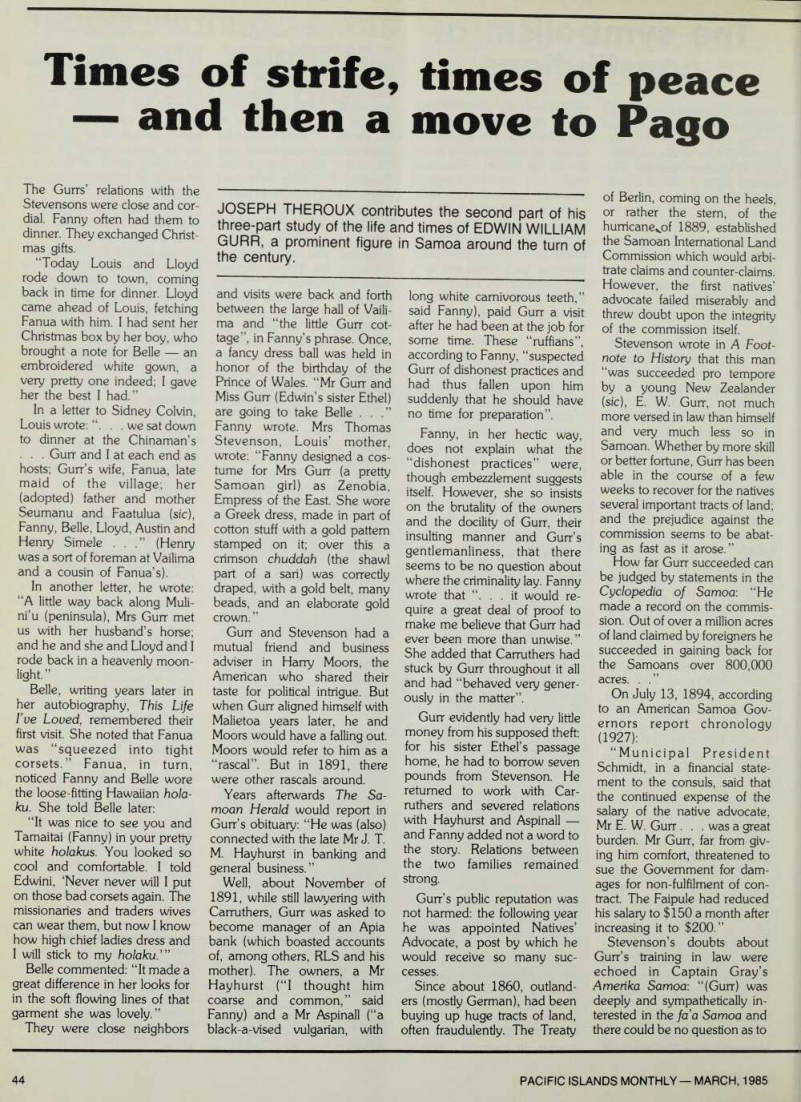
Heretofore he has had to suck with a straw. ” A scar, the length of his left jaw, is barely visible in photographs.
The Gurrs are discussed right up to the end of Fanny’s diary: July 24, 1893: “Just in time for dinner, Mr Gurr and Fanua came to stay a few days, to get a change for the latter, who is threatened with consumption.” (Fanua remained well).
July 25, 1893; “Pelema (Graham Balfour) and Mr Gurr made a tumstyle at the gate today. ”
Nothing momentous; neigh bors chatting, sharing work and food and drink, jungle walks and moonlight rides, births and, inevitably, deaths.
In his last letter to Sidney Colvin, in November 1894, Stevenson talked about the
birth of Gurr’s first child, Teuila Diana. Stevenson’s step daughter, Isobel (Belle), was the girl’s godmother. For the christening, Isobel was carried down to Apia by “four half naked bearers”. Teuila was also Isobel’s Samoan name, mean ing “The Adorner”, and about which Stevenson had com posed a poem.
Stevenson was dead by De cmeber 4. The world lost a writer, the Samoans a defen der, the Gurrs a friend. But Fanny did not finally leave the islands until 1898. She left Gurr “many odds and ends glass ware and such articles” and the keys to Vailima. He sold or gave away most of the items.
For her departure, Fanny was carried to the waiting vessel in Seumanutafa’s whaleboat which had been decorated with a flowered awning.
“Crowds of Samoan friends Fanua (Mrs Gurr), Lauli’i (Mrs Willis), Tamasese. . . the Vailima household, were in boats, also trimmed with ferns and flowers, to see them off,” wrote Fanny’s sister Nellie.
Departing Samoa for the last time, Fanny may have recalled an incident years before: “Mr Gurr described how, in the long shadows of a late afternoon in August 1893, his pretty wife Fanua had been playing tennis with Stevenson on the grass court. Suddenly they saw him halt and stagger, and Fanny rushed up to him as a hemorrhage started prob ably not to her complete sur prise. Fortunately the flow soon stopped. ‘Mrs Stevenson,’ wrote Gurr, ‘then insisted he should not play tennis any more . . .’ Lloyd remembered how afterwards at the tennis parties they could see his ‘wist ful face’ watching them as he paced the verandah, often glan cing up at the evening star in the sunset glow over Mt. Vaea. ”
The year before her friend Fanny left, on March 13, 1897, Fanua bore her second, and last, child, Bernard.
During the civil war of 1898- 99, Gurr became administrator of the Malietoa Tanumafili gov ernment. (This was the tempor ary government that had been
decided upon by the courts.) The armies of Mata’afa, along with the Germans, fought the British and Americans, who supported Malietoa.
One day, visiting Apia, the Gurrs were told that the Mata’afa forces had occupied their house near Vailima. With the children, Gurr and Fanua safely spent several night on a “man of war” in the harbor, but Gurr needed a sheaf of “valu
able papers” and a certain tin box from the house that could not fall into the hands of the Mata’afa forces, though “which was sought for by the warriors, ” said the O \e Fa’atonu. “Several attempts were made to get the documents lest they be de stroyed by the Mata’afa people.”
Foreign neutrals tried to in tercede but were turned away by the warriors. Fanua decided
Edwin William Gurr (the “B” is in error-they thought he was son Bernard). The scar from his 1891 jaw operation is visible in this photo from The Samoa-Apia Mission (L.D.S.) History. Diane Theroux copy.
that she had sufficient pule (authority) to attempt it, even though, as a Malietoa suppor ter,she was a significant enemy.
“She went to her home which was then occupied and surrounded by hundreds of men and informed Ali’ipia that she desired to take away her husband’s typewriter and some papers and other things he wanted on the man of war.
Ali’ipia courteously allowed her to get together the things she wanted including a tin case . . . She then turned to the young men and addressing them asked ‘Will any of you young chiefs carry these things to the town for me?”’
Several of Mat’afa’s warriors, who had been taking heads in battle, picked up the items and
walked with her the few miles to Apia. At the wharf, Fanua climbed into the waiting longboat and thanked them saying: “Do you know what you have brought down? You have carried the uniform and sword of Malietoa with those things!”
There was a moment of silence as the men stood on the beach of Apia staring at the beautifully arrogant 26-year-old.
But there was only laughter that day on the beach; the warriors were chagrined at being bested by a girl.
When the war was over, Gurr was twice elected to the council of the municipality of Apia, And, late in 1899, the Samoas were divided into German and American.
In January of 1900 Captain B F. Tilley found himself in a rather difficult position: to administer a new territory (cal led the “Naval Coaling Station Tutuila” in dispatches), he had,’ in effect, to set up a’ govern ment, have laws written, organ ise departments, etc., etc. He needed someone who was re spected by the “natives” who knew the law, who could speak the language, and who could stay for longer than the usual Navy tour of 18 months. When Tilley visited the new imperial Governor Wilhelm Solf to study his methods in German Samoa he met E. W. Gurr, the man he was looking for. When the outlines of the position were made clear to him, Gurr accepted.
There were some reports that Gurr moved to Tutuila to “escape” the German adminis tration, that he “had fled Apia when the Germans took over” (Grattan), that “he had become unwelcome to the Germans” (Gray). But, as The Samoan Herald reported, “He was opposed to German exploita tion ...” as evidenced, apparently, by their fraudulent land claims. Also, they were on opposing sides during the civil war.
But he was on good terms with Governor Solf, with whom he had served on the municipal council; O leFa’atonu reported: “Dr. Solf . . . whenever he visited Tutuila made a point of visiting the Gurrs.” Gurr also owned, through his wife, seve ral tracts of land in both Samoas and travelled back and forth frequently.
It was on August 4, 1900 that Tilley appointed him secretary of native affairs and judge. But he had other jobs. Sylvia Masterman, in An Outline of Samoan History, wrote: “In 1900, there were only two public servants who were not navy personnel. One was a customs officer, Mr E. W. Gurr, a barrister who gradually took over all the work involving Government relationships with the Samoans.”
In addition, he was registrar of titles and adviser to the governor. Somehow he found time for a hobby: studying Samoan plants.
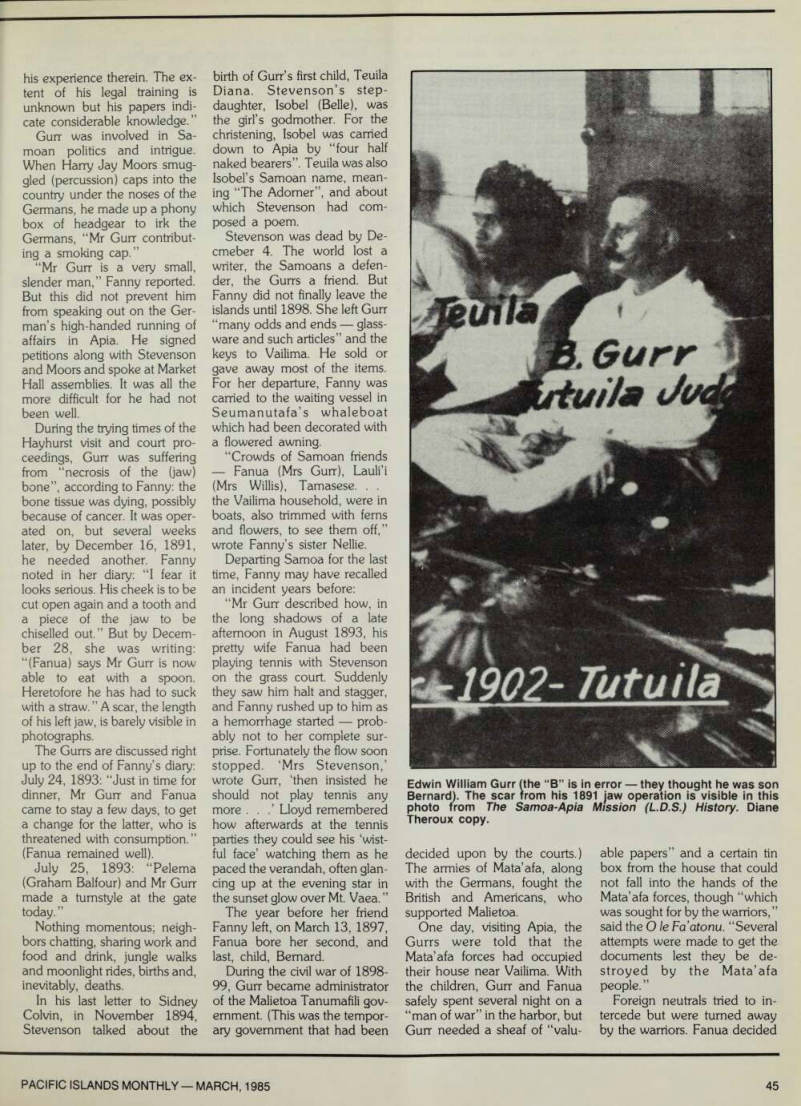
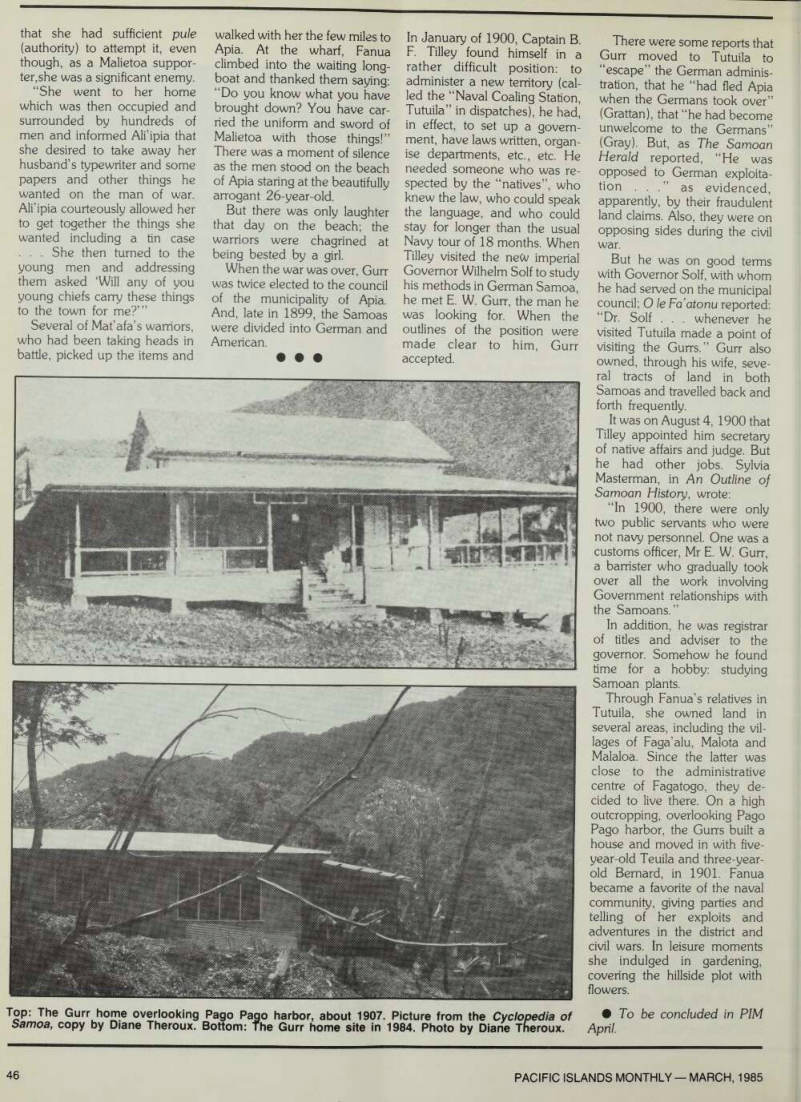
Through Fanua’s relatives in Tutuila, she owned land in several areas, including the vil lages of Faga’alu, Malota and Malaloa. Since the latter was close to the administrative centre of Fagatogo, they de cided to live there. On a high outcropping, overlooking Pago Pago harbor, the Gurrs built a house and moved in with five year-old Teuila and three-year old Bernard, in 1901. Fanua became a favorite of the naval community, giving parties and telling of her exploits and adventures in the district and civil wars. In leisure moments she indulged in gardening, covering the hillside plot with flowers. • To be concluded in PIM April.
Top: The Gurr home overlooking Pago Pago harbor, about 1907. Picture from the Cyclopedia of Samoa, copy by Diane Theroux. Bottom: me Gurr home site in 1984. Photo by Diane Tneroux.