centre-stage in France
pp. 26-27 · Read in the full issue
New Caledonia moves to centre-stage in France
By early February, the action in New Caledonia’s long-running crisis had largely moved to Paris, where the issue of the territory’s future was looming as a dominant issue in the French parliamentary elections to be held next year.
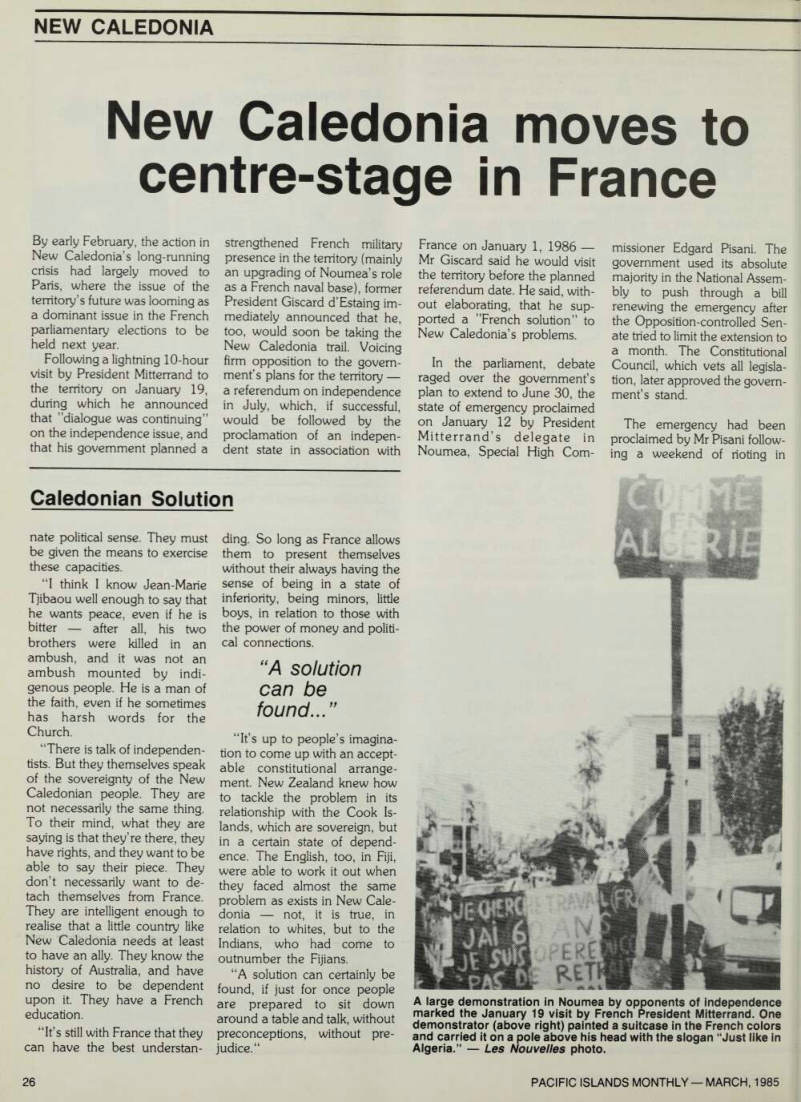
Following a lightning 10-hour visit by President Mitterrand to the territory on January 19, during which he announced that ’’dialogue was continuing” on the independence issue, and that his government planned a
strengthened French military presence in the territory (mainly an upgrading of Noumea’s role as a French naval base), former President Giscard d’Estaing im mediately announced that he, too, would soon be taking the New Caledonia trail. Voicing firm opposition to the govern ment’s plans for the territory a referendum on independence in July, which, if successful, would be followed by the proclamation of an indepen dent state in association with
France on January 1, 1986 Mr Giscard said he would visit the territory before the planned referendum date. He said, with out elaborating, that he sup ported a ’’French solution” to New Caledonia’s problems.
In the parliament, debate raged over the government’s plan to extend to June 30, the state of emergency proclaimed on January 12 by President Mitterrand’s delegate in Noumea, Special High Com
missioner Edgard Pisani. The government used its absolute majority in the National Assem bly to push through a bill renewing the emergency after the Opposition-controlled Sen ate tried to limit the extension to a month. The Constitutional Council, which vets all legisla tion, later approved the govern ment’s stand.
The emergency had been proclaimed by Mr Pisani follow ing a weekend of rioting in
Noumea, mainly by anti-inde pendence whites, after the fatal shooting on January 11, by persons unknown, of 17-year old Yves Tual, son of a French settler farming family. On the same weekend at La Foa, on the west coast, FLNKS leader, Eloi Machoro, ’’minister of security” in the provisional gov ernment of Kanaky proclaimed by the FLNKS last December 1, was shot dead, together with an aide, in a confrontation with French security forces (see separate report this issue).
Despite the return of relative calm following President Mitter rand’s visit, acts of sabotage continued in the territory, most notably at the important nickel mining centre of Thio on the east coast, where millions of dollars worth of mining equip ment is reported to have been damaged. Pro- and anti-inde
pendence spokesmen traded charges over the sabotage, with the latter claiming that FLNKS militants were responsible, and the former accusing the far Right of staging provocations in order to make the FLNKS look like the villains.
Whatever the truth of the matter, the effects of such activ ity were in no doubt at all: the territory was in the grip of a severe economic crisis. Territo rial officials said at the end of January that New Caledonia’s two main industries, nickel min ing and tourism, were virtually at a standstill. The head of the local tourist bureau said tourist bookings were down by 50 per cent, with mass cancellations by intending Australian tourists.
The sabotage at Thio, and other nickel-mining areas, had halted production of the terri tory’s biggest money-earner.
The territory’s Chamber of Commerce secretary said that activity in the car and building sectors had also virtually stop ped.
Mr Pisani, who was about to leave for Paris to present his final report to President Mitter rand, had his own word to say on some more fundamental aspects of New Caledonia’s economy when he wrote in a January 31 article in the Noumea daily, Les Nouvelles Caledoniennes,: “For me the ’generosity’ of France does not consist of an open-ended com mitment to provide ill-used and poorly-shared financial manna; an economy which is based for 35 per cent on transfers from metropolitan France is a per verse economy.”
France was not guilty of ’’colonialist tyranny” in New Caledonia, but of making the
territory excessively dependent, he added.
Mr Pisani rejected fears that an independent New Caledonia would be able to renounce a treaty of association linking it to France. ”To refuse this path to independence, to draw back before this inevitable leap, is a suicidal attitude which can lead only to confrontation and hatred,” he wrote.
On the day Mr Pisani’s article was published in Noumea, Aus tralia’s foreign minister, Bill Hayden, was speaking to French journalists in Canberra.
Mr Hayden told them that in his view Mr Pisani’s plan was ’’the last and best hope” for New Caledonia. ”1 would be sad dened if it is not supported,” he said. ’’There seems to be no alternative, except the status quo and that is unaccept able.”