"Caledonian solution
pp. 24-26 · Read in the full issue
New Caledonia
"Caledonian solution can be found"
Bishop Pierre Martin
The former Roman Catholic Bishop of Noumea who ordained the FLNKS leader, Jean-Marie Tjibaou -and later released him from his priestly vows has praised him for his integrity, and the “genu ineness of his authority” in the New Caledonian community.
The retired prelate is Monsig nor Pierre Martin, of the Marist Order, who was Bishop of Noumea from November, 1956, to December, 1970. He
remained in close touch with New Caledonian affairs for an other nine years while he served as chairman of the Con ference of Pacific Bishops, resi dent in Fiji. He now lives in France.
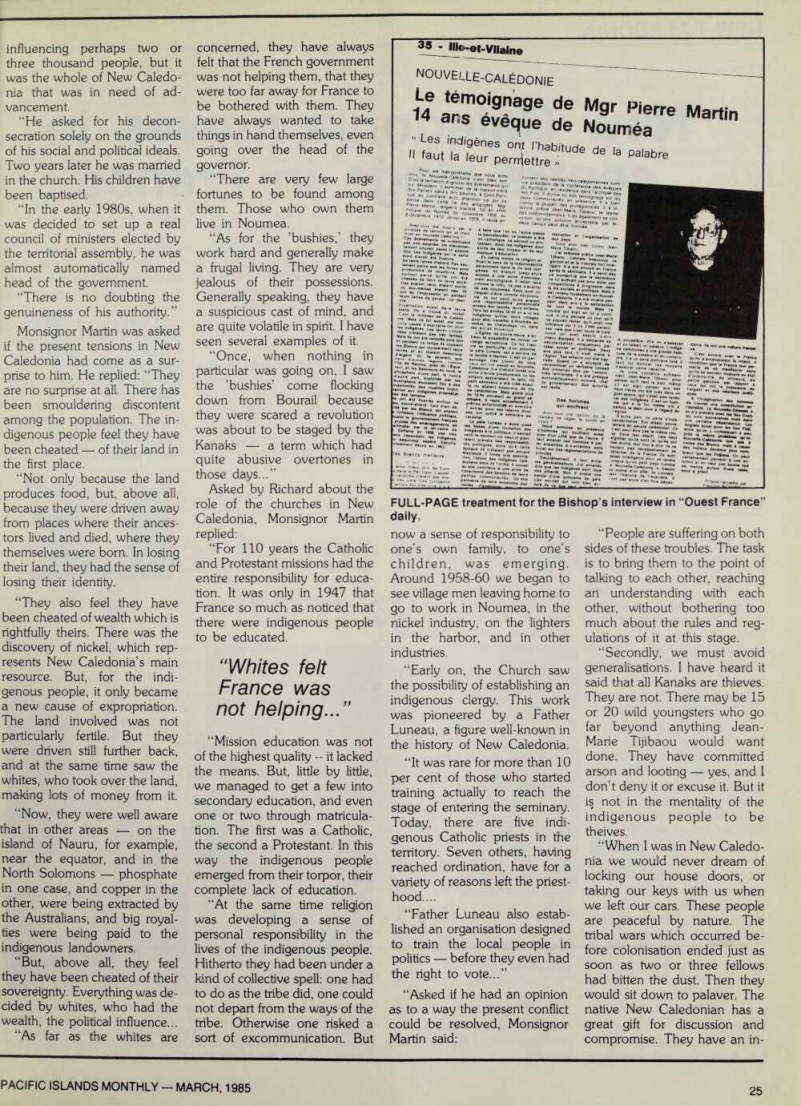
Monsignor Martin made his comments in a wide-ranging interview with the French pro vincial daily, Quest France, in its weekend issue of December 29-30, 1984.
Asked about his acquaint
ance with Mr Tjibaou by in terviewer Francois Richard, Monsignor Martin said:
“Iliked
the lad
very much...”
“I ordained Jean-Marie Tjibaou as a priest.
“I liked the lad very much, and found him highly intelli gent.
“After the seminary he was
sent to France. From that time on he felt that the priesthood was not going to be an ade quate means to the fulfilment of his desire to help the social and political advancement of his compatriots.
“But he dutifully returned to New Caledonia, and for two years served as a vicar, to the complete satisfaction of all con cerned.
“His inner conflict, however, continued. He told me one day that he couldn’t go on he was
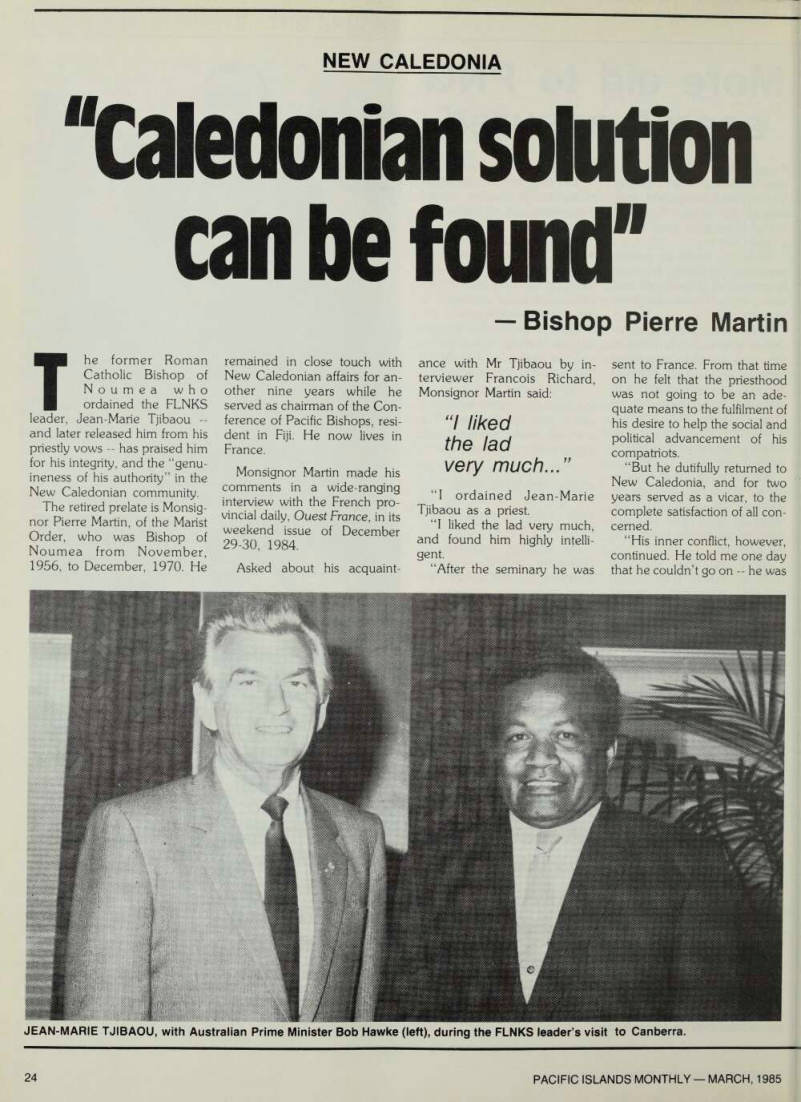
JEAN-MARIE TJIBAOU, with Australian Prime Minister Bob Hawke (left), during the FLNKS leader’s visit to Canberra.
influencing perhaps two or three thousand people, but it was the whole of New Caledo nia that was in need of ad vancement.
“He asked for his decon secration solely on the grounds of his social and political ideals.
Two years later he was married in the church. His children have been baptised.
“In the early 1980 s, when it was decided to set up a real council of ministers elected by the territorial assembly, he was almost automatically named head of the government.
“There is no doubting the genuineness of his authority.”
Monsignor Martin was asked if the present tensions in New Caledonia had come as a sur prise to him. He replied: “They are no surprise at all. There has been smouldering discontent among the population. The in digenous people feel they have been cheated of their land in the first place.
“Not only because the land produces food, but, above all, because they were driven away from places where their ances tors lived and died, where they themselves were born. In losing their land, they had the sense of losing their identity.
“They also feel they have been cheated of wealth which is rightfully theirs. There was the discovery of nickel, which rep resents New Caledonia’s main resource. But, for the indi genous people, it only became a new cause of expropriation.
The land involved was not particularly fertile. But they were driven still further back, and at the same time saw the whites, who took over the land, making lots of money from it.
“Now, they were well aware that in other areas on the island of Nauru, for example, near the equator, and in the North Solomons phosphate in one case, and copper in the other, were being extracted by the Australians, and big royal ties were being paid to the indigenous landowners.
“But, above all, they feel they have been cheated of their sovereignty. Everything was de cided by whites, who had the wealth, the political influence...
“As far as the whites are
concerned, they have always felt that the French government was not helping them, that they were too far away for France to be bothered with them. They have always wanted to take things in hand themselves, even going over the head of the governor.
“There are very few large fortunes to be found among them. Those who own them live in Noumea.
“As for the ’bushies,’ they work hard and generally make a frugal living. They are very jealous of their possessions.
Generally speaking, they have a suspicious cast of mind, and are quite volatile in spirit. I have seen several examples of it.
“Once, when nothing in particular was going on, I saw the ’bushies’ come flocking down from Bourail because they were scared a revolution was about to be staged by the Kanaks a term which had quite abusive overtones in those days...”
Asked by Richard about the role of the churches in New Caledonia, Monsignor Martin replied: “For 110 years the Catholic and Protestant missions had the entire responsibility for educa tion. It was only in 1947 that France so much as noticed that there were indigenous people to be educated.
“Whites felt
France was
not helping...”
“Mission education was not of the highest quality it lacked the means. But, little by little, we managed to get a few into secondary education, and even one or two through matricula tion. The first was a Catholic, the second a Protestant. In this way the indigenous people emerged from their torpor, their complete lack of education.
“At the same time religion was developing a sense of personal responsibility in the lives of the indigenous people.
Hitherto they had been under a kind of collective spell: one had to do as the tribe did, one could not depart from the ways of the tribe. Otherwise one risked a sort of excommunication. But
now a sense of responsibility to one’s own family, to one’s children, was emerging.
Around 1958-60 we began to see village men leaving home to go to work in Noumea, in the nickel industry, on the lighters in the harbor, and in other industries.
“Early on, the Church saw the possibility of establishing an indigenous clergy. This work was pioneered by a Father Luneau, a figure well-known in the history of New Caledonia.
“It was rare for more than 10 per cent of those who started training actually to reach the stage of entering the seminary.
Today, there are five indi genous Catholic priests in the territory. Seven others, having reached ordination, have for a variety of reasons left the priest hood. ...
“Father Luneau also estab lished an organisation designed to train the local people in politics before they even had the right to vote...”
“Asked if he had an opinion as to a way the present conflict could be resolved, Monsignor Martin said;
“People are suffering on both sides of these troubles. The task is to bring them to the point of talking to each other, reaching an understanding with each other, without bothering too much about the rules and reg ulations of it at this stage.
“Secondly, we must avoid generalisations. I have heard it said that all Kanaks are thieves.
They are not. There may be 15 or 20 wild youngsters who go far beyond anything Jean- Marie Tijibaou would want done. They have committed arson and looting yes, and I don’t deny it or excuse it. But it is not in the mentality of the indigenous people to be theives.
“When I was in New Caledo nia we would never dream of locking our house doors, or taking our keys with us when we left our cars. These people arc peaceful by nature. The tribal wars which occurred be fore colonisation ended just as soon as two or three fellows had bitten the dust. Then they would sit down to palaver. The native New Caledonian has a great gift for discussion and compromise. They have an in-
FULL-PAGE treatment for the Bishop’s Interview in “Quest France” daily.
Caledonian Solution
nate political sense. They must be given the means to exercise these capacities.
“I think I know Jean-Marie Tjibaou well enough to say that he wants peace, even if he is bitter after all, his two brothers were killed in an ambush, and it was not an ambush mounted by indi genous people. He is a man of the faith, even if he sometimes has harsh words for the Church.
“There is talk of independen tists. But they themselves speak of the sovereignty of the New Caledonian people. They are not necessarily the same thing.
To their mind, what they are saying is that they’re there, they have rights, and they want to be able to say their piece. They don’t necessarily want to de tach themselves from France.
They are intelligent enough to realise that a little country like New Caledonia needs at least to have an ally. They know the history of Australia, and have no desire to be dependent upon it. They have a French education.
“It’s still with France that they can have the best understan
ding. So long as France allows them to present themselves without their always having the sense of being in a state of inferiority, being minors, little boys, in relation to those with the power of money and politi cal connections.
“A solution
can be
found...”
“It’s up to people’s imagina tion to come up with an accept able constitutional arrange ment. New Zealand knew how to tackle the problem in its relationship with the Cook Is lands, which are sovereign, but in a certain state of depend ence. The English, too, in Fiji, were able to work it out when they faced almost the same problem as exists in New Cale donia not, it is true, in relation to whites, but to the Indians, who had come to outnumber the Fijians.
“A solution can certainly be found, if just for once people are prepared to sit down around a table and talk, without preconceptions, without pre judice/ 4
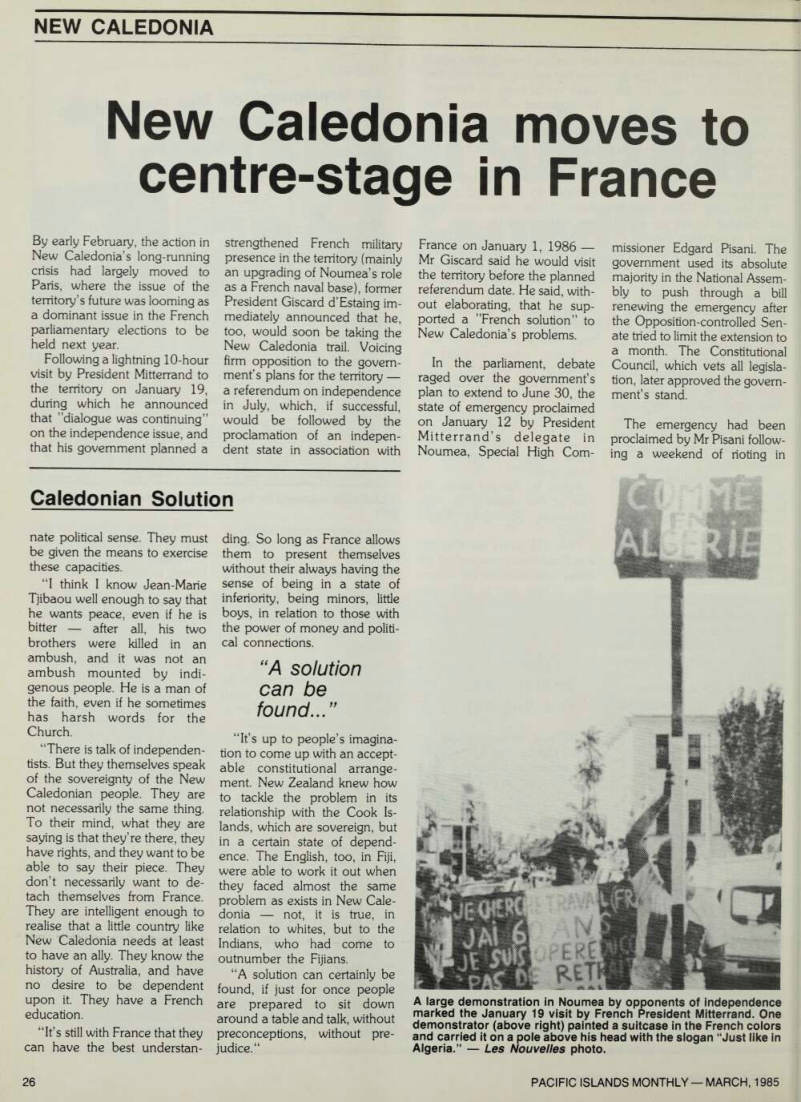
A large demonstration in Noumea by opponents of independence marked the January 19 visit by French President Mitterrand. One demonstrator (above right) painted a suitcase in the French colors and carried it on a pole above his head with the slogan “Just like in Algeria.” Les Nouvelles photo.