New Caledonia in the aftermath
pp. 16-17 · Read in the full issue
aftermath of NOV. 18
Like a rock hurled into a lake, the “active boycott” of the November 18 elec tions in New Caledonia by the newly formed Kanak National Socialist Liberation Front (FLNKS) and the subse quent events (PIM Jan., p. 14), have given rise to ever-wide ning rings of consequences and the process is far from over yet.
First of all, the French Gov ernment has been shaken out of the illusion that pro-inde pendence Kanak political forces could be prevailed upon to wait patiently for five years until 1989 for a referendum on independence five years during which, on all present political indications, the Social ists would lose their majority in the National Assembly (par liamentary elections are due in 1986) and the resurgent con servative parties in French poli tics would throw out the re ferendum idea anyway.
PIM Associate Editor MALCOLM SALMON pulls together the main strands of the turbulent story of New Caledonia as the territory entered a new and perhaps fateful year.
In a mid-December interview with the Paris daily Liberation, President Mitterrand’s nego tiator and new high commis sioner in New Caledonia, Edgard Pisani, noted that the Kanaks wanted sovereignty, but had not demanded a total break with France. He added: “The referendum on independ ence originally scheduled for 1989 should, however, take place within months, not years.”
In line with this development, New Caledonia has been pushed forward as an issue in French domestic politics in a manner never before known, The Opposition parties have mounted scathing attacks on
the government of President Mitterrand, accusing it of being prepared to sell out Frenchsettler interests in the territory in order to appease an allegedly tiny minority of pro-independence Melanesians.
In a major move, former r-) . i , n . , ~c , .
President Giscard d Estamg ..i c u joined with six former French * . ... . , , pnme ministers in late Decernber to sign a statement warning against allowing debate on the future of New Caledonia to become embroiled in elector al manipulation. They declared that “all French citizens in the territory must be allowed to vote”, and that “stressing independence as the only solution is tantamount to depriving French
citizens of the right to choose. ”
The statement represented a counter-blast to Kanak de mands that limitations be placed on participation in the referendum, and a warning to the government not to give any ground on the issue.
As well as making New Cale donia a big issue in French national politics, recent events have caused it to become an international political issue for the French as well not least in their relations with Australia.
In a television interview in Paris on December 16, Presi dent Mitterrand said he found Australia’s interest in New Cale donia “quite surprising.”
“If the problem of the native people does not exist any more in Australia in fact if there are still some Aborigines, it is be cause they have not been killed.
“That’s not the way France does things. That is why France
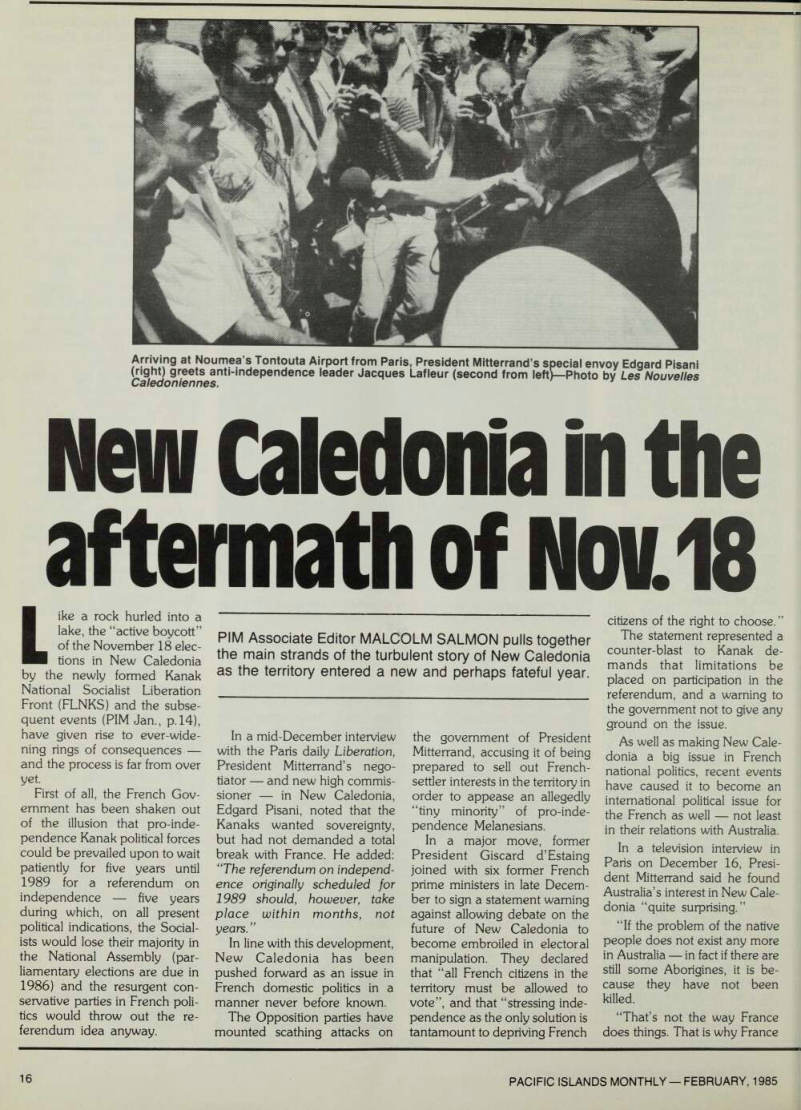
Arriving at Noumea’s Tontouta Airport from Paris, President Mitterrand’s special envoy Edgard Pisani (right) greets anti-independence leader Jacques Lafleur (second from left) Photo by Les Nouvelles Caledoniennes.
is so highly regarded and re spected in her former colonies. ”
Australia’s Foreign Affairs Department was quick to tell France’s Ambassador, Jean Bernard Merimee, that the Aus tralian Government viewed with “disapproval and con cern”, and found “offensive and irrelevant”, President Mit terrand’s statement about Aborigines.
The Sydney Morning Herald editorialised on December 19: “. . . (the statement) is offensive because while Austra lia can justly be accused of something close to genocide in respect of its Aborigines a cen tury ago, in the last 20 years it has made increasing and genu ine efforts to redress the ba lance. It is offensive because France last century succeeded in halving New Caledonia’s Kanak population through a contemptuous disregard for Kanak health, culture and land rights which more than para lleled Australia’s for its Abor igines.
“It is irrelevant because how Australia treated its Aborigines has little to do, except as an unrelated debating point, with New Caledonia’s present situa tion, which is one entirely of France’s own making. Nothing that the President says disguises the fact that present Kanak anger and frustration stem from past land alienation and denial of development and education, both grievance areas which France now seeks earnestly to remedy. ”
PIM Tahiti correspondent Bengt Danielsson had another angle on the affair. He said in a January telephone interview with PIM: “What you seem to have missed in Australia is that what Mitterrand and a great number of other French political leaders are accusing Australia of is harboring expansionist ambi tions in the Pacific. The Austra lian Government has for years been accused of supporting in dependence movements in the French colonies and opposing the Moruroa tests in a thor oughly hypocritical manner, since its real intention all along has been to push the French out of the Pacific maybe not by taking over the French terri
tories politically, but certainly by taking them over econo mically.
“What is crucial in Mitter rand’s statement is therefore not his charge that you Austra lians have killed your natives (whereas we French, etc . . .), but the exchange which took place between him and a journalist at his press confer ence in which they agreed that New Caledonia is threatened by appetite exterieurs “out side appetites” the main one being Australia's appetite which can be satisfied, of course, only by swallowing up this French territory ...”
In the Pacific, the New Caledonian developments have led Vanuatu’s Prime Minister Father Walter Lini to dissociate himself publicly from the Aus tralian Government’s position that the Kanak population are not ready to cope with full independence.
Bill Mellor reported from Port-Vila in Sydney’s Sun- Herald on December 16: “. . . Father Lini made it plain he was opposed to Aus tralia’s policy of supporting only a gradual move towards inde pendence in New Caledonia.
“Other countries consider decolonisation as a process that
could take years to arrive at.
But it’s not a process, it’s a right of the people,” he said.
“One does not have to mea sure whether they have enough educated people or economic base it is their right. If people want it right away, they should have it.”
On the other side of the Islands political fence, leaders of the parties opposed to inde pendence in New Caledonia and French Polynesia have formed “an alliance of French Pacific territories to defend their common interests and promote joint action in political, admin istrative, economic, cultural and social matters.”
The agreement was signed in Papeete by Senator Dick Ukeiwe of New Caledonia’s RPCR party, and Gaston Flossc of the like-minded ruling party in French Polynesia.
In the territory itself, the death toll from politics-related violence rose to 16 on Decem ber 20 with the death of a third person from bums sustained in an arson attack on a store in the west coast town of Bourail.
Twenty-two Kanaks were arrested after the fire, and four have been charged with arson.
Later, anti-independence set tlers set up roadblocks at Bourail “to keep the tribesmen out of town and prevent them buying supplies.” Gendarmes later dismantled the roadblocks without incident.
On the east coast, the impor tant nickel centre of Thio, seized by FLNKS militants in November but later relin quished to the authorities, was described as “a ghost town” in a January press report. A local Frenchman said only about 30 of the town’s former 100-plus European residents remained.
Although French authority had largely been restored by the turn of the year, there was still more than a grain of truth in the sweeping December sum ming-up by Melbourne Age reporter Damien Murphy: “New Caledonia is now effec tively three countries: the French Government controls Noumea, the Kanaks have the east coast, and the locally-born French have a shaky hold on the west coast.”