What jurists saw
pp. 14-15 · Read in the full issue
The Png-Irian Java Border
What jurists saw and what they say
An international com mission should be set up to investigate the situation of the 11,000 refugees from West Irian now harbored in Papua New Guinea as the result of sweeps against Melaneisan villagers by units of the Indone sian Army, says the legal mis sion which visited the border area last September.
Clearly, a serious situation existed in Irian Jaya, and there was need for international attention to be focused on it, they said.
This is one of the principal recommendations of the party from the Australian, and Netherlands sections of the In ternational Commission of Jur ists who went to Papua New Guinea in September to exam ine the plight of the refugees.
The group was led by John Dowd, MP, of the New South Wales parliament, president of the Australian section of the I.C.J. With him were Judge Trevor Martin, QC, Professor Garth Nettheim, professor of law at the University of NSW, Daniel Rowland, a solicitor and faculty member at the Univer sity of Wollongong, Mr David Bitel, another NSW lawyer, and Father L. van der Berg, of Megen, Holland, a member of the Netherlands Institute of Hu man Rights, formerly a mission ary in Irian Jaya, and attending at the invitation of the Nether lands section of the ICJ.
The group spent about eight days in Papua New Guinea, visiting refugee camps and con ducting interviews in Port Moresby, Vanimo, Kiunga, Green River, Kamberatoro, Komopkin, and Rumginae. The government of Papua New
More than 9000 Melanesian refugees now live in varying degrees of deprivation and discomfort at makeshift camps along the remote and difficult border between Indonesia’s West Irfan and the sovereign and independent state of Papua New Guinea. The number is down from a peak of more than 11,000 last September due to the voluntary return of some Irianese to West Irian in the past few months. But the problem remains massive. As a human situation it is one of the most tragic in the Pacific. They have left their homelands because, they say, the Indone sian Army, ostensibly hunting down dissidents, has made their lives untenable. They say the Indonesian policy of transmigration, under which Islamic people from the over-crowded island of Java have been literally trucked into Irian Jaya by the thousand and settled there without regard for Melanesian tribal interests and right, has deprived them of their most precious possession their land.
The Indonesians say they are working for the greatest good for the greatest number and that the border villages have been harboring rebels some of whom have taken arms against the government. Jakarta says law-abiding Melane sian irianese have nothing to fear.
It is an exceedingly sensitive and awkward issue for eveiyone, not least the government of Australia which has been at pains to avoid public involvement in a row which cannot possibly profit it.
But, Australia entered the affair when the Australian Section of the Executive Committee of the International Commission of Jurists sent a delegation to examine the treatment and situation of the refugees in their border camps.
Some controversy developed over their report, with the Indonesian government clearly irritated by it.
Guinea gave them permission to visit the border areas but the report concedes that the gov ernment developed reserva tions about the mission which, by then, had excited interest in
Jakarta.
“There was a degree of obfuscation on the part of cer tain government officials,” the jurists said. “There was also a natural reticence on the part of
local officials to make state ments which might place them in some difficulty with their superiors; notwithstanding this, we encountered a remarkable degree of frankness. One ex ample was the disclosure of a hitherto unannounced large camp in the Western Province. ”
The report, filling 68 type written pages, chronicles the observations of the mission members, and some of the statements taken from among refugees, and others dealing with the situation on the PNG side.
For example: “To get to Komopkin camp required a 50 minute drive from Kiunga to Memingiri, three hours’ walk through the jungle to Ok Tedi river, and a 40 minute canoe trip down the river to Komopkin.
“The camp houses over 2000 refugees,” the report said.
PNG had stationed a kiap, a health officer and a policeman permanently at the village.
“The people ... had suffered serious malnutrition and over 100 had died. About 100 had been sent to the mission hospi tal at Rumginae...
“We were told that about 165 refugees had returned across the border saying they planned to join the OPM. Most were men, some women, most aged 18 to 30. We were told that the only weapons of the OPM were bows and arrows.
There were no firearms.”
The report said the refugees had come from nine villages in the Mindiptana district. All vil lages were Christian, two Pro testant, seven Catholic.
“They had started to cross the border in April and the last group had arrived in August...
some had spent three months in the bush,” the report said.
The jurists were told that some villages of 700 or more had emptied of inhabitants following shootings by Indone sian soldiers. Villagers spoke of rumors that Javanese transmig rants were to be moved into the emptied villages.
“In one reported instance a village church had been shot up by Indonesian soldiers who had broken the host and destroyed vestments. This was corrobo rated by the Bishop of Kiunga who reported that villagers had gathered the desecrated items and brought them to him,” said the report.
“We were given details of the deaths of 10 people on the way to Komopkin,” said the jurists.
“A girl aged one, two girls aged three, a boy aged five, a girl of seven, a woman of 37, and four men aged between 40 and 60.
“All the people questioned denied that the OPM or anyone associated with it had told them to leave,” they said. “All de clared that they would not go home until the Indonesians had left Irian Jaya.
“Further questions about the OPM produced varied re sponses. One old man seemed fearful when asked about it, looked around, and did not wish to discuss it.
“Another said; ’OPM is not an organisation, it is just a feeling that everyone has for their own fate.’
“Still another said; ‘We are All OPM.”
That the jurists felt deep anxiety about the methods used by Indonesian forces against people who might, in other countries or different circumstances, be seen as civil rights activists, or seekers after democratic freedoms, is shown by their reference to the killing of Arnold Ap, a gentle Melane sian traditionalist and academic.
As well as urging internatio nal attention on the situation they recommend an indepen dent and internationally-super vised inquiry into the death of Arnold Ap, curator of a small museum in Irian Jaya who was taken for questioning by In donesian authorities about the time of the February uprising, and who was later found brutal ly murdered.
Statements made to them by people claiming to be eye witnesses were “clearly incon sistent with the statements made by Indonesian officials that he was shot escaping,” the report says.
The mission makes a total of 17 recommendations, first of which is a blunt assertion that “no one should be returned, involuntarily, to Indonesia” for “there is clear evidence of hu man rights violations in the area of Irian Jaya nearest to PNG by the Indonesian authorities against local villagers.”
They suggest that the UN High Commissioner for Re fugees should be given “full authority and responsibility,” in conjunction with the govern-
ment of PNG, to provide assist ance for the refugees, pending a durable solution.
Nations, and international aid agencies should be urged to help the government of PNG both in caring for the refugees and in finding a workable, and durable solution to their plight.
The jurists demanded that the Indonesian government “make clear both the precise nature of criminal charges that individual refugees will attract on their return to Irian Jaya, and the appropriate authority, civil or military,” which would deal with them.
Indonesia should provide assurances, subject to UN monitoring, that voluntary re turnees would face “no other punishment or penalty.”
Meantime, they urged, the refugees should be given permissive residence status within PNG.
While the contents of the report have not been specifical ly attacked by the Indonesians, they have through their ambas sador in Canberra, displayed irritation with the jurists and have challenged their authority.
Observers in Australia have not doubted the accuracy of the report’s observations.
The Papua New Guinea gov ernment has maintained a low profile on the report, but clearly is vastly troubled by the dilem ma it faces between its powerful and awkward neighbor, and its own Melanesian voters many of whom hold strong anti-Indone sian feelings over the border incidents.
The majority of the refugees
in PNG now considered them selves to be indefinitely, or even permanently, displaced from Irian Jaya, the jurists said in their report. Most of these peo ple came from communities with traditional border-crossing rights under the Border Agree ment between PNG and In donesia. There was a further, smaller, group of urbanised people, mainly from the Jayapura area where the Free West Irian movement uprising occurred in February, 1984, and set off the Indonesian reac tion.
The jurists said they consi dered the 11,000 in the border camps were refugees within the terms of the 1951 Convention, and the 1967 Protocol Relating to the Status of Refugees. With the exception of the very small number now prepared to return voluntarily to Irian Jaya, all
came within the mandate of the United Nations High Commis sioner for Refugees.
The report said that because most of the refugees came from the immediate border area, with clan and language affilia tions with people on the PNG side, “there is little evidence that the taking of this number of refugees will open a flood-gate for refugees from other parts of Irian Jaya.”
But, they said, “the displace ment of this large number of persons is an indication of se rious problems within Irian Jaya.”
The jurists were obviously anxious about the likelihood of reprisals by the Indonesians against returning Melanesians, a fear obviously shared by the refugees themselves.
Thus, the jurists urged in their report that individuals who had actively participated in political action, (they were mainly those sheltered in the Blackwater camp, near Vanimo), be given refugee status and settled within PNG or, “if necessary, in other countries within the region.”
The remainder, they said, “should be located where pos sible in their own clan/language groupings within PNG, but at some reasonable distance from the border to prevern them from constituting a continuing problem for PNG-Indonesian relations. ”
While the jurists paid con siderable attention to what they saw as the need to protect the refugees from Indonesian reac tion, they also urged that the PNG government should not discriminate against them in decisions on the granting of citizenship.
Also, they said, “Australia has a special role to play in the future of the Irian Jaya re fugees, as the most appropriate independent nation in the re gion. In particular Australia should be willing to accept some of the refugees for whom third country resettlement is
deemed necessary.”
Finally, they recommended that both Indonesia and Papua New Guinea ratify the In ternational Covenant on Civil and Political Rights, and the Convention and Protocol on the status of refugees. Garry Barker.
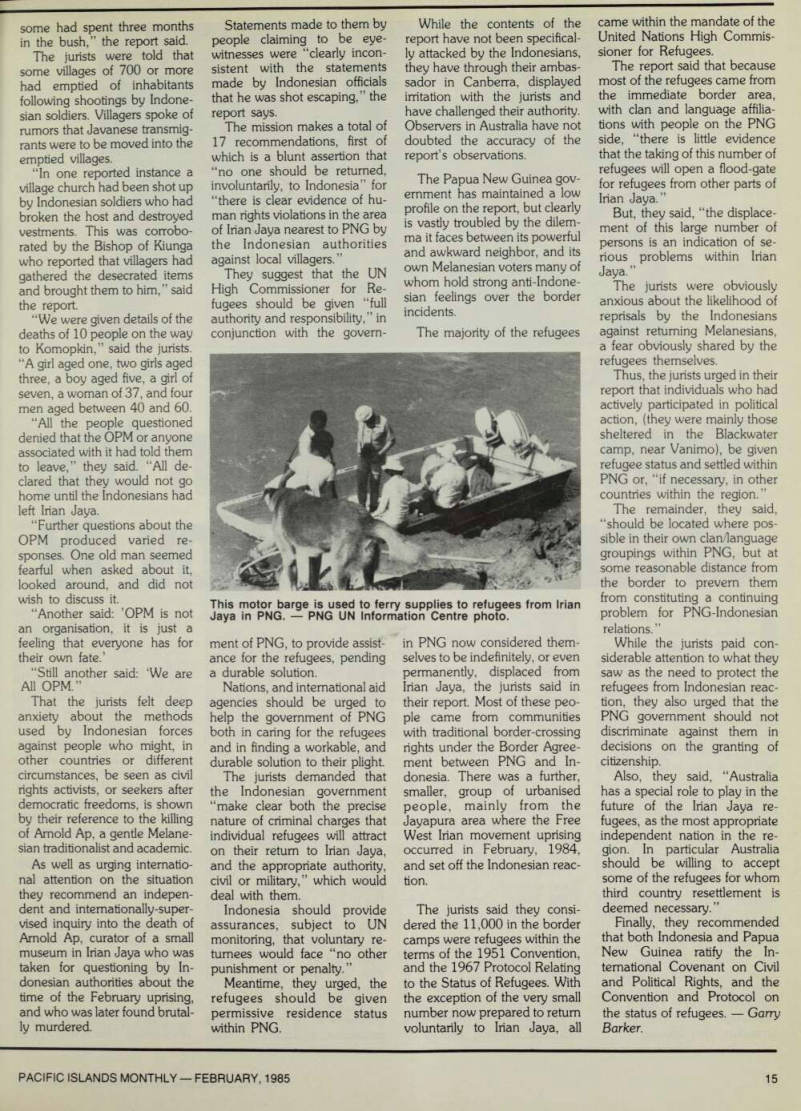
This motor barge is used to ferry supplies to refugees from Irian Jaya in PNG.-PNG UN Information Centre photo.