“De-segregating” Fiji’s
pp. 53-54 · Read in the full issue
political currents
Teachers Protest
“De-segregating” Fiji’s communal schools
A bitter row about race and culture has broken around the head of one of Fiji’s leading liberal intellectuals, Dr Ahmed Ali, who is also Minister for Education. He has proposed a Pacific version of the Amer ican ’’bussing” which was de signed to make schools the melting pots for better racial integration. As has happened elsewhere, parents have ob jected and, in Fiji, teachers, too, have swarmed to the cultural battlements using all manner of arguments but, in effect, saying that the old ways, and the old racial divisions, should be pre served.
A factor in teachers’ thinking has been the minister’s deci sion, approved by Cabinet, that teachers, too, should be moved around among the schools to spread racial integration.
Dr Ali, and his permanent secretary, professional civil ser vant Narsey Raniga, have, as a result, fallen out with the na tion’s teachers. The dispute has simmered for some months, but came to a head late in October when both teachers’ unions petitioned the prime minister, Ratu Sir Kamisese Mara, to intervene and resolve the dis pute. This, they indicated, would be most efficiently done by sacking both Dr Ali and Mr Raniga.
Late in September the Fiji Teachers’ Confederation, which is made up of the two main teacher organisations, the Indian-dominated Fiji Teachers’
Union, and the Fijian Teachers’
Association, staged a march through Suva to protest about the changes in national educa tion policies being formulated
Fiji’s Constitution recognises, and to some degree enshrines, the differences between the main racial groups in the country. Ethnic Indians, descendants of the original indentured canefield workers, and of later immigrants who came as small shopkeepers, artisans and far mers, have mixed virtually not at all with Fijians.
Each community has elected, amicably enough, to go its own way for a whole variety of reasons.
Fiji society is changing, but in certain areas the changes are causing a degree of pain.
Our Suva correspondent here writes about the opposition from Fiji’s teachers, both Fijian and Indian,to government’s efforts to spread racial integration in the classrooms.
and implemented by Dr Ali and his ministry.
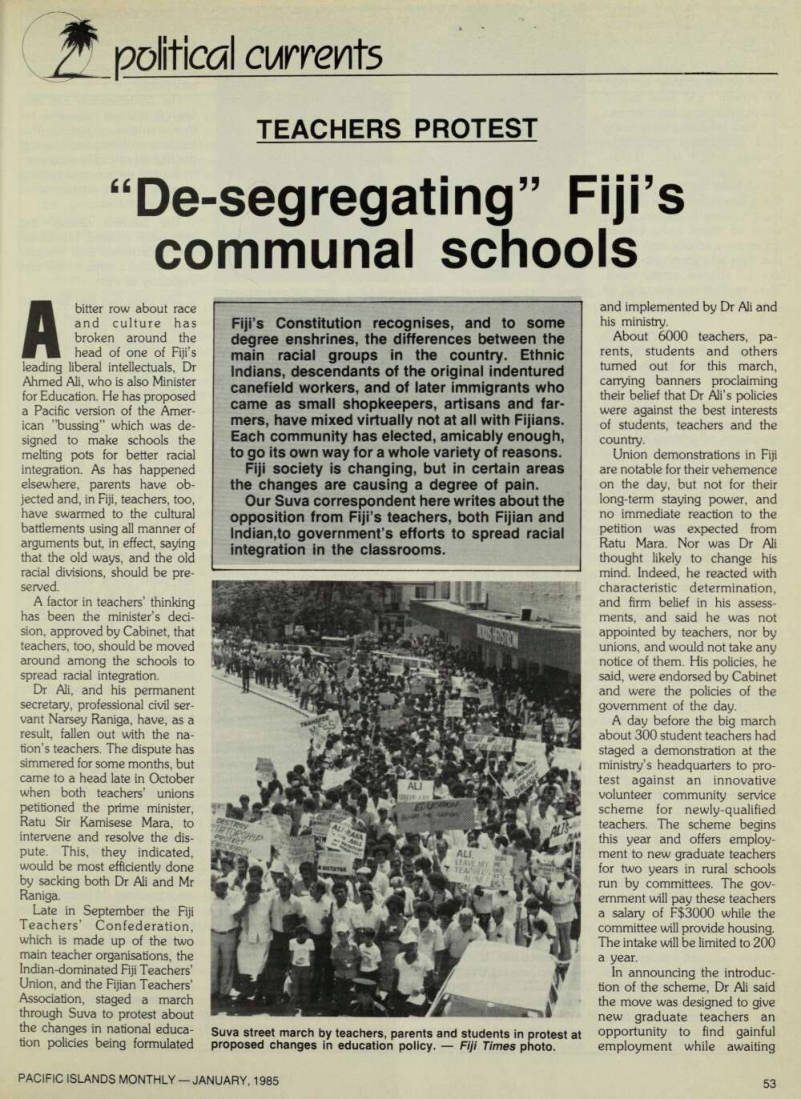
About 6000 teachers, pa rents, students and others turned out for this march, carrying banners proclaiming their belief that Dr Ali’s policies were against the best interests of students, teachers and the country.
Union demonstrations in Fiji are notable for their vehemence on the day, but not for their long-term staying power, and no immediate reaction to the petition was expected from Ratu Mara. Nor was Dr Ali thought likely to change his mind. Indeed, he reacted with characteristic determination, and firm belief in his assess ments, and said he was not appointed by teachers, nor by unions, and would not take any notice of them. His policies, he said, were endorsed by Cabinet and were the policies of the government of the day.
A day before the big march about 300 student teachers had staged a demonstration at the ministry’s headquarters to pro test against an innovative volunteer community service scheme for newly-qualified teachers. The scheme begins this year and offers employ ment to new graduate teachers for two years in rural schools run by committees. The gov ernment will pay these teachers a salary of Fs3ooo while the committee will provide housing.
The intake will be limited to 200 a year.
In announcing the introduc tion of the scheme, Dr Ali said the move was designed to give new graduate teachers an opportunity to find gainful employment while awaiting
Suva street march by teachers, parents and students in protest at proposed changes in education policy. Fiji Times photo.
vacancies in the civil service.
There will be no intake of new teachers in the civil service in 1985.
However, the teachers have described the scheme as ’’par tial slavery” and have said it was not voluntary, but coercive.
The new graduates were being used as ’’guinea pigs” in a scheme which was ill-con ceived, they said.
Graduate teachers protested that it was unfair of the govern ment to deny them jobs when some of them were offered government scholarships to fur ther their education with prom ises of secured employment.
They were victims, they said, of poor planning by ministry offi cials.
Aside from their dispute with the civil servants administering their affairs (and, in Fiji, critic ism of civil servants is not restricted to education), Fiji’s teachers are also very exercised about the matter of the racial integration of primary schools.
Dr Ali has directed three government-financed schools in the country to adopt a new policy on admissions for 1985.
The policy outlined by Dr Ali demanded an intake made up 40 per cent by Indians, 40 per cent by Fijians, and 20 per cent by other races. He had also directed that 80 per cent of the places in the new intakes for the selected schools be reserved for children whose parents’ joint income was below $3500 annually.
Dr Ali said the move was designed to give the parents of lower income bracket people an opportunity to send their children to a government-fin anced school with better facili ties than committee-run schools.
Previously, one of the gov ernment schools, the Veiuto Primary School in Suva, which was established during the colo nial days to cater to the children of expatriates, has tended to show preference for children from higher income groups and expatriate families. Dr Ali said the new policy was designed to break down class and social barriers as well as promote integration. However, when admissions for new intakes closed at the Veiuto School, only 15 applications were from children whose parents were in the under-$3500 income
group. The remaining places were to be given on a first come, first-served, basis.
The teachers’ unions say they are opposing the moves because racial integration is a delicate and sensitive issue in Fiji and should be tackled with care and tact. They argue that simply placing equal numbers of Indian and Fijian children in the same class did not mean the achievement of racial tolerance and understanding among the two main groups. They said that if racial integration was to be meaningful and effective, the target should be the adult population, starting from the top and filtering down to va rious levels of the society.
The Teachers’ Confederation in its petition submitted that there was no need for forced integration which could lead to resentment and prove to be counter-productive.
In promoting its policies of integration, the Education Ministry also announced the mass transfer of some 500 primary school teachers, most swapping places with their In dian or Fijian counterparts, arguing that a better mix of teachers would attract a better mix of students.
Until now, teacher postings and transfers have largely been determined on the racial make up of the schools. Dr Ali has maintained that the existing sys tem was keeping children of the two races away from each other, but parents and teacher organisations argued that the system ensured the preserva tion of culture and traditional
values cherished by the two ethnic groups. They said these could be lost if infants and younger children were taught by teachers of a different race and social background, rather than their own.
While the Fijian Teachers’
Association was party to the petition sent to the prime minis ter by the confederation, it also lent its voice to another petition sent to the prime minister by an organisation called the Fijian Discussion Group, which also condemned the policy changes proposed by the ministry. The group has the support of lead ing Fijian academics, such as the general manager of the Native Land Trust Board, Mr Josefata Kamikamica, the Re gistrar of the University of the South Pacific, Dr Tupeni Baba, and the chief executive of the Fiji Development Bank, Mr Laisenia Qarase.
The three had signed the petition in their personal capa city as, respectively, the chair man of the Fijian Discussion Group, a parents’ representa tive, and a Fijian school board’s representative.
Some parent associations felt so strongly on the issue that they threatened to close down their schools rather than allow their teaching programs to be disrupted with a new make-up of teaching staff. In some inst ances the ministry agreed to review or reverse its decision.
In the whole controversy the confederation has accused Dr Ali and Mr Raniga of disregar ding the accepted principle of dialogue and consultation with
unions on issues or major policy changes. The teachers said the two were also making unilateral decisions and their dictatorial style of operation was un acceptable.
The confederation has also strongly rejected statements by the minister accusing the teachers of being lazy, having the highest rate of absenteeism in the civil service, and seeking more and more remuneration for their services.
The teachers claimed the statements insulted, humiliated and undermined their integrity and instilled a sense of fear and insecurity in them.
The issue was also taken up in the Fiji Senate with a motion calling for the setting up of a select committee to investigate the ministry’s changes in policy.
The motion was defeated, but it generated much debate with one senator, Jone Banuve, pro ducing a small knife. The sena tor said the knife should be used to cut off the hands of the person who wrote an insulting placard (carried during the pro test march), about Dr Ali and his wife. Two senators, Ratu Osea Gavidi, and Ratu Napo lioni Dawai, objected to this ’’unparliamentary behavior. ”
The vice-president of the Sen ate, Ratu Tevita Vakalalabure, who was in the chair, ordered Senator Banuve to put the knife away, and the order was obeyed.
Dr Ahmed Ali is a former high school teacher and was previously the head of the Institute of Social and Admi nistrative Studies at the Univer sity of the South Pacific. He entered politics in the 1982 general election. Ironically, perhaps, the Fiji Teachers’ Un ion welcomed Dr Ali’s ministe rial appointment saying that “his experience in educational administration should make everyone in education feel happy as far as association, consultation and organisation are concerned.” The union said then that Dr Ali was ’’indeed an added inspiration to the field of education, and assured him of their full support and coopera tion in bringing about needed changes and innovations.” His most sweeping innovations so far seem to have made them change their minds. From our Suva correspondent.
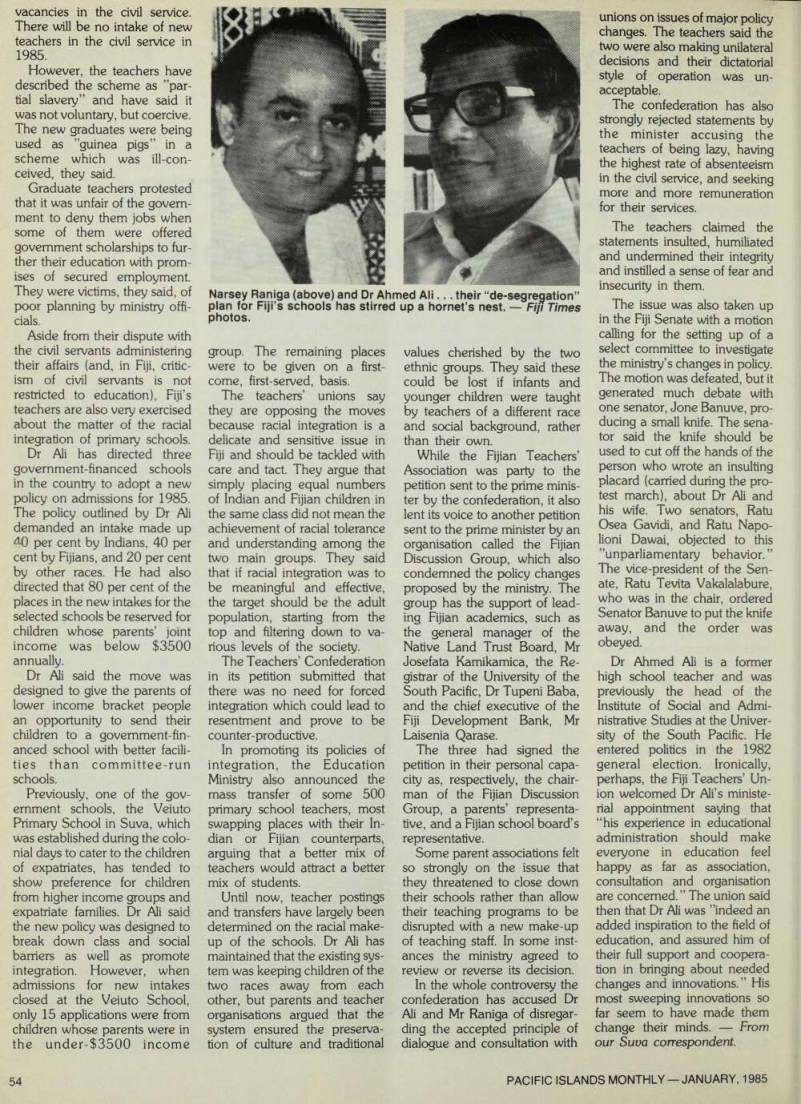
Narsey Raniga (above) and Dr Ahmed Ali... their “de-segregation” plan for Fiji’s schools has stirred up a hornet’s nest. Fiji Times photos.