A call for a turn away
pp. 51-52 · Read in the full issue
Pacific Islands Cuisine
A call for a turn away from the "diet of death"
One feature Pacific Island tour ist resorts have in common is the virtual non-availability of indigenous foods, traditionally cooked. There are plenty of “genuine Pacific Islands feasts” notably, in Melanesian Fiji; New Zealand boasts the “genu ine Maori hangi”; Hawaii the luau; and Papua New Guinea, the umu.
But they are pale reflections of the original earth oven cuisine. And where genuine examples can yet be found for example, in the highlands of Irian Jaya, or the more remote islands of Polynesia they are in societies so poor that even a feast does little for the palate of the sophisticated traveller fat pork, or tough hombill (usually, by the time they are served, lukewarm) with starchy veget ables of sago, taro, kumara, breadfruit or manioc, are not redeemed by the variety of fresh fruit (which is seldom served anyway). In a recent article in Insight, Michael Guy points out that New Zealand has two Korean restaurants (for a population of 88 Koreans), a Thai restaurant (for 205 Thais), thousands of Chinese eating places (for a Chinese popula tion of 15,000) but not a single ethnic restaurant for over 330,000 Polynesians.
Moreover, throughout the Pacific the once-large diversity of foods available is inexorably shrinking before the onslaught of convenience junk foods.
With the development of plantation agriculture, foreign owned companies found it con venient to house their workers in labor lines, with no access to gardens, and to feed them on imported rice, canned fish, re fined sugar and wheat pro ducts. Thus began the shift from “subsistence affluence” to what Robert Keith-Reid has described as the “diet of death” a shift accelerated everywhere by increasing urbanisation. Three or four de
cades ago, degenerative dis eases such as diabetes, hyper tension, ischaemic heart dis ease, iron-deficiency anemia, hyperuricaemia, gout and malnutrition were virtually un known: now they reach epidemic proportions. Diabetes rates have been estimated for urban Tonga at 31 per cent and 42 per cent for females and males, respectively, between the ages of 45 and 54 years.
Similarly, 40 per cent of adult Nauruans, are diabetic, and the tiny republic holds the world records for hyperuricaemia and gout. Urban Polynesians can claim a similar record for obes ity bringing with it hyperten sion and cardio-vascular dis eases. There is plenty of evi dence that these disorders are dietary and stem from the enormous increase in con sumption of refined carbohy drates (no longer adequately diluted by fibre or protein), animal fats (from tinned meat, cooking fat and cheap brisket), demineralised processed foods and alcohol.
The effects of dietary de ficiencies (and excesses) which have accompanied changing food habits have been exacer bated by changes in lifestyle.
One such cultural change is the demise of the earth oven.
Traditionally, the earth oven was universal even in societies which had the skills and materials to make pots, and which could therefore have boiled food. The earth oven is well adapted to communal liv ing (it can be dug to any size) and enables a variety of foods to be cooked at the same time. (In 1777, in Tahiti, Captain Cook was served a pudding containing breadfruit, plantain, taro, pandanus nuts and coco nut. ) The cooking process needs little attention, so the cooks can attend to other chores. And most important ly cooking in the earth oven entails no loss of nutrients (as does pot cooking) and ensures
the uniform cooking of meat (unlike grilling or spit roasting).
Earth oven cooking is not, of course, a feature of societies having cereal staples (which require heat-proof pots for cooking); nor is it practised in the nuclear family systems which have developed with urbanisation. An important fac tor influencing the growth of cereal cultures relative to those based on root and tree crops has been the success in breeding high-yielding varieties. This is obviously an easier and more rapid process than in the case of vegetatively propagated plants. Obsession with high yields obscures other intrinsic crop values but it has been widely spread by the international aid agencies (which are themselves domin ated by rice and wheat-eaters).
It is a deplorable fact that the international agencies (includ ing the World Food Program) have spent more time, effort and money trying to change the food habits of Pacific Islanders than in increasing yields of their existing staples. Yet the calorific
and nutritive values of yam, for example, related to costs of production, greatly exceed those of rice on most sites. The labor input to roots is also lower an important factor on most islands, since labor is generally in short supply, and the single crop yield is much higher on virtually all Pacific Islands.
If a fraction of the millions spent annually by the in ternational finance agencies on irrigation projects geared to in creasing rice production were devoted to root staples, benefits to the Pacific Islands would be immense; and, perhaps, to other regions of the developing world. It is only in the past few years, however, that the nutri tive value and cost-effective productivity of these staples has come to be recognised by re searchers. That recognition has yet to penetrate the conscious ness of the international agency administrators.
The outstanding feature of traditional Pacific Island cuisine was its diversity. A publication of the South Pacific Commis sion in 1956 lists more than 300 “main” food plants growing on the islands within its territory.
Even with the demise of the earth oven, there is tremendous scope for dietary improvement in the Pacific Islands, for the re-discovery of indigenous foodstuffs, and for their mar riage with imported tastes in the development of a unique
cuisine.
Dennis Richardson.
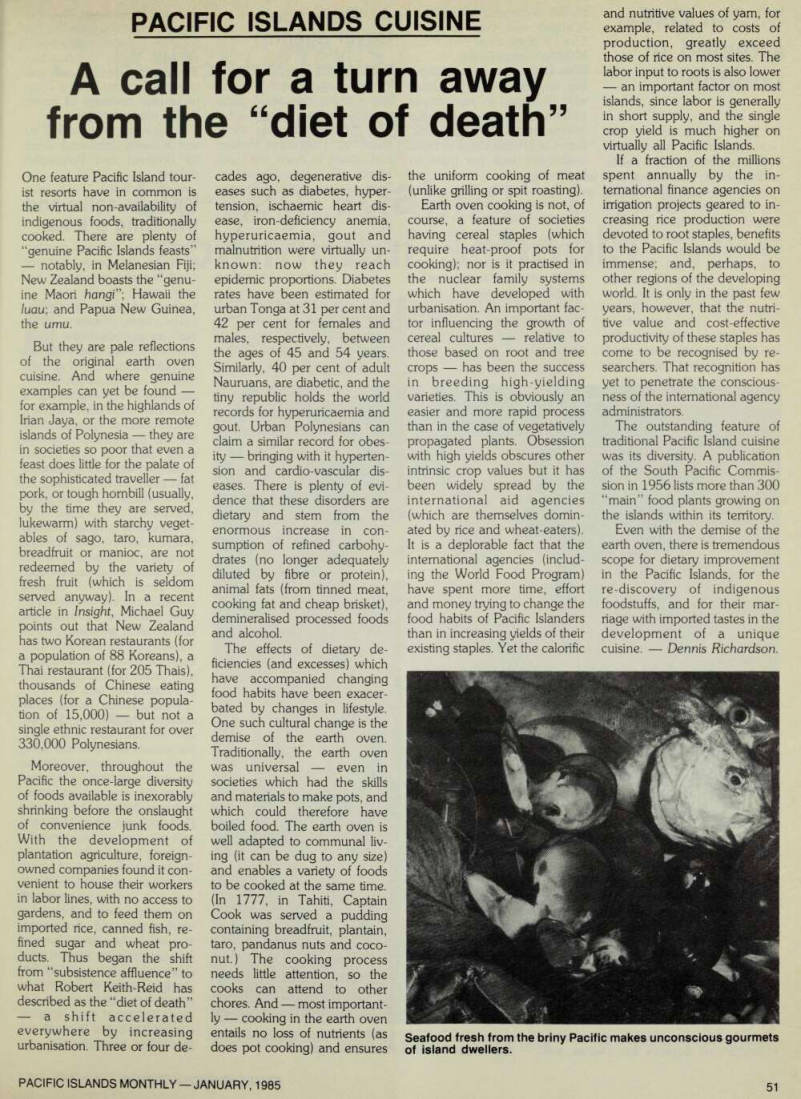
Seafood fresh from the briny Pacific makes unconscious gourmets of island dwellers.
Shrian Oskar
arrested in
London
Dr Shrian Oskar, one of the most mysterious businessmen ever to appear upon the Pacific trading scene, was arrested in London on August 17 and, as we write, was being held in custody without bail. The hol ding charge alleges that he attempted criminal deception over $9300 (U.S.) worth of traveller’s cheques. However, other charges are reported to be pending.
Dr Oskar, 44, was the central and controversial figure in a series of edible oil deals in the
Pacific, namely Fiji, as well as in Australia and New Zealand.
The Fiji plant, now part of the Motibhai organisation, is in Walu Bay, Suva, and no longer has any links with Dr Oskar who is alleged to have made millions of dollars out of the international food-oil business.
Some of his associates in these businesses were not quite so fortunate.
Dr Oskar was arrested at the London Hilton Hotel on Friday, August 17, and appeared in Bow Street magistrate’s court the same day. He was reman ded in custody and remained in custody, with weekly court appearances, while Scotland Yard detectives and Crown lawyers worked on what were described as more serious charges.
A “Bible” for
travel agents
Pacific Islands Travel Fact File is for travel agents and is there fore a highly specialised guide to tourist facilities in the Pacific.
The 1984 edition was spon sored by Polynesian Airlines and covers in detail the Cook Islands, Fiji, New Caledonia, Papua New Guinea, the Samoas, Solomon Islands, Tahiti, Tonga and Vanuatu.
Norfolk Island, Niue, Kiribati and Lord Howe Island are also included.
Keira Lockyer, advertising and promotions manager for Polynesian Airlines said her company had supported the guide because it offered a com prehensive view of the Pacific. ’’Western Samoa, Tonga and
Vanuatu have never had the exposure that countries like Fiji and New Caledonia have had,” she said. “Now, in this guide, they are included in detail, and travel agents can have a com prehensive coverage of South Pacific tourist facilities.”
The guide is priced at $17.50 and is being distributed direct by Braynart and Polynesian Airlines.
Goanna salve and
the King’s knee
The goanna, a large monitor lizard of the genus Varanus which is native to Australia, has been much in the news in Australia of recent months.
The term “Goanna” was used as a code name for a prominent Australian business man in the context of a long running Royal Commission ostensibly into the affairs of a trade union, but in fact casting a much wider net. As a result the humble goanna has received more publicity over recent months in the Australian media than ever before in history.
Not that it has ever been neglected.
The famous Iguana Brand Goanna Salve (“goanna” is a corruption of iguana), made from goanna fat, was credited with almost magical curative powers in earlier years in Aus tralia. The label for the Iguana Brand Salve promised that it would cure “rheumatism, lum bago, sciatica, infantile para lysis, eczema, catarrh, ulcers, sore legs, piles, etc, etc.”
Writing of the famous oint ment in The Bulletin , Sydney, in October, journalist Keith Dunstan reports that it is doing good work in important places far from Australia. Dunstan writes that the present manu facturer of the salve, a young Brisbane man, Euan Murdoch, recently received “a wonderful telegram” from the King of Tonga.
Dunstan explains: “The King, who is a large gentleman, fell down some stairs and his knee swelled to grand proportions.
He was on the point of flying to New Zealand for medical help when his staff suggested ap plying Goanna Salve. Accor ding to His Majesty, next mor ning his knee was back to normal. He wired Brisbane for four dozen bottles.”
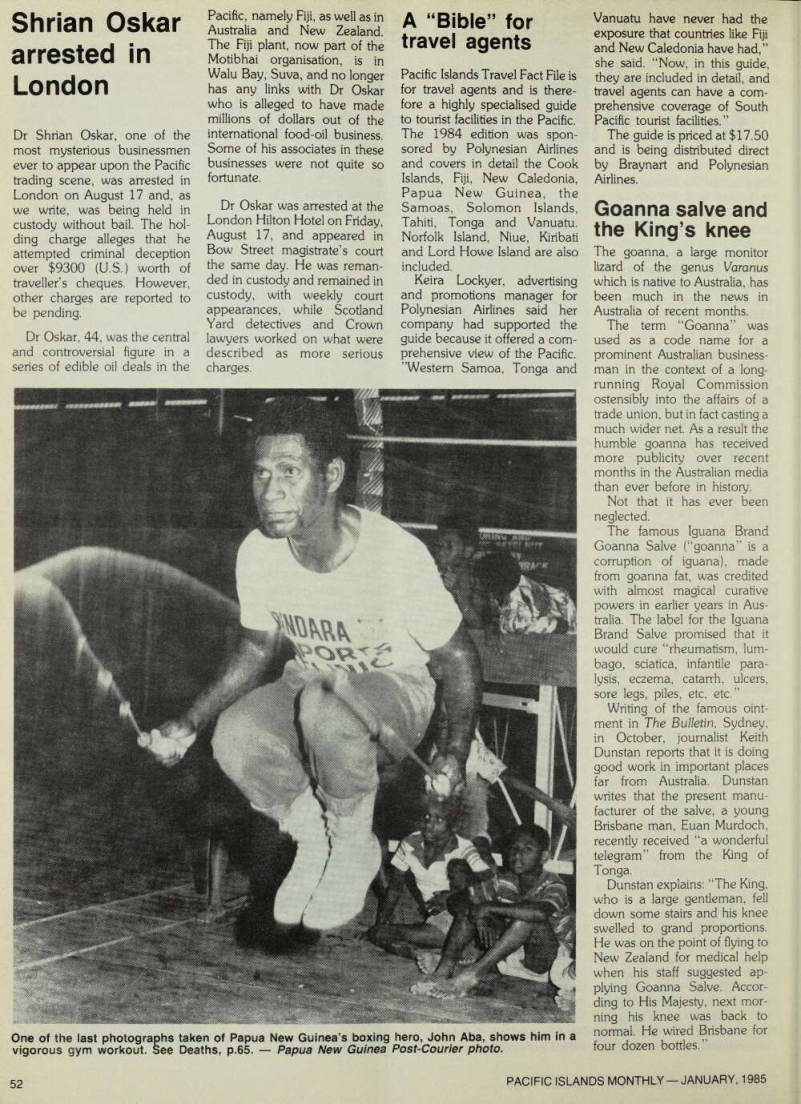
One of the last photographs taken of Papua New Guinea’s boxing hero, John Aba, shows him in a vigorous gym workout. See Deaths, p.65. - Papua New Guinea Post-Courier photo.