up the river?
pp. 47-48 · Read in the full issue
tropioalitigs
New Tourist Treat
Can he canoe them up the river?
A pilot-project group of nine Australians re cently canoed down two of Fiji’s rivers from the centre foothills to the coast of Viti Levu. Although individuals have been into the area on a variety of expedii tions, hare-brained and other wise, Clive Richardson, an adventure holiday operator, of Canberra, has been responsible for organising the first trial ex pedition to discover whether regular adventure canoeing trips to Fiji are feasible.
He believes many Australians would enjoy the beauty of Fiji’s inlands and an adventure trip which would give them the oportunity to meet Fijians who
The Pacific Islands are justly renowned for many natural attractions, but river thrills are not usually counted among them. Australian freelance journalist, Judy Cannon, recently discovered that Fiji offers some pretty exciting canoeing.
live in areas which at present are visited by Europeans only once in three or four years.
The trial run was so success ful that Mr Richardsons is await ing the Fiji government’s per mission to establish regular trips, beginning next May, after the hurricane season. He be lieves that although opening up the area to tourism would influ ence the traditional life led by most Fijians in the inlands, tourism would bring employ
ment where at present there is considerable unemployment.
This is, of course, the crucial question not only for Fiji, but for all of the Pacific islands keen to maintain their own culture and traditional social structure.
Many of the smaller countries, indeed, feel that Fiji has already gone too far, and in considering their own tourism feel that most development ought to be con fined to offshore islands which
could be turned into tourist enclaves from which local peo ple would be isolated. Yet, deeply felt though this desire may be, tourism is one of the very few avenues open to the Pacific for strong economic de velopment into the next century and an effect upon the people and their Pacific way is prob
ably inevitable.
The first party of adventurers left Sydney by Canadian Pacific Airlines for Nadi at the end of August and travelled by bus and truck via Sigatoka town to begin the first part of the trip on the Sigatoka river a little south of Keiyasi, a village in the foothills.
Our group included teachers,
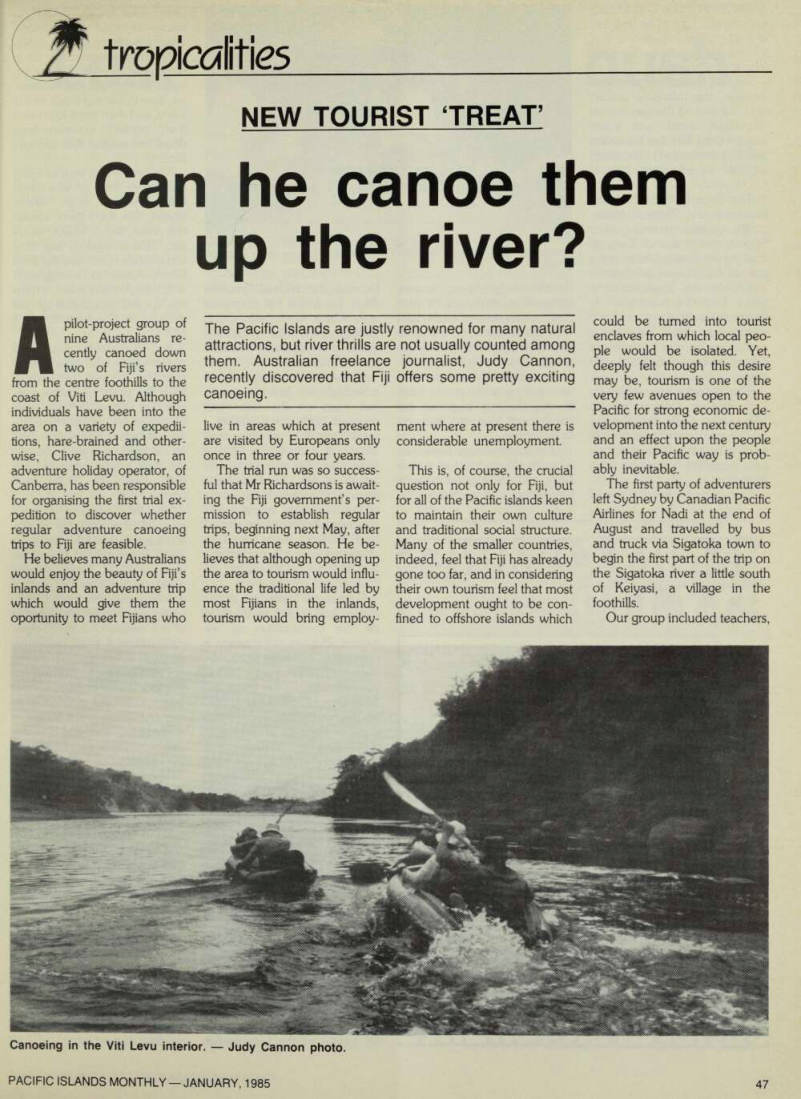
Canoeing in the Viti Levu interior. - Judy Cannon photo.
government officers, a solicitor and myself. Few of us had any real canoeing experience and we were aged from the early 20s to just over 50.
We had carried our minimum luggage, the inflatable canoes and raft and all the paddles on the flight, which was made easier by the fact that Canadian Pacific is interested in the deve lopment of adventure trips in Fiji.
The water levels of both the Sigatoka and Waidina rivers, which we later traversed, were so low at this time of the year that we frequently had to jump out of the canoes and some times also the luggage raft in order to avoid punctures. At other times of the year flood waters rage down these rivers and have in the past swept village houses and crops with them.
The Sigatoka river makes its way through arid, sometimes hilly areas, while the Waidina on the south-eastern side of Viti Levu meanders through jungle with beautiful mountains as a backdrop.
Our guide for the first part of
the trip was Lati Levu, a former international rugby player, who made arrangements each night with village headmen for us to stay. The Fijian villagers made our group overwhelmingly wel come and for most of the time we made ourselves comfortable in our sleeping bags on the bamboo or concrete floors of their houses.
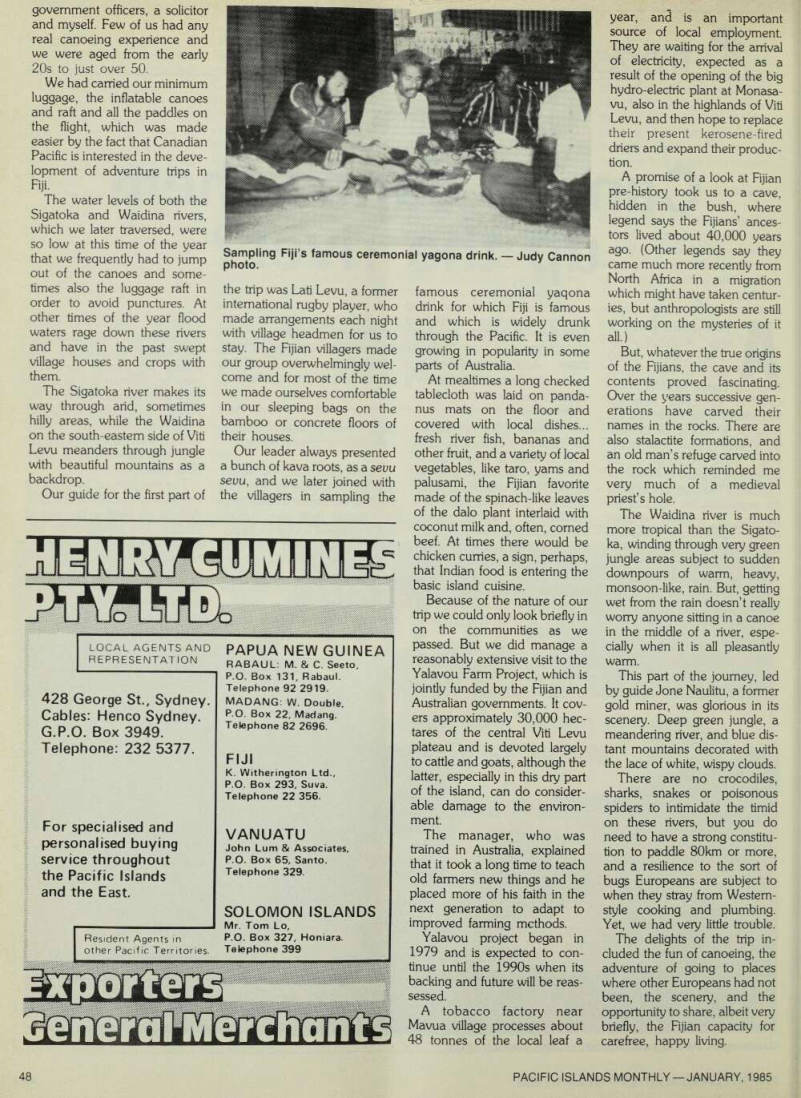
Our leader always presented a bunch of kava roots, as a sevu seuu, and we later joined with the villagers in sampling the
famous ceremonial yaqona drink for which Fiji is famous and which is widely drunk through the Pacific. It is even growing in popularity in some parts of Australia.
At mealtimes a long checked tablecloth was laid on panda nus mats on the floor and covered with local dishes... fresh river fish, bananas and other fruit, and a variety of local vegetables, like taro, yams and palusami, the Fijian favorite made of the spinach-like leaves of the dalo plant interlaid with coconut milk and, often, corned beef. At times there would be chicken curries, a sign, perhaps, that Indian food is entering the basic island cuisine.
Because of the nature of our trip we could only look briefly in on the communities as we passed. But we did manage a reasonably extensive visit to the Yalavou Farm Project, which is jointly funded by the Fijian and Australian governments. It cov ers approximately 30,000 hec tares of the central Viti Levu plateau and is devoted largely to cattle and goats, although the latter, especially in this dry part of the island, can do consider able damage to the environ ment.
The manager, who was trained in Australia, explained that it took a long time to teach old farmers new things and he placed more of his faith in the next generation to adapt to improved farming methods.
Yalavou project began in 1979 and is expected to con tinue until the 1990 s when its backing and future will be reas sessed.
A tobacco factory near Mavua village processes about 48 tonnes of the local leaf a
year, and is an important source of local employment.
They are waiting for the arrival of electricity, expected as a result of the opening of the big hydro-electric plant at Monasa vu, also in the highlands of Viti Levu, and then hope to replace their present kerosene-fired driers and expand their produc tion.
A promise of a look at Fijian pre-history took us to a cave, hidden in the bush, where legend says the Fijians’ ances tors lived about 40,000 years ago. (Other legends say they came much more recently from North Africa in a migration which might have taken centur ies, but anthropologists are still working on the mysteries of it all.) But, whatever the true origins of the Fijians, the cave and its contents proved fascinating.
Over the years successive gen erations have carved their names in the rocks. There are also stalactite formations, and an old man’s refuge carved into the rock which reminded me very much of a medieval priest’s hole.
The Waidina river is much more tropical than the Sigato ka, winding through very green jungle areas subject to sudden downpours of warm, heavy, monsoon-like, rain. But, getting wet from the rain doesn’t really worry anyone sitting in a canoe in the middle of a river, espe cially when it is all pleasantly warm.
This part of the journey, led by guide Jone Naulitu, a former gold miner, was glorious in its scenery. Deep green jungle, a meandering river, and blue dis tant mountains decorated with the lace of white, wispy clouds.
There are no crocodiles, sharks, snakes or poisonous spiders to intimidate the timid on these rivers, but you do need to have a strong constitu tion to paddle 80km or more, and a resilience to the sort of bugs Europeans are subject to when they stray from Western style cooking and plumbing.
Yet, we had very little trouble.
The delights of the trip in cluded the fun of canoeing, the adventure of going to places where other Europeans had not been, the scenery, and the opportunity to share, albeit very briefly, the Fijian capacity for carefree, happy living.
Sampling Fiji’s famous ceremonial yagona drink. - Judy Cannon photo.