Great Fijian “Galleon"
pp. 44-46 · Read in the full issue
Manoa’S Vision
Great Fijian “Galleon" planned for Pacific
Manoa Rasigatale is acclaimed for his ex pert knowledge of ancient Fijian lore. At the Pacific Harbor complex near Suva it is his imaginative recreations of the past and his Fiji Dance Theatre productions with their realism, authenticity and sheer professionalism that intrigue and delight every visi tor. Over the years since the complex was built,Manoa has developed a cultural oasis that shows the most significant areas of ancient Fijian art and cus toms.
On an island site kept tabu to all non-Fijians, traditional Fijian culture is kept sacred. To tour around it in a canoe is to take a journey back into the past a journey that recognises the ability of the Fijian artist and craftsman to live in harmonious concert with nature. Through his skills, using them in a dignified yet exciting manner, he illustrates the arts of creating mats, masi (tapa cloth), and canoe carving.
The many ways of utilising products of the coconut tree, wood-carvings, pottery and even food processing in the ancient manner, is seen within a series of craft bures (Fijian houses) spaced around the waterway surrounding the is land.
However, the main interest and a principal purpose of the island are the nightly showings of ancient traditional dancing, the hunting chants and the dramatic re-enactment of legend stories of the Fijian peoples. Manoa did not do it all alone, but to a very great extent the quality and faithfulness of the productions are very much
To the Pacific Islander, the sea is life itself. Its waters provide the fish which make his meat.
The winds across its surface bring the rain which waters his crops and gives him drink. He hasOsailed its surface, survived its rages and enjoyed its gifts. It is a part of him, for by it he had his beginnings.
Manoa Rasigatale is one of the most en thusiastic, and knowledgeable of Fijian his torians, who feels, deep within his being, the magic of his ancestors and who has made it his business to recreate, in dance and mime, some of the legends, and much of the culture which is the Fijian heritage. Manoa leads the Fiji Dance Theatre, a group known ail over the world for the excellence of their performances, and the faith ful way in which they have kept alive so much of Fijian lore.
Now Manoa has begun to put together another dream ... to build a great ocean-going Fijian canoe, a twin-hulled drua such as the first Fijians used to sail the ocean on their war-like expeditions and which was their equivalent of the galleons of Spain, the men-o-war of Nelson, the quinqueremes of Nineveah.
Victor Carell, who has been associated with Manoa since the first South Pacific Festival of Arts in Suva, and who has, himself, done much to preserve the history of Fiji, here writes about Manoa’s undertaking.
his work and have made a visit to this unique theatre a high point on any South Pacific tour.
Now Manoa has come up with another bold, exciting and original project - to build again one of the most splendid of the Pacific’s legendary craft, a giant, twin-hulled drua.
The ambitious plan is to build not a scaled-down replica, but to go a stage further and build one of the biggest, if not the
biggest, vessel ever to come out of tribal Fiji.
The drua (the name means double-hulled canoe) will be manned by a Fijian crew who will use traditional navigational methods on a series of voyages, at first in Fiji waters, then to Tonga and Samoa and, finally, culmination of the great scheme, from Fiji to Hawaii and back. The boat builders and crewmen will be picked from
areas of Fiji historically noted for their sea-faring skills.
In building the great boat they will follow ancient proce dures, observing all the tabu, adopting ancient modes of dress, using, as far as practic able, the old tools and materials. On their voyages the same rules will apply, even to having the ancient style of sea-going louo earth oven on the cross-decking in which traditional foods will be pre pared. ”We probably will have radio for safety,” said Manoa, ’’but we won’t have refrigerators.”
No full-sized drua has been built this century, but records in Fiji and elsewhere show that some craft observed during the 19th Century were up to 100 or more feet long and could easily carry 200 warriors in full pillag ing and plundering rig. The most recent model was a small replica built in Kabara in the Lau group and sailed to Suva as part of the South Pacific Festival of Arts of 1972.
Tribal wars were common in old Fiji and the big double hulled war canoes carried armed warriors between the various islands of Fiji on their way to battles of revenge or of conquest. So superior were these big boats in their size, strength and speed, that the Tongans adopted them and sent skilled craftsmen to the Lau islands to use the better timbers there and to follow the Fijian designs and methods.
Tongan crews sailed such vessels on many long, arduous and dangerous exploring ex peditions probably as far east as New Caledonia, and certainly on their continuing forays to
and from Fiji.
Manoa is planning to sail his drua to Hawaii, by way of the Cook Islands and Tahiti. He feels that the early Fijians had probably made trips to Tonga and Samoa, and possibly as far as the Cooks, but he doubts that they ever went as far as Hawaii. Thus, his project will very likely involve the longest ever voyage by Fijian sailors (or anyone else) in a drua.
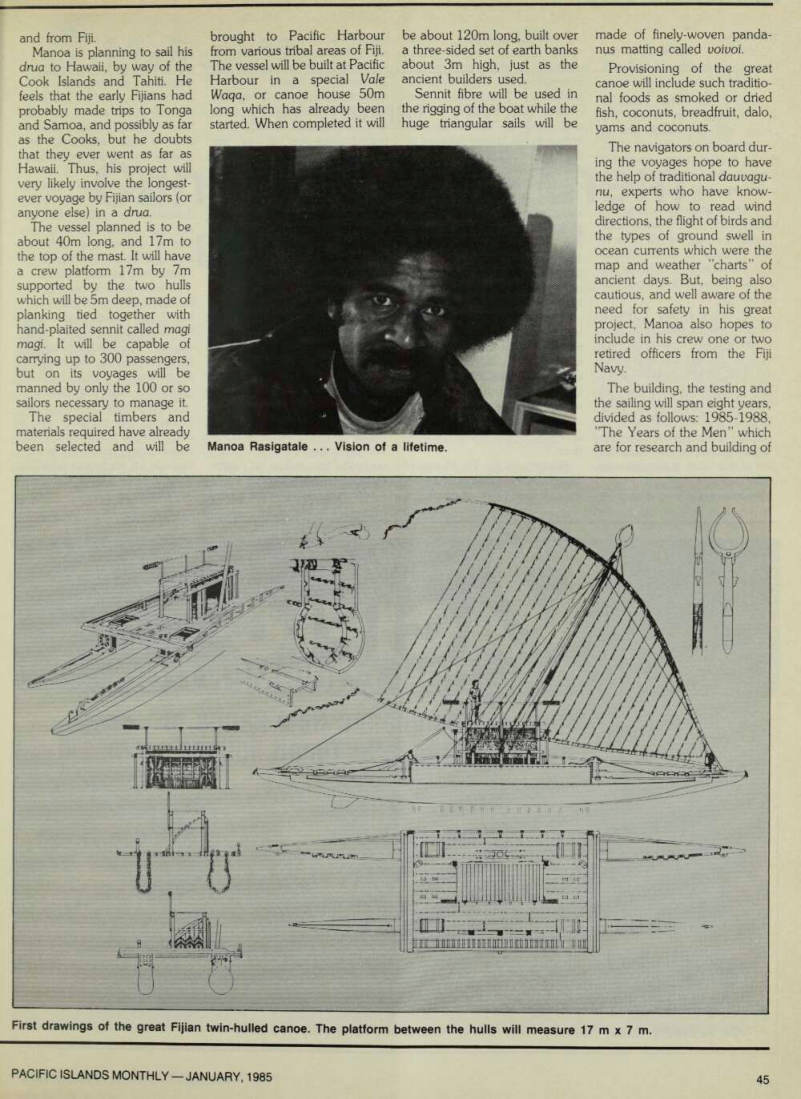
The vessel planned is to be about 40m long, and 17m to the top of the mast. It will have a crew platform 17m by 7m supported by the two hulls which will be 5m deep, made of planking tied together with hand-plaited sennit called magi magi. It will be capable of carrying up to 300 passengers, but on its voyages will be manned by only the 100 or so sailors necessary to manage it.
The special timbers and materials required have already been selected and will be
brought to Pacific Harbour from various tribal areas of Fiji.
The vessel will be built at Pacific Harbour in a special Vale Waqa, or canoe house 50m long which has already been started. When completed it will
be about 120 m long, built over a three-sided set of earth banks about 3m high, just as the ancient builders used.
Sennit fibre will be used in the rigging of the boat while the huge triangular sails will be
made of finely-woven panda nus matting called voiuoi.
Provisioning of the great canoe will include such traditio nal foods as smoked or dried fish, coconuts, breadfruit, dalo, yams and coconuts.
The navigators on board dur ing the voyages hope to have the help of traditional dauuagu nu, experts who have know ledge of how to read wind directions, the flight of birds and the types of ground swell in ocean currents which were the map and weather ’’charts” of ancient days. But, being also cautious, and well aware of the need for safety in his great project, Manoa also hopes to include in his crew one or two retired officers from the Fiji Navy.
The building, the testing and the sailing will span eight years, divided as follows: 1985-1988, ’The Years of the Men” which are for research and building of
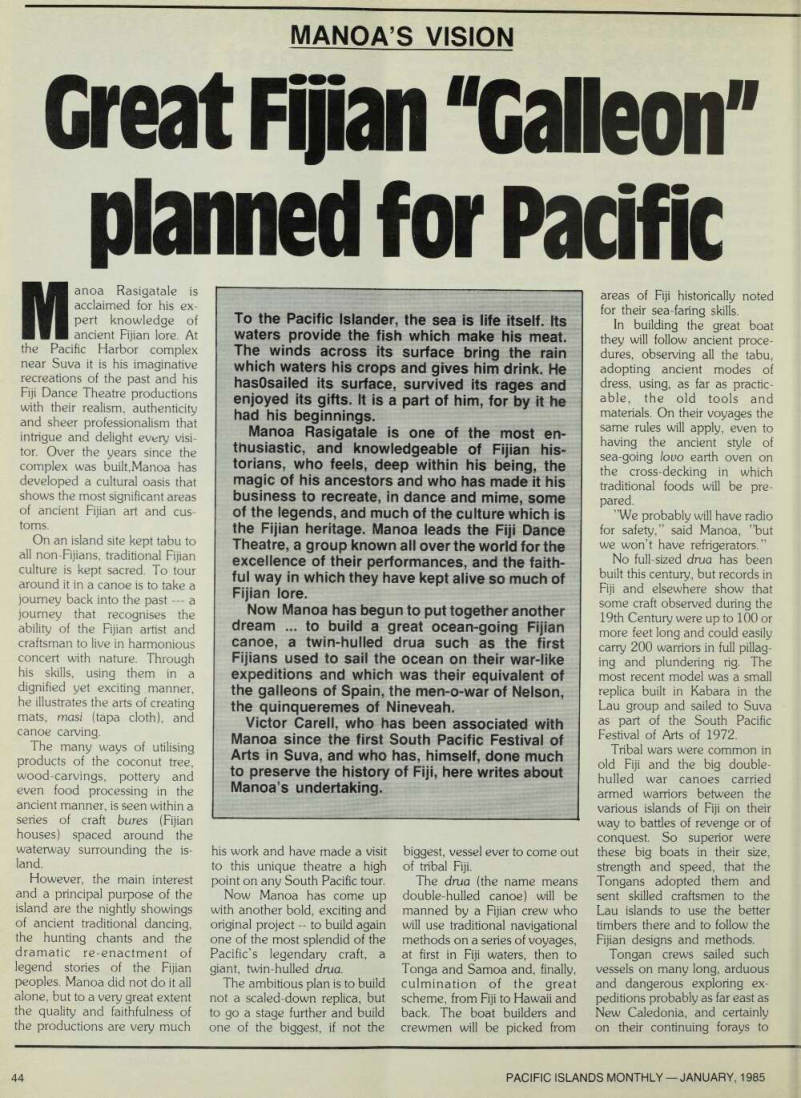
Manoa Rasigatale ... Vision of a lifetime.
First drawings of the great Fijian twin-hulled canoe. The platform between the hulls will measure 17 m x 7 m.
the canoe. 1988-89, ’’The Year of the Canoe,” in which sea trials will be held and training done. 1990-1992, ’’The Years of the Voyage,” in which the canoe will be sailed, first to Tonga, then to Samoa and, finally, the long voyage from Fiji through the Cooks and Tahiti, to Hawaii, and then back. ”1 don’t know how long the voyages will take,” Manoa said. ”It may be that we will have to wait months in some islands until the weather is right, or our people ready. I don’t know. But we will do it.”
The canoe house in which the drua will be built, is a major project in itself. It must be very solid to protect the workmen and their canoe, possibly even from hurricanes, during the three or four years which will be needed for the construction.
With funds given by the Pacific Harbour consortium this part of the work is already well under way.
Manoa has resolved that he
will not use any steel, screws, nails, modern ropes, glues, caulking or blocks and tackle.
Everything, he says, must be authentic. Fortunately, the needed skills of clever joinery and tying of sennit are still known in Fiji, largely because of the vigorous handicrafts in dustry promoted by the govern ment and the tourist industry.
Although the early European navigators, like Captains Cook and Bligh, felt that Fijians ’’did not make bold sailors” and 19th Century records seems to indicate they kept within their own island waters, Manoa be lieves otherwise. ’’Fijians sailed their twin-hul led canoes over thousands of miles, making landfall among their cousins inhabiting distant islands,” he said. ’’That they did this, and returned home to relate their adventures is re counted in epic poems handed down through many genera tions.”
Records at the Fiji Museum, one of the best institutions of its kind in the Pacific, show that a
big drua could attain at least 14 knots, Manoa talks of them as ’’moving easily between 18 and 20 knots,” a speed which is quite remarkable for a big sail ing canoe, although far from unknown in such modern cata maran-style yachts as the Hobie-Cat and its kind.
If Manoa’s dream comes true this voyage by a Fijian drua will go into history as one of the great modern adventures.
It will not be without its hazards. No living person has sailed such a giant canoe on even a short voyage, let alone what is, in fact, a traverse of the frequently far from pacific Paci fic. Much attention will be needed to training and handling the great canoe in difficult water and adverse winds.
Will half a dozen men be able to hold the sweep-oar that will be the rudder? Will the panda nus sail withstand the Pacific’s winds? Will the lashings hold?
Will the bailers be able to keep up with the inflow of water during a sudden storm?
Manoa knows by now a very
great deal about training athletes, for to a very great extent his Fiji Dance Company players are athletes at the peak of condition. And he will have to instil in his sailors not only boating skills, but also dedica tion to their traditions, and courage in a great and hazard ous undertaking.
The other problem is finance.
The project will cost many thousands of dollars. He has not yet come up with any formal sponsorship scheme, although he and his friends are considering various options. ”1 have already been prom ised enough to get it under way, but I will need much more before we can set out on the big voyage,” he said. ”If anyone feels like helping, with any sum of money, I would be very grateful to hear from them.”
Those who know Manoa and his work, and everyone who is interested in Pacific and Fijian culture could hardly fail to wish success for such a wonderfully imaginative and splendid undertaking.