himself king
pp. 45-46 · Read in the full issue
He came to the islands and believed himself king
The Curse of Lono. By Hunter S. Thompson and Ralph Steadman. Published 1983 by Pan Books Ltd., Cauaye Place, London SWIO 9PG. ISBN 0- 330-28295-6. Price $A14.95.
There have always been strange people roaming about the Pacific, from pirates to tourists, businessmen to roman tic fools, and there have even been a few writers.
While not literary in intent, de Bougainville and Cook both wrote accounts which appealed to the 18th-century European penchant for the exotic, and a lost world of innocence and Boys’ Own adventure. In varying degrees, Melville, Stevenson, Maugham, even Mark Twain have contributed their visions. Michener’s tales of
rakes and rascals, marooned after World War 2 exploits, are known to many.
Of late, we have had islan ders writing about their own encounter with their vast and empty world, which is so filled, still, with mystery and intrigue.
The serious Albert Wendt and the picaresque Epeli Hau’ofa amongst the best, and counter pointed by the outside-insiders, Indo-Fijian writers such as Pillai, Subramani, and Nandan.
The artist is always an out sider, grappling with the con ventions that are unclear; how much more alienated the fore ign artist, struggling with an exotic reality?
Early on in Lono, a friend tells the author, “there’s a lot more here (in the Pacific) than most people understand.”
Thompson’s novel/account, straightforward, tells of his assignment to cover the Hon olulu marathon in 1981, his shenanigans in bars on the Big Isle, and his brushes with death and insanity on the high seas, in search of game fishing.
Heavy, menacing illustrations by Steadman, splash across the pages, rolling back the print or engulfing it entirely. There is a nice commercial photograph of Thompson with his prized mar lin, and short-handled Samoan war club.
We are used to the fearless Thompson of Hell’s Angels, to the political anarchist of various Fear and Loathing enquiries.
Here we have a stripped-down, and rather weird, in his own words, European psyche trying to cope with American glitter thinly covering the depths (up to eight miles) of the Hawaiian soul.
What, you may say, can one find of Hawaii in Hawaii, put up as it so often is as the ultimate in European debasement of the Polynesian paradise? Surely,
there can be nothing left? Or right?
It is the worry that there is something left behind that haunts Thompson’s long essay in renegade reporting, mixed
with mystical (this time) fear and loathing.
Hawaii is portrayed as a tawdry outpost of empire, with a cast of misfit escapees, hard drinking, swearing and rough
housing in the classic B grade movie mould.
There is Ackerman, with his arm blue-dyed in an airline lavatory, Captain Steve’s pen chant for hard liquor and soft (and hard) drugs. The artist Steadman takes a battering with his family, as tidal forces demand a retreat, from hurtling lava, sharks, and banana heads. The sensitive flee, while Thompson persists in his un known pilgrimage.
Amid the familiar stimulants and depressants that seem so common to Thompson’s life style, amid his branded drinks and paraphernalia, he knows he is not on home ground. The weather and the landscape dis turb him and there is the fiery image of Pele, whom he tried to seek out as an old woman hitch-hiker; Pele of the fierce storm and hibachi flames.
Throughout the wild writer’s prose, moves a calm procession of 19th-century writers (Twain and William Ellis), and the commentary on Cook’s last voyage, by Richard Hough.
The cover of the book is Thompson masked by Lono, while halfway through is Dance’s Cook Portrait, masked by Steadman.
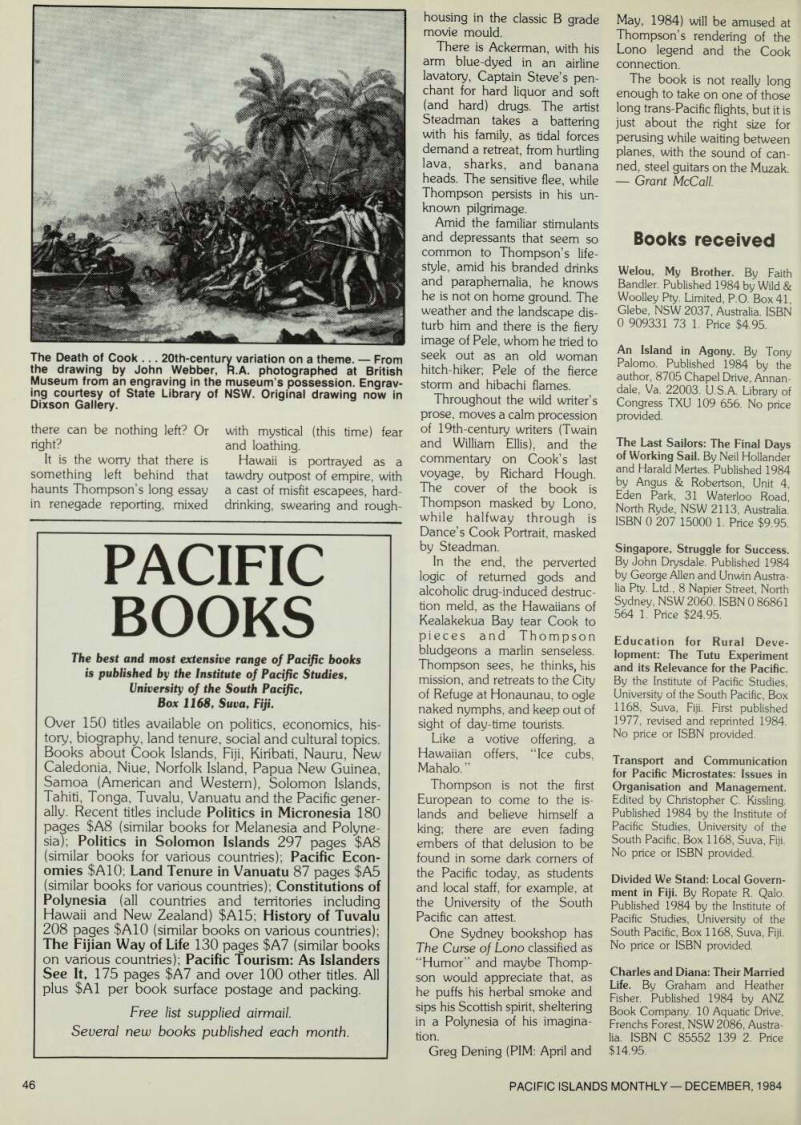
In the end, the perverted logic of returned gods and alcoholic drug-induced destruc tion meld, as the Hawaiians of Kealakekua Bay tear Cook to pieces and Thompson bludgeons a marlin senseless.
Thompson sees, he thinks, his mission, and retreats to the City of Refuge at Honaunau, to ogle naked nymphs, and keep out of sight of day-time tourists.
Like a votive offering, a Hawaiian offers, “Ice cubs, Mahalo. ”
Thompson is not the first European to come to the is lands and believe himself a king; there are even fading embers of that delusion to be found in some dark corners of the Pacific today, as students and local staff, for example, at the University of the South Pacific can attest.
One Sydney bookshop has The Curse of Lono classified as “Humor” and maybe Thomp son would appreciate that, as he puffs his herbal smoke and sips his Scottish spirit, sheltering in a Polynesia of his imagina tion.
Greg Dening (PIM: April and
May, 1984) will be amused at Thompson’s rendering of the Lono legend and the Cook connection.
The book is not really long enough to take on one of those long trans-Pacific flights, but it is just about the right size for perusing while waiting between planes, with the sound of can ned, steel guitars on the Muzak.
Grant McCall.
The Death of Cook ... 20th-century variation on a theme. From the drawing by John Webber, R.A. photographed at British Museum from an engraving in the museum’s possession. Engrav ing courtesy of State Library of NSW. Original drawing now in Dixson Gallery.