Savage; splendid: A
pp. 43-45 · Read in the full issue
books
Frank Hurley’s Papua Savage; splendid: A camera supreme
Frank Hurley in Papua Photographs of the 1920-23 Expeditions. Selected and annotated by Jim Specht and John Fields. Published by Robert Brown and Associates in association with the Austra lian Museum Trust, ISBN 0 909197 90 3. $A29.95.
When I was young I had a passion for reading accounts of the great Antarctic expeditions, and I marvelled at the great qualities of the photographic records of them. In particular I appreciated the skill shown in H. G. Ponting’s photographs of Scott’s last expedition, and Frank Hurley’s photographic acccount of the demise of Shackleton’s Endurance, and of the escape of the expedition to South Georgia.
Now I have an even greater admiration for Frank Hurley’s great creative skill both with the still and movie camera. Two recent events which com memorate Hurley’s 1922 ex pedition to Papua have given the accolade to Hurley as the cameraman/photographer supreme. The Australian Broadcasting Corporation gave its TV viewers a rare opportun ity to see Hurley’s film Pearls and Savages, and the Austra lian Museum in Sydney mounted an exhibition of a selection of Hurley’s still photo graphs of some aspects of the expedition.
What a photographer Hurley was! He was no mere techni cian, but an acute observer of nature’s varied moods, of the nuances of mankind’s range of customs, behavior, and re lationships, and he was the
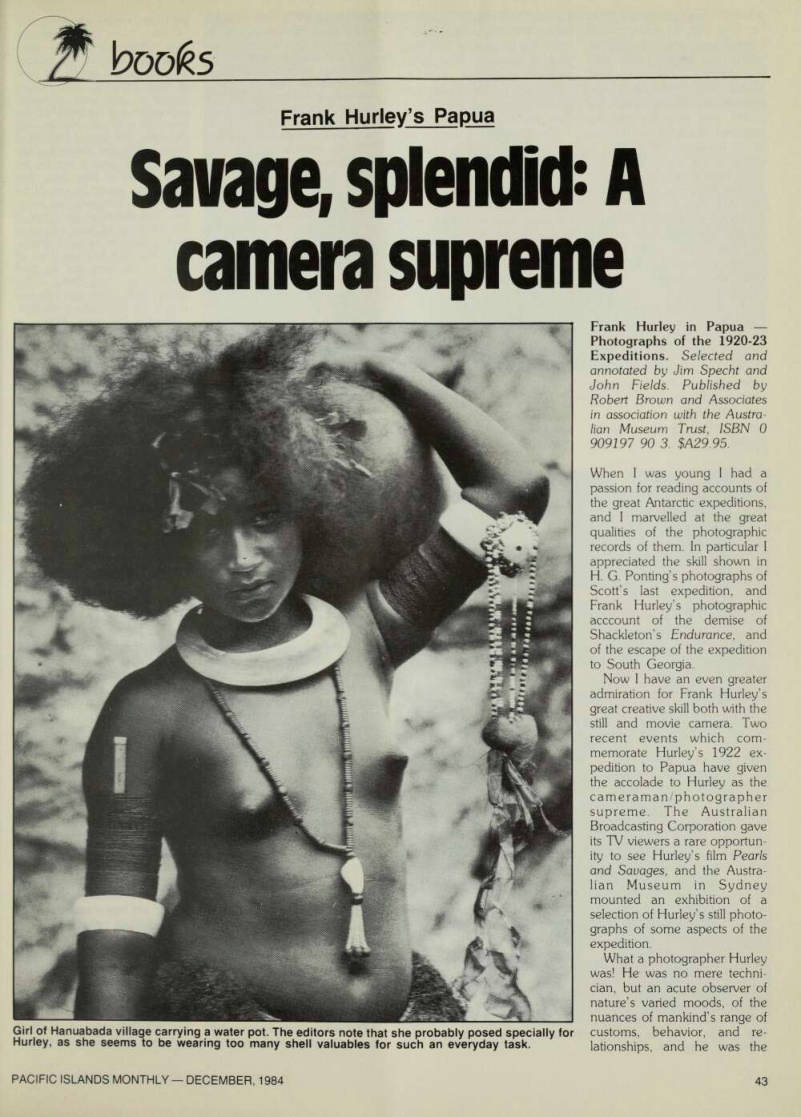
Girl of Hanuabada village carrying a water pot. The editors note that she probably posed specially for Hurley, as she seems to be wearing too many shell valuables for such an everyday task.
adventurer par excellence. Hur ley took part in Antarctic and tropical expeditions; he was an official war photographer with the Australian forces in both World Wars; he was a film cameraman who travelled the world; and with his lens he captured much of the essence of his homeland, Australia.
But to me his record of the 1922 expedition along the Pa puan coast and up the Fly River to Lake Murray ranks almost supreme among his achieve ments. The expedition sought to break new ground, to visit people to whom the white man was an uncomprehended stranger, and to use small flying boats in the first endeavor to use aircraft in Papua New Guinea to support parties mov ing into uncontrolled territory.
The film records much of the movement, and the sense of entering the unknown experi enced by Hurley and his com panions. First Hurley takes his audience on the schooner
Eureka along the coast of Papua from Thursday Island to meet the peoples of that coast and to observe their fishing methods, their many uses of the sago palm, their skills as potters, and the fun and mimicry of their dancing.
The commentary for the film as shown on TV is Hurley’s written account of the expedi tion, and he passes on to a 1980 s audience the 1920 s perspectives of the European making first contacts with Melanesians on their home ground.
The film has unique footage taken from the expedition’s air craft and we are able to appreciate the risks taken by these aviation pioneers.
With full petrol tanks a favorable day was awaited. Our farewell to Kaimari was exceptionally drama tic. The whole population assem bled by the waterfront to see us off, the Seagull quickly gathered way, and soon we were skimming the river at 50 miles per hour; but the
machine refused to leave the water.
A light breeze was blowing from the opposite direction, so Lang turned about and made another attempt.
Again we swept past the village, then the keel just lifted, but we were now at the end of the lake. The only exit was by a very tortuous creek 200 feet wide. Into this creek we burst like a whirlwind, racing a mad race with death at our wing-tips.
The trees were a blur, and the roar of the engine was hurled back.
Slowly we climbed, but when Lang banked and the machine swept around the bends, we lost the gain and the trees seemed to brush our wings-tips. We had now flown three miles and were just level with the mangrove tops. We cleared the creek entrance and swept out over the broad free expanse of Port Romilly.
On the next stage across the delta of the Turama we kept out over the sea. The sky now grew densely overcast, we were crossing the estuary of the Fly—leaden clouds formed a gloomy ceiling, scattered showers and squalls surrounded us, but Lang was able to manoeuvre the plane. All went well until we reached a point of the southern extremity of Kiwai. Could we make the narrow passage between the warring elements? We barely cleared the passage between the storms, fully expecting the way to be barred by lightning which was flickering among the clouds in the vicinity, but all we experienced was a violent tossing.
The Seagull rose, fell, and rocked so violently that it was a case of hold on and sit tight. In half a minute we fell from 1500 feet to 300 feet. The machine was almost overturned and began to slip side ways; but once more Lang brought her up to even keel. An open sea expanded below us, and less turbu lent airs harassed the flight to our goal which now resolved itself from out of the mists. We made a broad sweep over Dam, and then de scended bumpily on to the crest of the rollers, for a big sea was driving in.
The passage of the Eureka up the Fly River to Lake Murray was captured on film to give those fortunate to view it inti mate glimpses of Melanesian cultures little affected by the traumatic intrusion of a domi nant and alien society. Hurley’s
pictorial evidence provides in
credibly clear insights into the lifestyle of the Lake Murray people. His written account provides us with a melange of the European’s perceptions of that era about the place in the order of things of the so-called
“primitive” man.
The strange people when they came alongside fulfilled all the
grotesque fanciful ideas we had formed of them. Tmly indeed they were prehistoric creatures prac tically nude, covered by a hideous skin disease and having the most amazing features. Their voices, strange to say, were pleasantly euphonious and comparable to the mountain folk of Maifulu and Ononghe. The cast of features of these people was amazingly Heb raic. Indeed, were it not for the deep bronze of their skins, they might have passed for one of the Lost Tribes. They coincided accur ately with historians’ description of the lost tribes of Israel and could have passed for bronzed Babylo nian Jews. The hair was shorn off close in the front; but the back extended in a long cluster of lux uriant pigtails which were increased in length by plaiting them with fibre.
Speedily we made friends, or rather appeared to, and began active trading. Matches, the taste of salt and of sugar alike astonished and pleased them; but what they clamored for were the empty tins which we had saved for the pur pose empty oil and benzene tins.
These primitive folk were entirely destitute of utensils of any descrip tion beyond bamboo and a few water baskets made by folding the sheath of the Goru palm.
For a few tins we purchased a bundle of arrows, while the same currency bought paddles, stone clubs and other implements. After trading profitably, they directed us to their village.
The misunderstandings
which frequently occur when two vastly separated cultures come into contact were present at Lake Murray. Hurley put into words the almost ritualised character of the encounter.
The exhibition at the Austra lian Museum of Hurley’s still photographs shows all his skill as a photographer. The contrast of black and white, and the intermediate shades, is such that there is almost a three dimensional quality to the scenes the men, women and children appear as proud, out going representatives of their cultures. Hurley portrayed in fine detail an impressive record of their material culture; their everyday utensils and tools, articles of clothing and adorn ment, and many aspects of the spiritual and ritualised cere monies.
Much of this pictorial essay was accompanied by very de liberate attempts to take physi cal possession of evidence of the local material culture. Hur ley tells of entering a single immense house which was in
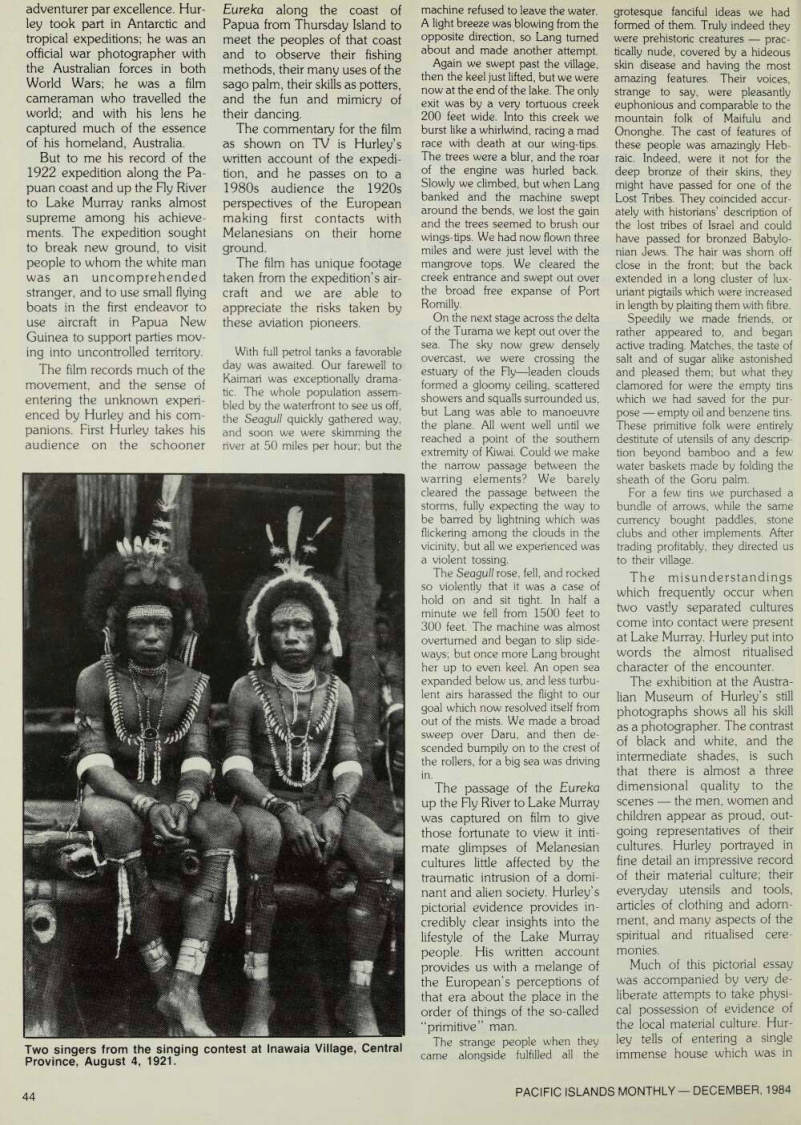
Two singers from the singing contest at Inawaia Village, Central Province, August 4, 1921.
effect the totality of a Lake Murray village.
We entered and passed within the gloom. At convenient points hooked uprights were placed where the bows, arrows, and stone clubs were hung in readiness. From the rafters pended gruesome war trophies of human skulls and sou venirs of the chase. Truly it was a dwelling out of the Stone Age.
Everything was inexpressibly crude and primitive.
In the cause of science, McCul loch allowed that even an unfair exchange was no robbery; so we collected and exchanged, to the great advantage of the owners and to our supreme satisfaction.
Skulls, human bits and titbits filled our bone-bag; whilst axes, knives and fabrics were substituted.
From a dim alcove I gave a yell of delight. We had discovered trea sures beyond bonanza! Human heads! Stuffed heads! What luck!
Skulls painted and decorated had grinned from every niche, but heads studded and stuffed heads! Glorious beyond words.
Had we raided a bank and carried off the bullion we could scarcely have been more pleased than with such desirable objects.
Attitudes towards contact be tween cultures have changed vastly since 1922. However, we should pay tribute to Hurley for passing on the scenes he re corded. He gives us the opportunity to view the Kai raui (men’s clubhouse) at Kaimari, with its vaulted roof structure, and to note the costumes of the participants in a singing contest at Inawaia village.
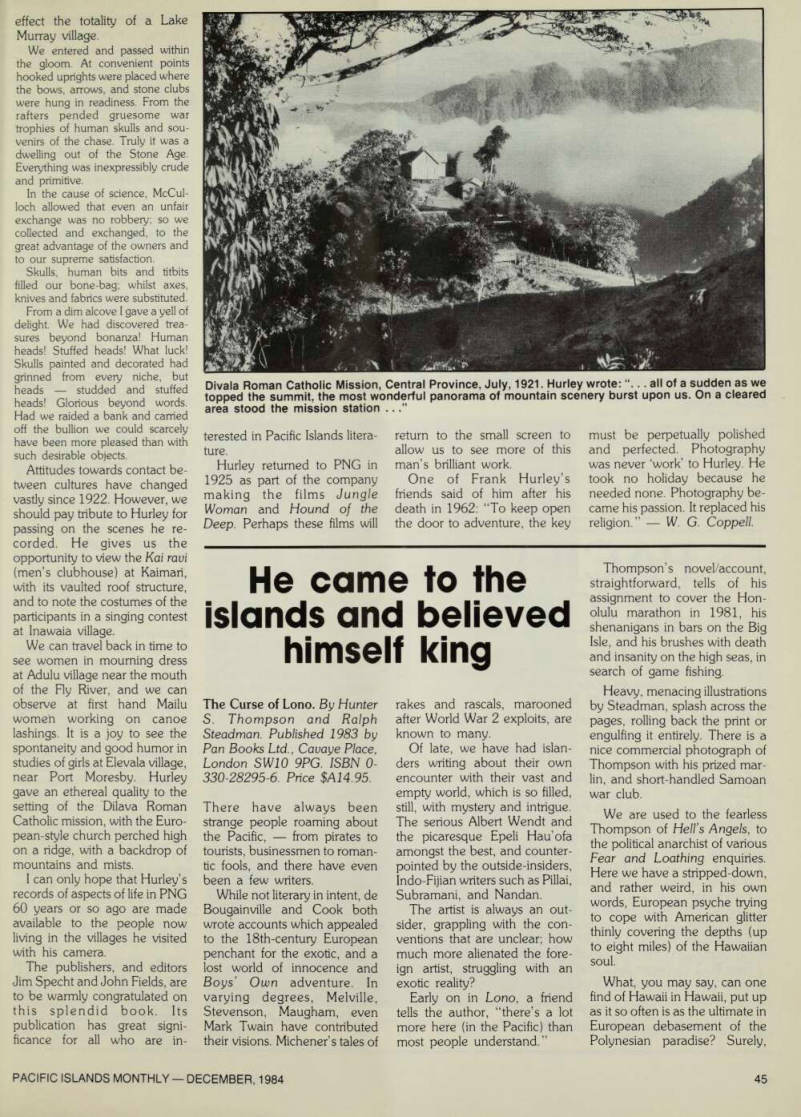
We can travel back in time to see women in mourning dress at Adulu village near the mouth of the Fly River, and we can observe at first hand Mailu women working on canoe lashings. It is a joy to see the spontaneity and good humor in studies of girls at Elevala village, near Port Moresby. Hurley gave an ethereal quality to the setting of the Dilava Roman Catholic mission, with the Euro pean-style church perched high on a ridge, with a backdrop of mountains and mists.
I can only hope that Hurley’s records of aspects of life in PNG 60 years or so ago are made available to the people now living in the villages he visited with his camera.
The publishers, and editors Jim Specht and John Fields, are to be warmly congratulated on this splendid book. Its publication has great signi ficance for all who are in-
terested in Pacific Islands litera ture.
Hurley returned to PNG in 1925 as part of the company making the films Jungle Woman and Hound of the Deep. Perhaps these films will
return to the small screen to allow us to see more of this man’s brilliant work.
One of Frank Hurley’s friends said of him after his death in 1962: “To keep open the door to adventure, the key
must be perpetually polished and perfected. Photography was never work’ to Hurley. He took no holiday because he needed none. Photography be came his passion. It replaced his
religion.”
W. G. Coppell.
Divala Roman Catholic Mission, Central Province, July, 1921. Hurley wrote:"... all of a sudden as we topped the summit, the most wonderful panorama of mountain scenery burst upon us. On a cleared area stood the mission station..."